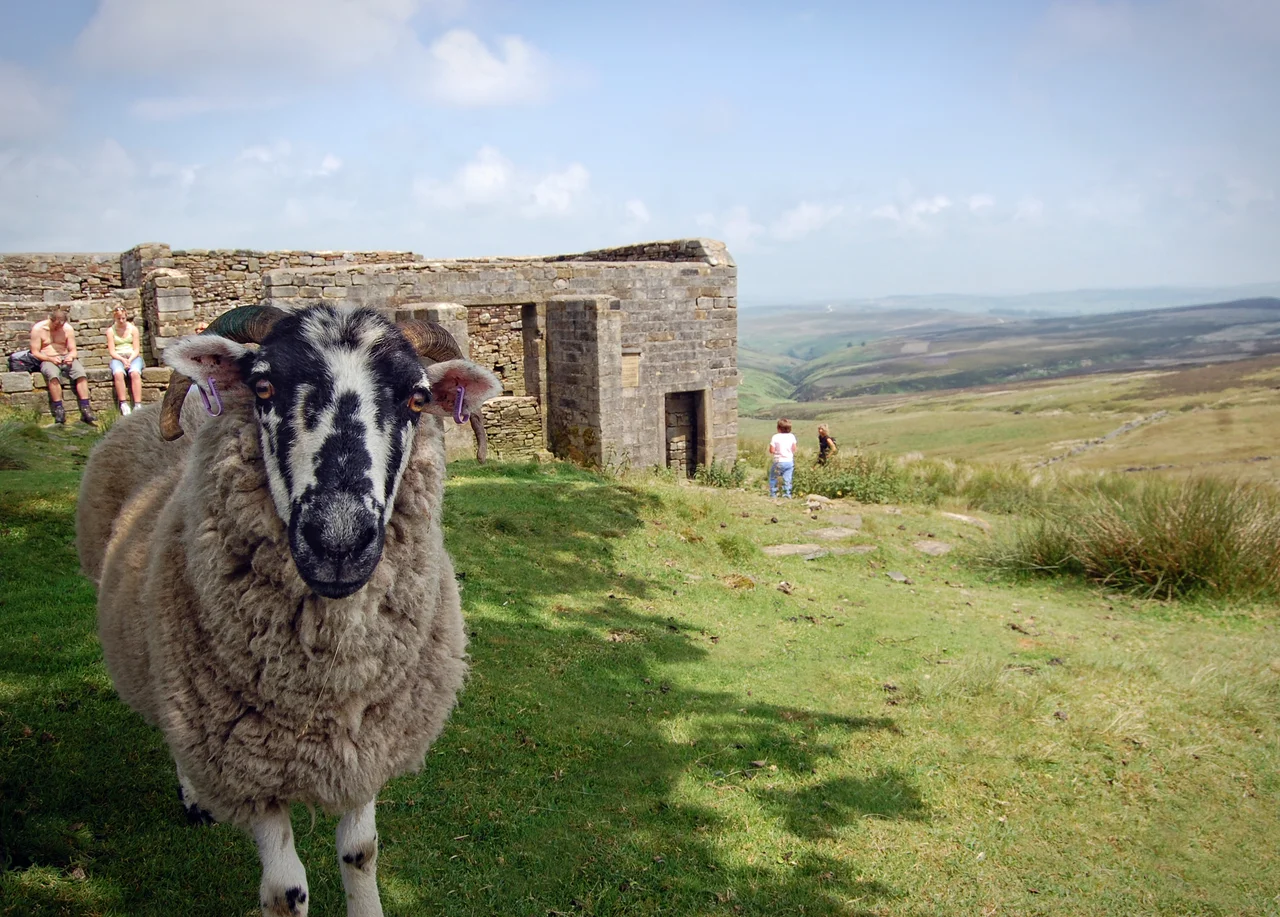

Top Withens
The walls still stand, just barely, on a fold of moor 1,377 feet above sea level. Sheep crop the heather around them; wind moves through window holes that no longer hold glass. Three and a half miles southwest of Haworth, at the head of a long valley above South Dean Beck, the ruined farmhouse called Top Withens has become a literary pilgrimage site without quite earning the title. Emily Bronte never confirmed that this was the inspiration for the Earnshaw house in Wuthering Heights. But the setting matches, and that, for generations of readers, has been enough.
A Name From the Willows
The spelling shifts between Top Withens and Top Withins on different maps. Either way, the name traces back to a Yorkshire dialect word for willow trees, though precious few willows survive on this exposed plateau today. The farmstead sat at the boundary of two parishes and at the limit of what could be coaxed from the soil. Tenants raised sheep, cut peat, walked into Haworth or Stanbury for market, and watched the storms roll over Wadsworth Moor. By the late nineteenth century the house was deteriorating; the last family left in the 1920s, and the roof eventually fell in. The Bronte Society fixed a plaque to one surviving wall that diplomatically explains the location matches but the building itself almost certainly did not inspire the novel.
The Night of Lightning
Top Withens did once host a moment of pure drama, just not the one literary tourists came looking for. On 18 May 1893, the farmhouse was still occupied and still roofed when a thunderstorm broke over the moor. Lightning struck the building directly. Holes opened in the walls. Slates flew off the roof. Around thirty windows were torn out of their frames. A slate was hurled some distance by the wind, and in the kitchen, a knife blade was fused by the heat. A bowl of dough that Mrs Sunderland had set to rise was smashed to pieces. Her dog and her cat bolted from the house in terror. The Todmorden and District News reported every detail the following week. The house survived that night, but only just.
The Pilgrim Path
Wuthering Heights was published in 1847, the year before Emily Bronte died of tuberculosis at thirty. Her publisher, George Smith, later wrote to Charlotte Bronte's friend Ellen Nussey asking for places that had inspired the novels. The list of possibilities that emerged from that correspondence may be how Top Withens became attached to the story. The misconception stuck. Walkers from across England, and increasingly from Japan, where Wuthering Heights has a vast readership, climb out of Haworth along signed paths to reach the ruin. So many Japanese pilgrims arrive that the footpath signs include Japanese text. The Bronte Way and the Pennine Way both pass nearby. On a clear day you can see for miles, the colour of the heather shifting with the wind. On a wet day, which is most days, the moor closes in and the novel begins to make sense regardless of where it was actually written.
What Remains
Two trees, planted by the Bronte Society, stand near the wall. The masonry has been stabilised so the ruin stops shrinking. Beyond the house, the path drops to South Dean Beck and the small waterfall the Brontes are said to have visited from the parsonage in Haworth, three miles away by foot. There is no road here. The walk takes a couple of hours from the village and crosses ground that has hardly changed since Emily walked it. That, more than any plaque, is what the pilgrims come for: a chance to stand in landscape that a young woman with a fierce imagination once knew, and to look out at the same horizon she did.
From the Air
Top Withens stands at 53.81 N, 2.03 W on the high moorland of Haworth Moor, about three and a half miles southwest of the village of Haworth. The nearest airport is Leeds Bradford (EGNM), thirteen miles to the east. Manchester (EGCC) is twenty-eight miles south-southwest. From cruising altitude, the site is hard to spot; the ruin is a small grey rectangle on open moor at 420 metres elevation. Look for it on the watershed ridge between the Worth Valley to the east and the Calder Valley to the south. Best viewed from 4,000 to 6,000 feet in clear weather, with the dark expanse of the Pennine moors stretching away in every direction.
Nearby Stories
- Battle of Seacroft Moor 3 km away
- RAF Topcliffe 7.4 km away
- Pretoria Pit Disaster 8.7 km away
- Lundhill Colliery Explosion 11 km away
- Forest of Bowland 12 km away
- Coverham Abbey 16 km away
- Macclesfield Canal 18 km away
- Leighton Hall, Lancashire 21 km away