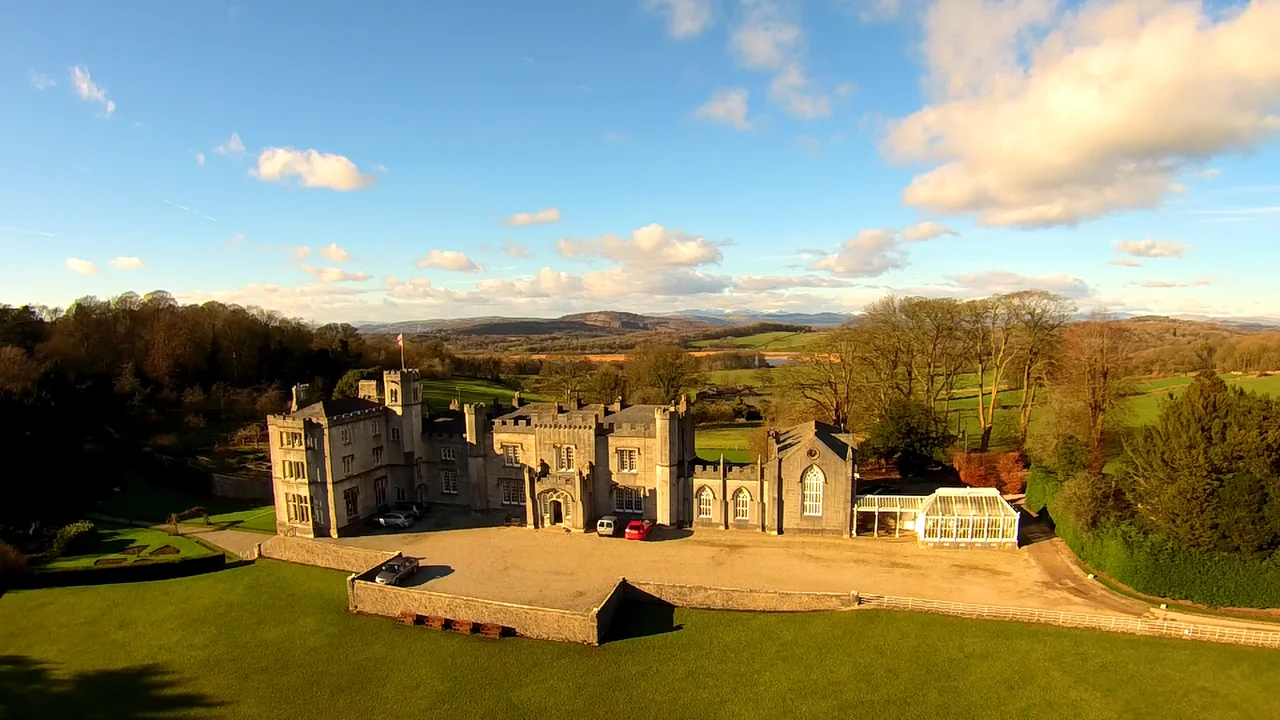

Leighton Hall, Lancashire
The house was burnt to a shell in 1715 because its owner backed the wrong king. Albert Hodgson had married into Leighton Hall through Dorothy Oldfield, settled comfortably into the country squire's life, and then joined the Jacobite rising of that year on the side of the exiled Stuarts. He was captured, the estate confiscated, the building torched and its contents seized. When the wreckage was sold at public auction in 1722, a sympathetic friend named Winkley bought it specifically so that Hodgson - eventually released from prison - could live out his days in the ruin he had once owned. That is not how most English country houses begin their modern story. Leighton Hall is where you go to see a façade Gothicised by a furniture maker, in a house still occupied by the same family that bought it two centuries ago.
From Rebel Ashes to Georgian Order
After Hodgson's death the property passed via his daughter Mary into the hands of George Towneley of Towneley Hall in Burnley, whose marriage to her brought the estate west across Lancashire. Towneley demolished what remained of the seventeenth-century house and commissioned an entirely new building from the architect John Hird between 1759 and 1761. This is the Georgian core of the present hall - a regular, classical block of local pale stone, sited to capture the long view across the bay toward the Lake District fells. Hird laid the woods out fresh in 1763. George and his wife had no children, and the property went to his nephew John, who sold it in 1805. For seventeen years the hall passed through anonymous owners. Then in 1822, it came into the hands of someone whose family name was already famous across England for an entirely different reason.
The Gillow Treatment
Richard Gillow was the grandson of Robert Gillow, founder of the Lancaster furniture firm whose mahogany pieces had become the gold standard of English Georgian cabinetmaking. The Gillows knew materials. Richard immediately set about transforming the new house he had inherited: between 1822 and 1825 he refaced the Georgian façade in white local limestone and Gothicised it with battlements, pointed-arch windows and the entire vocabulary of the Regency-Gothic revival. The effect is striking even today - a pale fairytale silhouette set against the dark woods of the Silverdale plateau. In 1870, Richard's son commissioned the renowned Lancaster firm of Paley and Austin to add a three-storey wing with a billiard room below and guest rooms above. Paley and Austin were the architects every prosperous north-of-England family wanted by then; their work at Leighton handles the join between the two periods without visible strain.
The Long Tenure
Richard Thomas Gillow died in 1906 leaving the hall in poor condition. His grandson Charles Richard inherited, then died young in 1923. Charles's widow stayed on. She lived at the hall for another forty-three years and died there in 1966 at the age of ninety-six. The story does not end with a National Trust handover. The property passed through her daughter Helen to her grandson Richard Gillow Reynolds, who with his wife Susan still owns and occupies the hall - direct lineal descendants of the man who bought it at auction over two centuries ago. The Reynolds family received the Historic Houses Association's 2023 Sustainability Award for their stewardship of the estate, an unusual recognition in a sector dominated by institutional owners. Leighton remains, against all the odds of twentieth-century inheritance tax and economic pressure, a working private home.
What You See From the Drive
Approaching from Yealand Conyers, the house comes into view across parkland that Hird first laid out and the Gillows refined. The white limestone catches every shift of Cumbrian weather - bright as bone in sun, soft grey in mist, almost luminous at dusk. The Gothic battlements run a clean horizontal line above windows that were Georgian when they were cut. Behind the house, the woods rise toward Warton Crag and the Arnside knot; on a clear day the view extends across Morecambe Bay to the Lake District peaks. Birds of prey are flown daily in the grounds during the visiting season - hawks, owls, a falcon or two demonstrated above the lawn the Gillows planted out. The hall, in its sixth Gillow generation of family ownership, still receives visitors.
From the Air
Leighton Hall sits at 54.16 degrees north, 2.78 degrees west, half a mile west of Yealand Conyers in north Lancashire. From altitude, look for the white limestone façade against wooded grounds at the base of the Silverdale-Arnside limestone plateau. Best viewed from 2,000-3,000 feet AGL. Carlisle (EGNC) lies approximately 50 nautical miles north; Blackpool (EGNH) is about 25 nautical miles south. Morecambe Bay opens immediately to the west, with the Lake District fells visible north and northwest in good visibility.
Nearby Stories
- Lake District 0.9 km away
- Forest of Bowland 3.5 km away
- Yorkshire Dales 4.6 km away
- Skipton Castle 6.2 km away
- Bowes Castle 6.8 km away
- Millom 7.2 km away
- Appleby Castle 13 km away
- Hoylake Lifeboat Station 63 km away