
Millom
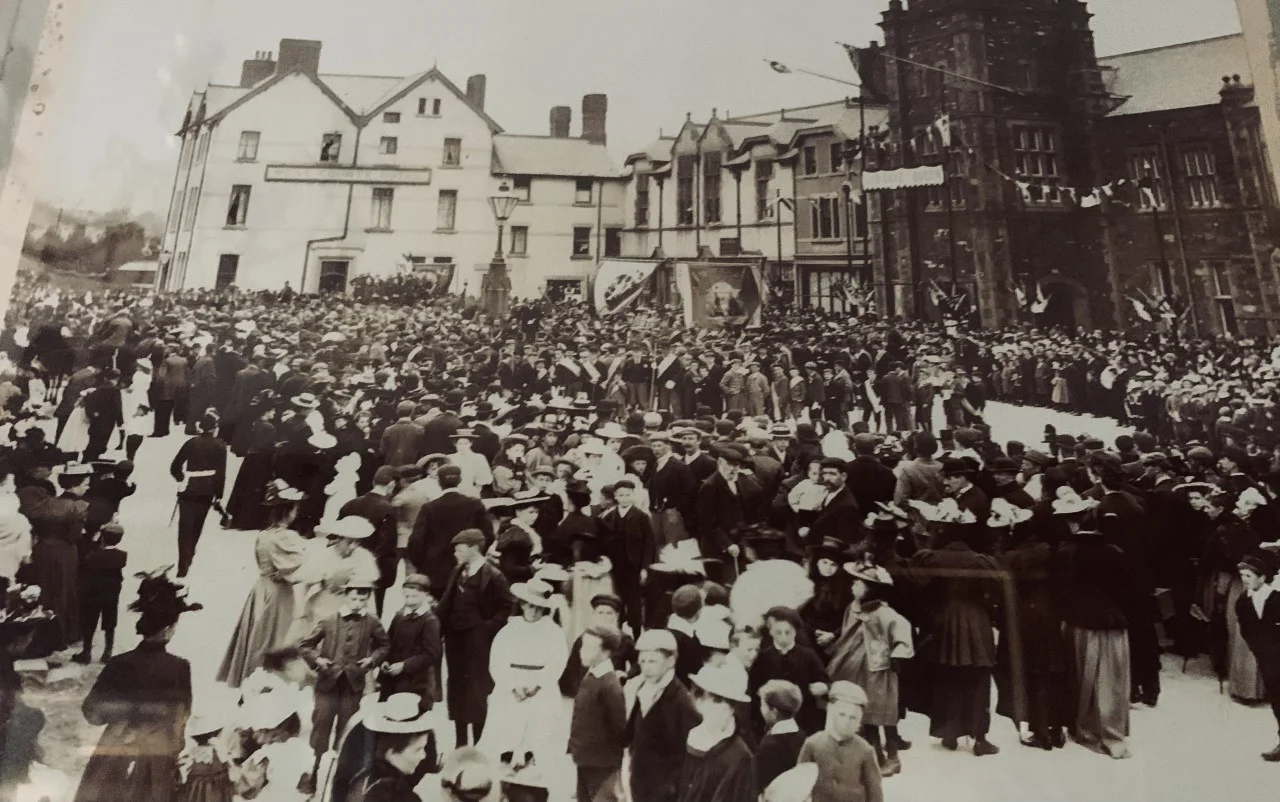
Until the 1860s, Millom barely existed. There was a 12th-century parish church called Holy Trinity, a dilapidated castle that had been a wreck since 1739, and a small hamlet called Holborn Hill with a railway halt and a brickworks. Then the Hodbarrow Mining Company found haematite — high-grade, phosphorus-free iron ore — between Holborn Hill and the seashore, and everything changed inside a decade. Furnaces went up in 1866. A grid of terraced streets followed. A library, a police station, banks, hotels, a school, and a market square arrived. By 1899 there was a town where there had been a hamlet, and by the 1960s Millom had grown to almost 11,000 people. Then the mines and the ironworks closed, all in 1968. By the 1971 census, the population had fallen to 7,101.
The Sea Held Back
Hodbarrow's iron lay close to the shore — and as the mines extended outward under the beach and the Duddon estuary, the sea became a problem. Three successive seawalls were built to hold it off, the last and largest finished in 1905 after five years of work and at a cost of almost £600,000 in money of the day. The Hodbarrow Outer Barrier was an engineering feat that the Edwardian press wrote about with genuine awe: a curving rampart of stone and concrete, holding back the Irish Sea so that miners below could keep digging out the ore that fed the furnaces in town. The Hodbarrow Mining Company also built a lighthouse on Hodbarrow Point in 1866 to guide ships into its dock, then a second lighthouse on the new seawall in 1905. Both structures still stand. In 2004, the newer one — abandoned since 1949 — was refurbished by a community initiative. By 2016 its solar light had stopped working again. The seawall is still there, holding.
The Town the Poet Made
Norman Nicholson was born in Millom in 1914 and spent his entire life in the town — almost without exception, on the same street. T.S. Eliot, then a director at Faber and Faber, published his poetry. Nicholson wrote about the ironworks closing, the seawall holding, the fells visible from the back garden. He is commemorated by a blue plaque on his house at 14 St George's Terrace and by a memorial stained-glass window in St George's Church, designed by the artist Christine Boyce. There is a Norman Nicholson Society. There is a chair-in-residence at Millom School. The Mayor of Copeland once called the town 'a place of despair,' and Nicholson lived through every reason for the description, but he also wrote about the town with a tenderness that comes from staying — through the closure, through the years when there was nothing obvious to stay for. The poems are still in print.
Older Than Almost Everyone
Millom Rugby League Club was founded in 1873. It is the oldest existing amateur rugby league club in the world. Millom's rugby union club was also founded in 1873, making it among the oldest rugby clubs in England — and they meet in the same town. The town's other heritage runs further back than the mines: Holy Trinity Church dates parts of itself to the 12th century; the Domesday Book of 1086 records Millom as part of the Manor of Hougun, held before the Conquest by Tostig Godwinson, Earl of Northumbria; in January 2023 a metal detectorist found six Bronze Age socketed axe heads at a site near the town, later featured on the BBC's Digging for Britain. King Henry III granted a market charter to John de Huddleston, Lord of Millom, in 1251. Millom Castle, grade I listed, sits in disrepair near the original parish church. The mining era was loud, but it was not long, and the town's older bones are still there to be felt.
What the Estuary Holds
Two nature reserves now sit where industrial Millom once worked. Hodbarrow Nature Reserve, owned by the RSPB, lies south of town on the Duddon Estuary — designated a Site of Special Scientific Interest and internationally important for terns, wading birds, and wintering wildfowl. Millom Iron Works Local Nature Reserve covers the old works site itself, returning slag to wildflower meadow. RAF Millom, which trained Observers and Air Gunners during the Second World War on Blackburn Bothas, Fairey Battles, and the more reliable Avro Anson, became HM Prison Haverigg after the war. The prison is now one of the town's larger employers. North above Millom rises Black Combe — 1,970 feet of fell with views, on a clear day, of England, Scotland, Ireland, and Wales. Millom became a Fairtrade town in 2004. Tourists arrive on the Cumbrian Coast Line. Norman Nicholson's poems describe most of it better than any guidebook ever has.
From the Air
Millom sits at 54.21N, 3.27W on the north shore of the Duddon estuary in southern Cumbria, just outside the Lake District National Park. From the air, the curving Hodbarrow Outer Barrier sweeps around the former mine workings south of town, with the two surviving lighthouses visible on the headland and seawall. The Duddon estuary mud flats are unmistakable at low water. Black Combe rises 1,970 feet to the north-west. Millom railway station sits centrally on the Cumbrian Coast Line. Nearest field is Walney Island (EGNL) some 8 nm south-east across the Duddon. The estuary's tidal range and shifting channels demand caution at low altitude.
Nearby Stories
- Ennerdale Water 3.9 km away
- Levens Hall 4.1 km away
- Lowther Castle 14 km away
- Forest of Bowland 15 km away
- Fleetwood 22 km away
- Ramsey Bay 31 km away
- Raeberry Castle 33 km away
- Celtic Array 42 km away