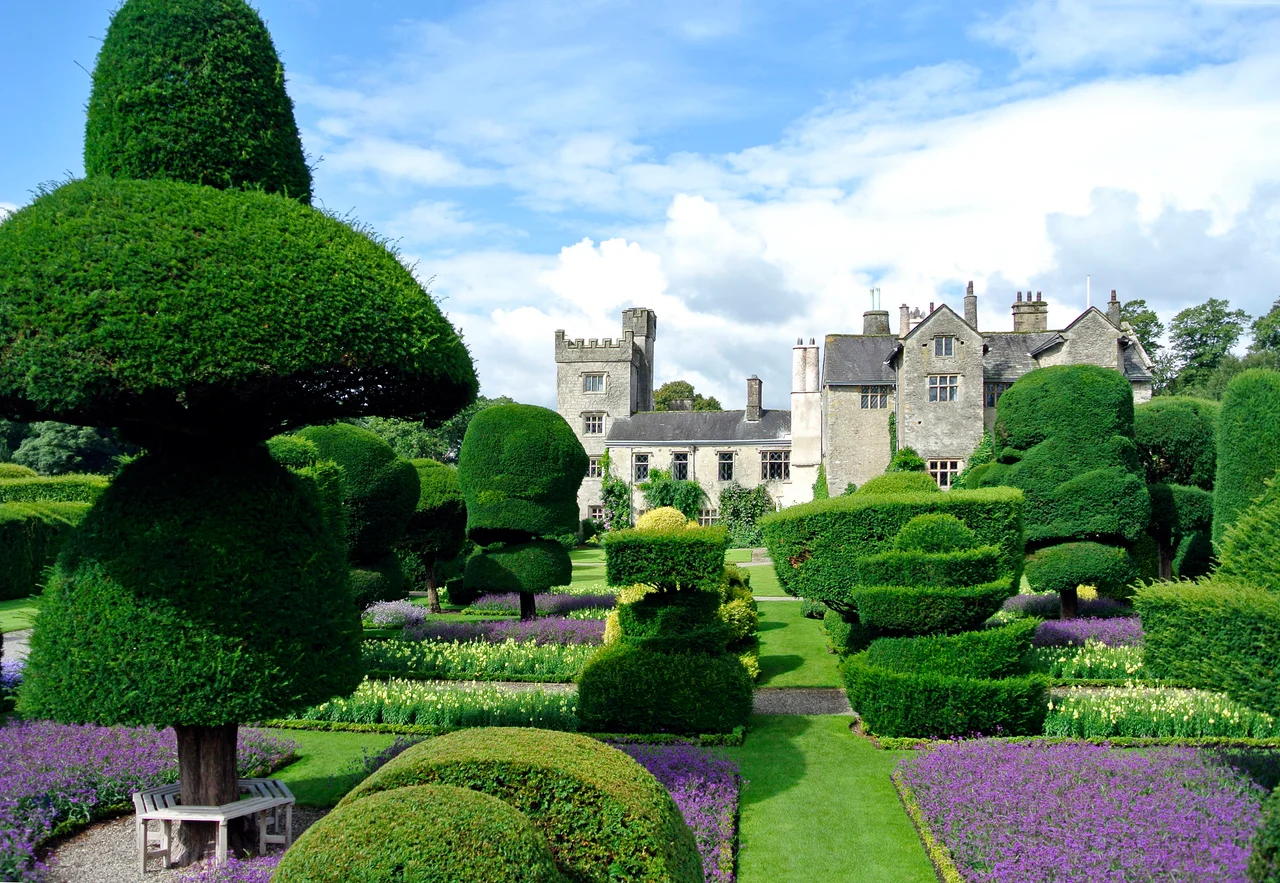

Levens Hall
The hedges have been clipped continuously for over three hundred and thirty years. Guillaume Beaumont arrived in the Kent valley in 1689, brought from France via the court of King James II, and began laying out a topiary garden that he would work on until 1712. He had previously designed the grounds at Hampton Court for his royal patron; this was his private commission for Colonel James Grahme, Keeper of the Privy Purse. Most topiary gardens of that period have been lost to fashion, neglect, or root rot - replaced by softer eighteenth-century landscaping, swept away by Capability Brown's followers, or simply abandoned. Levens is the exception. The chess pieces, the cone, the corkscrew, the great geometric shapes - all of them shaped from yew and box - have grown gnarled and corpulent with three centuries of growth, but they stand where Beaumont planted them.
Before the Garden
The hall itself is far older than the topiary. A pele tower built by the Redman family around 1350 still forms the structural core of the house - one of the squat defensive towers that line the northern English borders, built when raids from Scotland made every prosperous landowner choose stone and slit windows over comfort. The Bellingham family extended the pele tower into a substantial Elizabethan house in the late sixteenth century. They were the ones responsible for the carved oak panelling and the elaborate plasterwork ceilings that still survive in the main rooms. Then, in 1689, the Bellinghams sold the house and the estate together to James Grahme, a Cumbrian who had risen to one of the most intimate positions in the royal household: Keeper of James II's Privy Purse, the man who handled the king's personal expenses. Grahme bought the house, the land, and the right to commission Beaumont.
The Beaumont Garden
What Beaumont did between 1689 and 1712 has survived essentially intact. A 1730 map of the park and gardens shows almost all the essential elements still present today. The topiary itself sits in tight geometric beds, the yew and box clipped into shapes that are difficult to date precisely because they have grown so much - the original silhouettes long since outgrown into the rounded, weighted forms of trees three centuries old. The deer park beyond was Beaumont's work as well: he chose the locations of the original trees, set out the rides, designed the relationship between the parkland and the house. Black fallow deer still graze the park, joined by Bagot goats - one of Britain's rarest native breeds. The fact that any of this looks the way Beaumont intended is the result of an unbroken three-century chain of gardeners who decided not to redesign.
Steam, Hounds and the Bagot Years
Grahme's son Henry Graham served as knight of the shire for Westmorland. Further additions were made to the house in the early nineteenth century. The estate is now owned by the Bagot family, who keep the gardens open to the public from spring through autumn. The visitor experience has acquired some unusual layers. There is a small collection of working steam road vehicles - traction engines and steam wagons that get steamed up most Sundays and Bank Holidays, smoke drifting across the topiary on summer afternoons. The hall played Baskerville Hall in the BBC's 2002 production of The Hound of the Baskervilles. And in October 2021, Levens received part of the government's £35-million Culture Recovery Fund - one of 142 sites supported through that programme. In December of the same year, the BBC's Gardeners' World featured the gardens in a winter special.
The Slow Garden
What you walk through at Levens is fundamentally different from the formal gardens at Versailles or Hampton Court, both of which were heavily reworked in subsequent centuries. Here, the same plants are still being clipped to roughly the same outlines by gardeners standing on the same garden paths. The topiary has been called the oldest in the world still maintained, and that claim has not been seriously challenged. Time runs differently inside a garden like this. A yew that was planted as a small shrub in 1694 is now a dense, dark, organic mass weighing several tons, still trimmed each year, still recognisable from old engravings. The hedge maze of fashion has passed in and out a dozen times since Beaumont arrived. His garden simply kept going.
From the Air
Levens Hall is located at 54.26 degrees north, 2.78 degrees west, in the Kent valley 5.4 miles south of Kendal in Cumbria. From altitude, look for the formal topiary garden adjacent to the Elizabethan house, with the deer park stretching south. The M6 motorway passes close to the west. Best viewed from 2,000-3,000 feet AGL. Carlisle (EGNC) lies approximately 50 nautical miles north; Blackpool (EGNH) is about 35 nautical miles south. The Lake District fells rise to the north and northwest; Morecambe Bay opens to the southwest.
Nearby Stories
- Lake District 0.9 km away
- Forest of Bowland 3.5 km away
- Yorkshire Dales 4.6 km away
- Skipton Castle 6.2 km away
- Bowes Castle 6.8 km away
- Millom 7.2 km away
- Appleby Castle 13 km away
- Hoylake Lifeboat Station 63 km away