
Lake District
Beatrix Potter bought her first farm here with royalties from Peter Rabbit. Wordsworth grew up here and never really left. Arthur Ransome set Swallows and Amazons on these waters. Something about this corner of northwest England has, for two centuries, refused to let writers go. Walk into the central fells on a clear morning and the reason makes itself plain: sixteen major lakes lie cradled in glacier-carved valleys, ringed by the highest mountains in England, while sheep that know their patch of fell by heart graze slopes their ancestors grazed in Roman times. The Lake District is a national park, a UNESCO World Heritage Site, and, for many of the eighteen million people who visit each year, a kind of pilgrimage.
Born of Ice and Pressure
The geology is the easy part of the story. A granite batholith beneath the region buoys it up, and repeated glaciations over the past two million years gouged radial valleys outward from an axial watershed running from St Bees Head in the west to Shap in the east. The valleys took the classic U-shape of glacial work, and long narrow lakes settled into the bedrock hollows left behind. At higher elevations, smaller waters known as tarns occupy glacial cirques. Scafell Pike rises to 978 metres, the highest ground in England, with Helvellyn at 950 and Skiddaw at 931 close behind. Windermere, eighteen kilometres long, is the country's longest lake. Wast Water, at 79 metres deep, is its deepest. From the summit of Scafell Pike on a clear day, the view stretches to the Galloway Hills of Scotland, the Mourne Mountains of Northern Ireland, the Isle of Man, and Snowdonia in Wales.
The Writers Arrive
Travelers came first as observers. Celia Fiennes rode through Kirkstone Pass in 1698 and described the fells as terrible and pleasant in the same breath. Daniel Defoe, less generous, called Westmorland the most barren and frightful country he had crossed. Thomas West changed the tone in 1778 with A Guide to the Lakes, listing viewpoints he called stations where visitors could compose the landscape like a painting. William Wordsworth's own Guide to the Lakes appeared in 1810, ran to five editions, and turned the region into a destination. His favoured ground was the Duddon Valley, in the quieter southwest. Beatrix Potter came later, bought farms, bred Herdwick sheep, and willed thousands of acres to the National Trust. Even now Japanese visitors arrive in numbers to see the cottage where she lived.
Sheep, Slate, and Survival
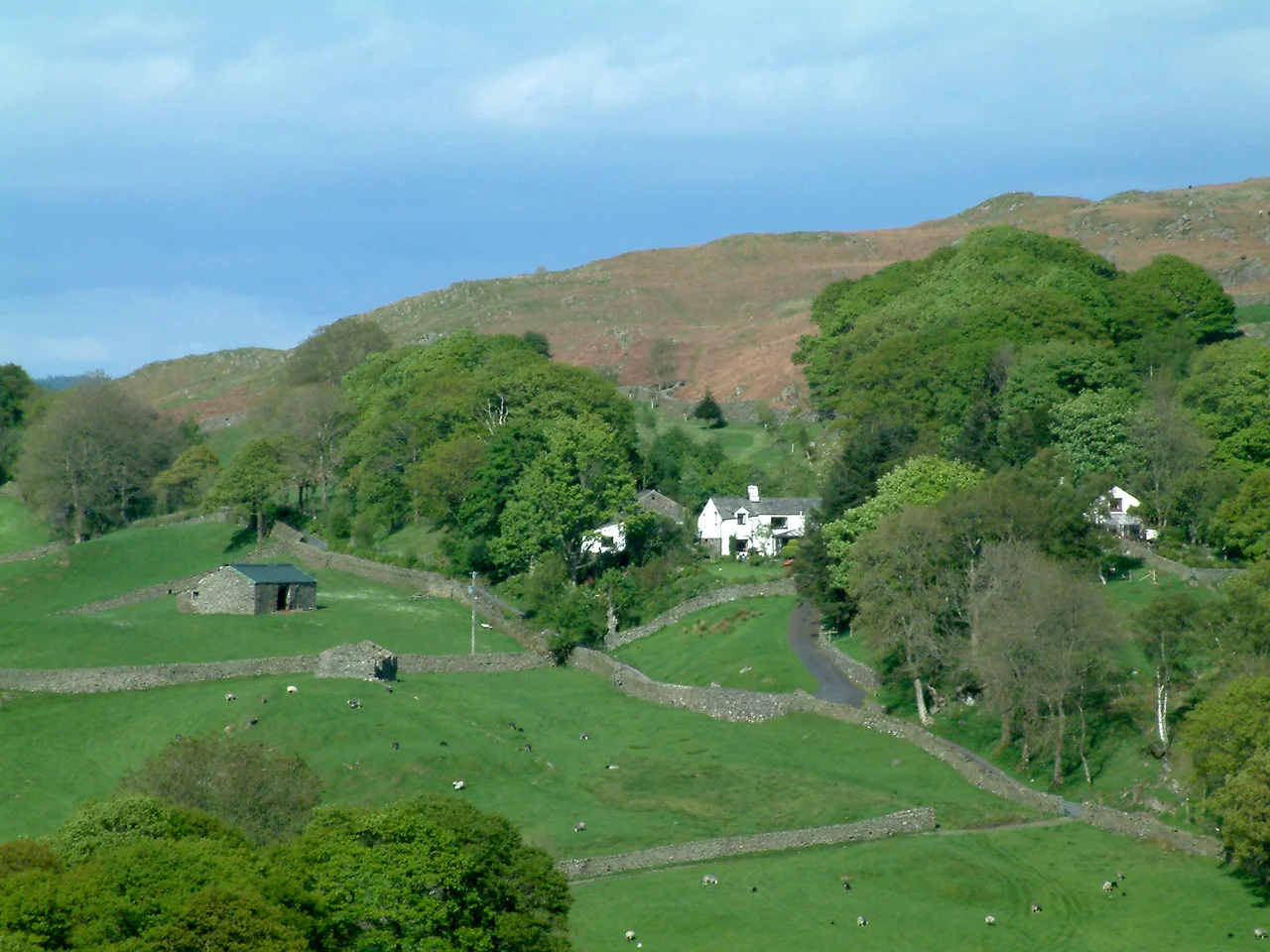
Farming has shaped these fells since Roman times. The local breed, the Herdwick, is hefted, meaning it learns its patch of unfenced fell and passes that knowledge to its lambs. When foot-and-mouth swept Cumbria in 2001 and the Herdwicks were destroyed in their thousands, the loss was not only of animals but of inherited knowledge. Electric fences went up for five years afterwards to let new flocks re-heaf. The dry stone walls that lace the valleys are sheep walls, holding the land together by another sort of inheritance. Slate is still mined at Honister at the top of its pass, and graphite once dug from Borrowdale gave Keswick a pencil industry that endures. In the mid nineteenth century, fully half the world's textile-bobbin supply came from these woods.
Eighteen Million Visitors
The national park was designated on 9 May 1951, one month after the Peak District opened the British system. Its 2,362 square kilometres make it the largest park in England and Wales, and the second largest in the United Kingdom after the Cairngorms. UNESCO inscribed the original boundary as a cultural landscape in 2017, on the fourth attempt. Around 18.14 million tourist visits were recorded in 2022, supporting the local economy and straining the paths. Soil erosion on the most-walked fells now costs millions of pounds to repair. Alfred Wainwright's Pictorial Guide to the Lakeland Fells, written by hand between 1955 and 1966, catalogued 214 summits and gave generations of walkers a target list. The pursuit of a complete set, known as bagging the Wainwrights, remains a quiet obsession across the British Isles.
The Wildness That Remains
England's last nesting golden eagles were a Lakeland pair; the female was last seen in 2004, the male in 2015. Ospreys returned to Bassenthwaite in 2001 after 150 years away, and red kites bred near Grizedale in 2014 for the first time in two centuries. The red squirrel still holds out here, in greater numbers than anywhere else in England. Three rare fish, the vendace, the schelly, and the Arctic charr, survive in particular lakes. Seathwaite in Borrowdale is the wettest inhabited place in England at 3,300 millimetres of rain a year, and nearby Sprinkling Tarn records over 5,000. The fells get gales for around a hundred days each year. None of this discourages anyone. The wildness is the point.
From the Air
The Lake District lies near 54.5 N, 3.17 W, covering roughly 2,362 square kilometres of northwest Cumbria. Recommended viewing altitude is 3,000 to 6,000 feet AGL to take in the radial valley pattern. Scafell Pike (978 m), Helvellyn (950 m), and Skiddaw (931 m) form the major summit profile. The nearest airports are Carlisle Lake District (EGNC) to the north and Blackpool (EGNH) to the south. Windermere, the largest body of water, is the easiest single landmark. Expect frequent cloud and rain over the central fells; the western coastal plain is generally clearer.
Nearby Stories
- Lowther Castle 5.5 km away
- Black Combe 6.6 km away
- Levens Hall 6.8 km away
- Threave Castle 13 km away
- Ruthwell Cross 18 km away
- Raeberry Castle 24 km away
- RAF Spadeadam 24 km away
- Cashtal yn Ard 33 km away