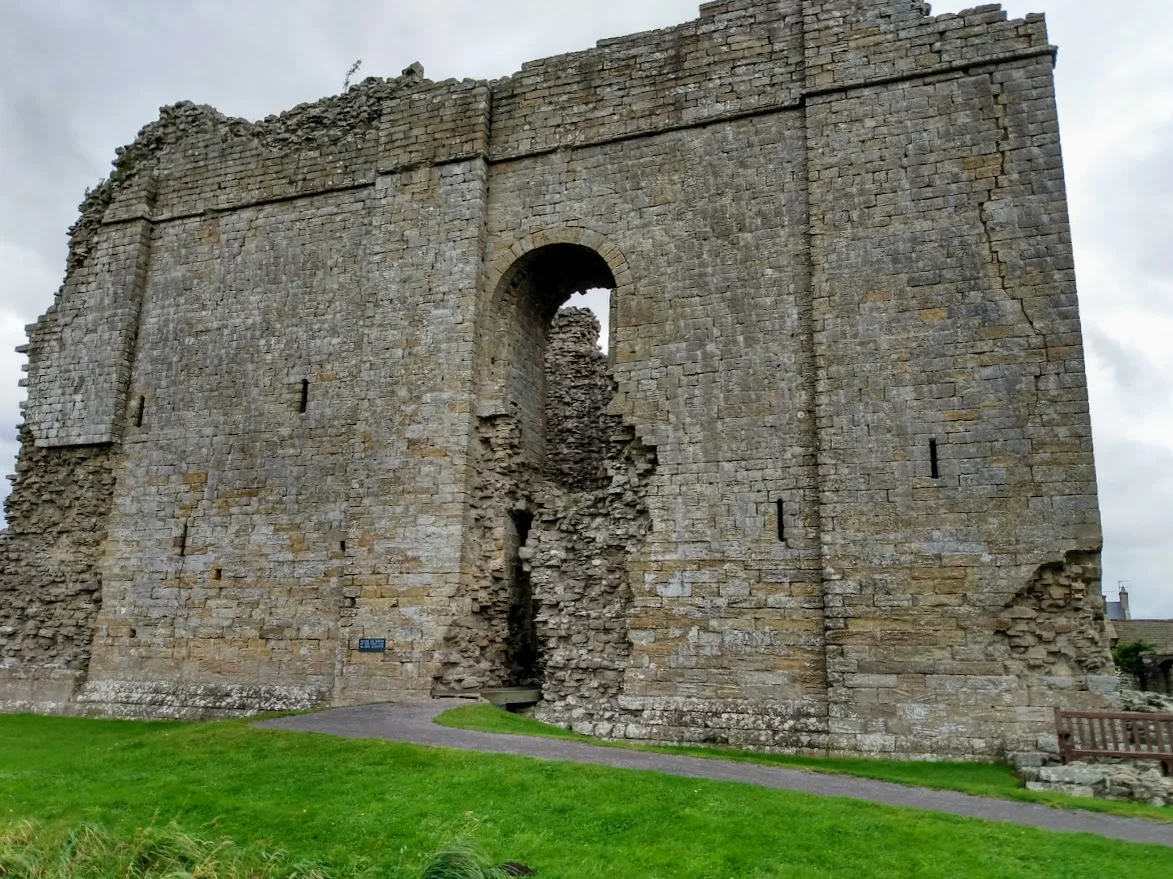

Bowes Castle
Henry II had a problem at the top of England. The Stainmore Pass cut clean across the Pennines, one of the few upland routes linking the south to Scotland, and the timber tower that watched it was inherited - not built. So between 1170 and 1174, the king poured nearly £600 of royal silver into a stone hall-keep set squarely inside the ruins of the Roman fort of Lavatrae. The walls rose 50 feet, the masons of Brittany's local tenants - Torfin, Osbert and Stephen of Barningham - dressed every stone, and a planned village ran up to the gate. The test came almost before the mortar set: King William the Lion of Scotland riding south, and Bowes Castle in the way.
Roman Stones, Norman Walls
The Romans called this fort Lavatrae and built it to watch the same pass. A thousand years later, Alan de Bretagne, Count of Brittany, dropped a timber castle into its north-west corner around 1136, and his successors held it as part of the Honour of Richmond. When Conan IV died in 1171, Henry II claimed the place outright. What he ordered next was unusual - a brand-new royal castle in a region the Crown rarely fortified directly. The design was unusual too. Most English castles of the period had separate halls and keeps; Bowes combined them into a single three-storey hall-keep, 82 feet long and 60 feet wide, with large rounded windows lighting a long hall and a private solar. A mill on the River Greta ground the garrison's flour. The architects borrowed details from Middleham and Pendragon, but the silhouette - a single great rectangle of stone rising from Roman ramparts - was its own thing.
The Lion at the Gate
The Great Revolt of 1173-74 was a coalition of rebel barons backed by William the Lion and continental allies, all hoping to break Henry's grip. William pushed south in 1173 and damaged Bowes in the raids. Over the winter, masons reinforced the chamber, repaired the gates, and threw bulwarks around the keep. The next year William came back in earnest and laid siege. The half-built defences held. A relief force commanded by Geoffrey, Henry's illegitimate son and then Bishop of Lincoln, marched up and forced the Scots to retreat. Weeks later William was captured at the Second Battle of Alnwick, and the revolt collapsed. For one brief campaigning season, the new keep on the Stainmore had done exactly what Henry built it for.
The Slow Forgetting
Peace was harder on Bowes than war. With the Scots quieted, royal interest drifted. King John handed the castle to Robert de Vieuxpont in 1203; Edward II later gave it to John de Scargill, and the Earl of Richmond's tenants rebelled and attacked it in 1322, looting what they could carry. Border raids kept gnawing at the manor. By 1340 the castle was ruinous and the surrounding fields abandoned. The English Civil War finished the dismantling. By 1928, the keep stood roofless and ignored, owned by Lady Lorna Curzon-Howe, who handed it to the Office of Works in 1931 to escape death duties. Today English Heritage manages the ruins. Admission is free. The keep's walls still rise sharp against the moor, still mark the line of the Roman fort, still watch the pass.
From the Air
Coordinates 54.5167N, 2.01355W. Bowes Castle sits in the village of Bowes on the A66 (the modern Stainmore Pass road) in County Durham, England, at the edge of the North Pennines. The roofless rectangular keep is visible from low altitude as a distinct stone block within the rectangular Roman fort outline. Best viewed at 1500-3000 ft AGL in clear weather. Nearest aerodromes: Durham Tees Valley (EGNV) about 28 nm east-southeast and Carlisle Lake District (EGNC) about 30 nm west. The Pennine ridge to the west often holds low cloud and lee-side turbulence in westerly winds.
Nearby Stories
- Appleby-in-Westmorland 1.6 km away
- Ryhope Engines Museum 3.2 km away
- Stockton-on-Tees 5.7 km away
- Coverham Abbey 7.8 km away
- Crook Hall 8 km away
- RAF Topcliffe 12 km away
- Levens Hall 21 km away
- RAF Spadeadam 22 km away