
RAF Topcliffe
Walk into the old control tower at RAF Topcliffe today and you will find the Yorkshire Air Ambulance crew getting their helicopter ready for the next callout. The runway behind them once launched Halifax bombers heading for Germany. The buildings around them belong to the British Army now - this is Alanbrooke Barracks - and the only RAF unit left here teaches Air Cadets to fly gliders. It is the layered, half-forgotten kind of airfield that Britain is full of: a piece of flat Yorkshire farmland that became important in 1940, stayed important for thirty years, and quietly became something else.
Whitleys and Halifaxes
Topcliffe opened in September 1940 as a Bomber Command station, home to 77 Squadron and 102 (Ceylon) Squadron flying the Armstrong Whitworth Whitley - a slab-sided twin-engined heavy bomber that looked unimpressive and did the hard work anyway. A decoy site was built at Raskelf, a few miles south, designed to draw Luftwaffe night raiders away from the real airfield. In 1942 the Canadians arrived: 419 and 424 Squadrons of the RCAF, flying Vickers Wellingtons and later the Handley Page Halifax III. On 1 January 1943 the station transferred to No. 6 Group RCAF and became a training base, controlling sub-stations at Wombleton, Dalton, and Dishforth. By war's end it had trained crews who flew - and many who never came back from - the Bomber Command campaigns over the Ruhr and Berlin.
Cold War Classrooms in the Sky
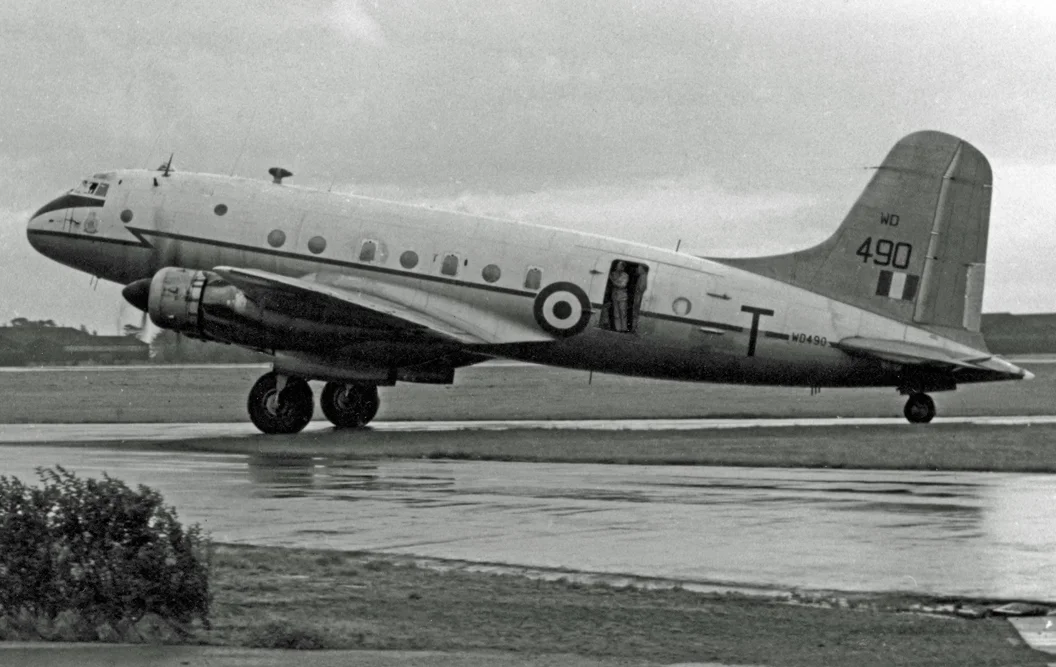
After 1945 Topcliffe became a school. No. 1 Air Navigation School moved in from 1947 to 1954, then again from 1957 to 1961, training navigators on Wellingtons, Avro Ansons, and the chunky Vickers Varsity. The Air Electronics School arrived in 1962, growing into the Air Electronics and Engineers School five years later - the place where the men who would sit in the back of V-bombers and maritime patrol aircraft learned their trade. The Northern Communications Squadron ran VIP flights out of here with Ansons and Beagle Bassets. Brigade-level helicopter crews from the Army Air Corps trained on Westland Scouts and de Havilland Beavers. None of it was glamorous in the way fighter wings are glamorous. All of it was the working backbone of British air power.
Army Takes the Field
Between 1972 and 1973 most of the station passed to the British Army to become Alanbrooke Barracks, named for the wartime Chief of the Imperial General Staff. The runway and a small RAF enclave survived inside the Army's perimeter. Tucano training squadrons used it as a relief landing ground for nearby RAF Linton-on-Ouse. Parachute clubs jumped from it through the 1990s. The Royal Navy's Elementary Flying Training Squadron used it during the 1980s. Today only one RAF unit remains: No. 645 Volunteer Gliding Squadron, training Air Cadets on the Grob Viking T.1, a sleek white glider that catches Yorkshire thermals on summer weekends. The last permanent flying unit at an airfield that once sent Halifaxes over Berlin is a club teenagers fly into the wind.
An Ambulance in the Tower
Since March 2012 the former control tower has been the base for G-YOAA, one of two Yorkshire Air Ambulance helicopters - now an Airbus H145 painted in the charity's distinctive yellow and red. In 2025 the charity broke ground on a purpose-built replacement facility three and a half miles north, on part of the old RAF Skipton-on-Swale airfield. It is supposed to open in summer 2026. When it does, the tower at Topcliffe will probably fall quiet again. The runway will keep its few gliders, the Army will keep its barracks, and another piece of Bomber Command's geography will slip a little further into the past. Until then, on a clear day, you can still hear rotor blades spinning up behind the brick of a building that watched Whitleys take off in 1940.
From the Air
RAF Topcliffe (ICAO EGXZ) at 54.21 N, 1.38 W is an active military airfield 3 km west of the A19 in North Yorkshire's Vale of Mowbray. The airfield is enclosed within Alanbrooke Barracks; transit and overflight require ATC coordination. Nearest civil airport is Teesside International (EGNV), 30 km north. RAF Linton-on-Ouse lies 20 km south. Runway 06/24 is the main paved strip, used by Yorkshire Air Ambulance helicopters and 645 VGS gliders. Best viewed at 1,500 to 3,000 feet AGL with the Hambleton Hills as eastern reference.
Nearby Stories
- Battle of Marston Moor 1.6 km away
- Middlesbrough Cathedral 3.6 km away
- Ilkley 6.1 km away
- Middleham Castle 6.9 km away
- Scampston Hall 6.9 km away
- Raby Castle 11 km away
- RAF Leconfield 20 km away
- German submarine U-2367 72 km away