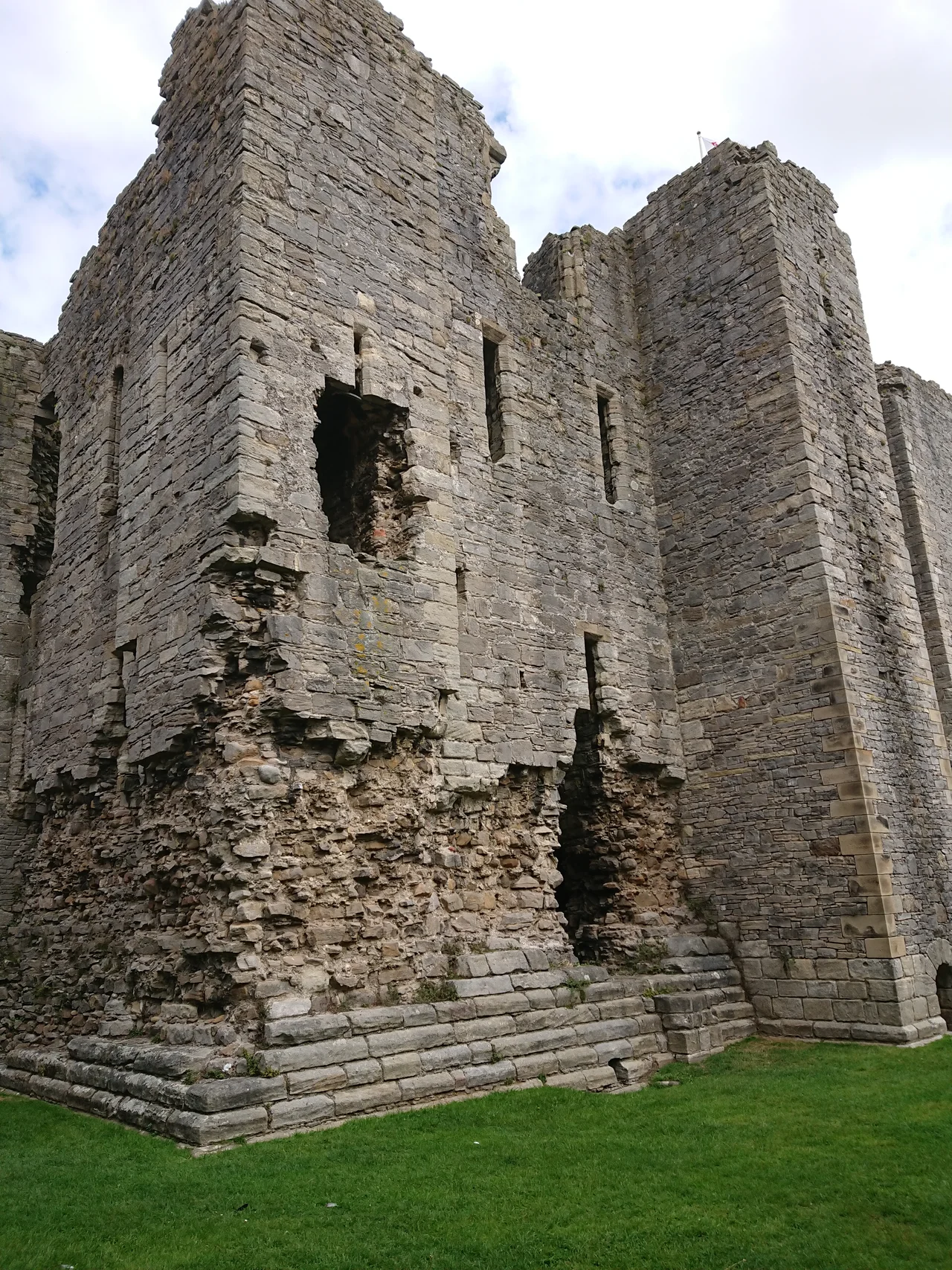

Middleham Castle
Before he was the most controversial king in English history, Richard Plantagenet was a boy in Wensleydale. He arrived at Middleham Castle around 1461, sent north as a ward of Richard Neville, the Earl of Warwick, after his father died at Wakefield. He learned to ride here, learned to fight here, eventually married Warwick's daughter Anne here. The square Norman keep that watched over his lessons still stands above the small market town, roofless now but stubbornly intact. Few buildings on the English landscape carry so much of one man's life inside their walls.
Stone on Stone
Construction began in 1190 under Robert Fitzrandolph, the third Lord of Middleham, on a site chosen to guard the road from Richmond to Skipton. An earlier motte-and-bailey castle stood nearby on William's Hill, where forty feet of earthworks still rise above the surrounding fields. The architectural critic Nikolaus Pevsner thought the older site was better placed for defence than the rebuild, which suggests Fitzrandolph had something other than pure strategy in mind. The keep he raised is enormous. At 105 feet by 78 feet, it ranks among the largest in England. Only two storeys tall, but built so thick that the walls themselves became the architecture, with chambers and stairs threaded inside the masonry. The thirteenth-century curtain wall later wrapped the keep concentrically, and the Nevilles eventually filled the space between with palatial halls. The castle was always more comfortable than truly martial.
The Kingmaker's Ward
The castle passed to the Neville family in 1270, and reached its peak under Richard Neville, the sixteenth Earl of Warwick, the man history calls the Kingmaker. He fought on both sides of the Wars of the Roses, deposing one king and crowning another. When the young Richard of Gloucester arrived at Middleham around 1461, he joined a household that was effectively a school for power. He grew up alongside Warwick's daughters, learning swordsmanship and statecraft from a man who had bent the English crown twice. The wheel turned strangely. In 1469 Warwick captured Richard's own brother, King Edward IV, and briefly held him prisoner inside these same walls. Two years later Warwick died at the Battle of Barnet. Richard, restored to favour, married Warwick's younger daughter Anne and made Middleham his principal residence. Their son Edward was born here around 1473 and died here in 1484, a boy of perhaps ten. Tradition places the birth in the south-west tower, still called the Prince's Tower today, though the only contemporary survey calls it simply the Rounde Towre.
After Bosworth
Richard became king in 1483 and almost never returned to Middleham. His two-year reign ended at Bosworth Field in 1485, the last English king to die in battle. Henry VII seized the castle and the Crown held it for more than a century. Under Elizabeth I, the Earl of Huntingdon wrote to the Lord Treasurer proposing the castle's full demolition and replacement with a manor house suitable for the Queen on royal progress. The plan went nowhere. James I sold the castle in the early seventeenth century, and the new owners had no use for a draughty medieval pile. Villagers helped themselves to the stones. Roofs collapsed. By the time the castle fell to English Heritage and became a Grade I listed monument, the keep was a ruin, but a magnificent one. A repaired spiral staircase in the south-east tower still climbs to a wall-walk with views across Wensleydale, and the old motte of William's Hill is visible to the south-west.
Horses and Pilgrims
Middleham today is a small town wrapped in racehorses. Trainers exercise strings of thoroughbreds across the surrounding moors at dawn, hooves drumming on the same turf that medieval squires once rode. The connection runs deep. The nearby Cistercian monks of Jervaulx Abbey began breeding horses in Wensleydale in the twelfth century, and the tradition never died. Pilgrims of a different kind also arrive in steady numbers. The Richard III Society maintains an active interest in his Yorkshire associations, and visitors come specifically to walk the rooms where the king grew up. A modern bronze statue by Linda Thompson stands inside the keep, a young Richard in armour, looking out across the dale he loved. Whatever you think of the man whose reputation Shakespeare did so much to shape, this is the building that shaped him first.
From the Air
Located at 54.284 N, 1.807 W in Wensleydale, North Yorkshire. The castle ruin sits on the south edge of Middleham village above the River Ure. Best viewed at 2,000-4,000 feet AGL. Recognizable as a roofless rectangular keep surrounded by curtain walls, with the older motte of William's Hill visible to the south-west. Leeds Bradford (EGNM) lies roughly 35 nm south, Teesside (EGNV) about 25 nm north-east. The vast green expanse of the Yorkshire Dales National Park stretches west, with the Pennines as the dominant terrain feature.
Nearby Stories
- RAF Topcliffe 3 km away
- Yarm 4 km away
- Skipton Castle 5.3 km away
- Bowes Museum 5.6 km away
- Forest of Bowland 8.6 km away
- Appleby Castle 9.3 km away
- Battle of Marston Moor 10 km away
- Sedbergh School 12 km away