
Yarm
On 12 February 1821, a group of men met in the George and Dragon Inn on Yarm's High Street and decided to push the third Bill through Parliament for a railway between Stockton and Darlington. Two previous attempts had failed. This one succeeded, and four years later the world's first permanent steam-hauled passenger railway opened. The conversation that started it took place in a market town on a meander of the Tees, in a coaching inn that is still standing. Yarm's High Street, voted Britain's best in a 2007 BBC Breakfast poll, runs past Georgian buildings with red pantile roofs, a town hall from 1710, and the seven-million-brick viaduct that crosses the town on forty-three arches. Tom Brown, who lost his fingers cutting his way through enemy lines at the Battle of Dettingen in 1743, lived in a house here that dates from around 1480.
The Place of the Fish Pools
The name Yarm comes from the Old English gearum, the dative plural of gear, meaning a pool for catching fish. It appears in the Domesday Book of 1086, then a chapelry of Kirklevington in the North Riding of Yorkshire, later a parish in its own right. Dominican friars settled here around 1286 and ran a friary and hospital until 1583, surviving names in the modern town: Friarage and Spital Bank. The Friarage building from 1770 sits over the cellars of the medieval friary and is now part of Yarm School. In 2018, archaeologists announced the discovery of a Viking helmet at Yarm: the first relatively complete Anglo-Scandinavian helmet found in Britain, and only the second Viking helmet from northwest Europe. It is displayed at Preston Park Museum just up the river. Yarm sits on a tight meander of the Tees, with the River Leven joining from the southeast. It was, for centuries, the highest port on the Tees, the limit of navigation.
Bishop Skirlaw's Bridge and the Civil War
Bishop Skirlaw of Durham built a stone bridge across the Tees at Yarm in 1400. It still stands, weathered through six centuries. An iron replacement built in 1805 collapsed in 1806. The medieval bridge has carried traffic ever since, currently the A67 trunk road. On 1 February 1643, during the First English Civil War, a Roundhead force tried to halt a large Royalist waggon-train of arms landed at Tynemouth and bound for the Royalist war effort. The Parliamentarians were heavily outnumbered, the Royalists found fords nearby to outflank them, and the engagement ended quickly. The Royalists took the bridge and crossed into Yorkshire. The waggon train of arms moved on, the Yorkshire campaign continued, and Yarm carried on being a small market town on a Tees crossing.
The Viaduct and the Funfair
The Yarm Viaduct was built between 1849 and 1851 for the Leeds Northern Railway by Thomas Grainger and John Bourne. It is 2,280 feet long, comprises seven million bricks, and has 43 arches, the two over the river skewed in cut stone to take the load of the angled crossing. It still carries trains. Standing on the High Street, you can look up and see arch after arch of red brick striding across the town. Yarm's annual funfair takes over the High Street in the third week of October, the surviving form of the historic cheese and livestock trading fair held under the medieval market charter that King John granted to the town in 1207. Twelve inns operated in Yarm in 1890 alone: Black Bull, Cross Keys, Crown, Fleece, George and Dragon, Green Tree, Ketton Ox, Lord Nelson, Red Lion, Three Tuns, Tom Brown, Union. The town hall on the High Street was built in 1710 by Thomas Belasyse, the 3rd Viscount Fauconberg, lord of the manor.
Tom Brown and the Last Battlefield Knight
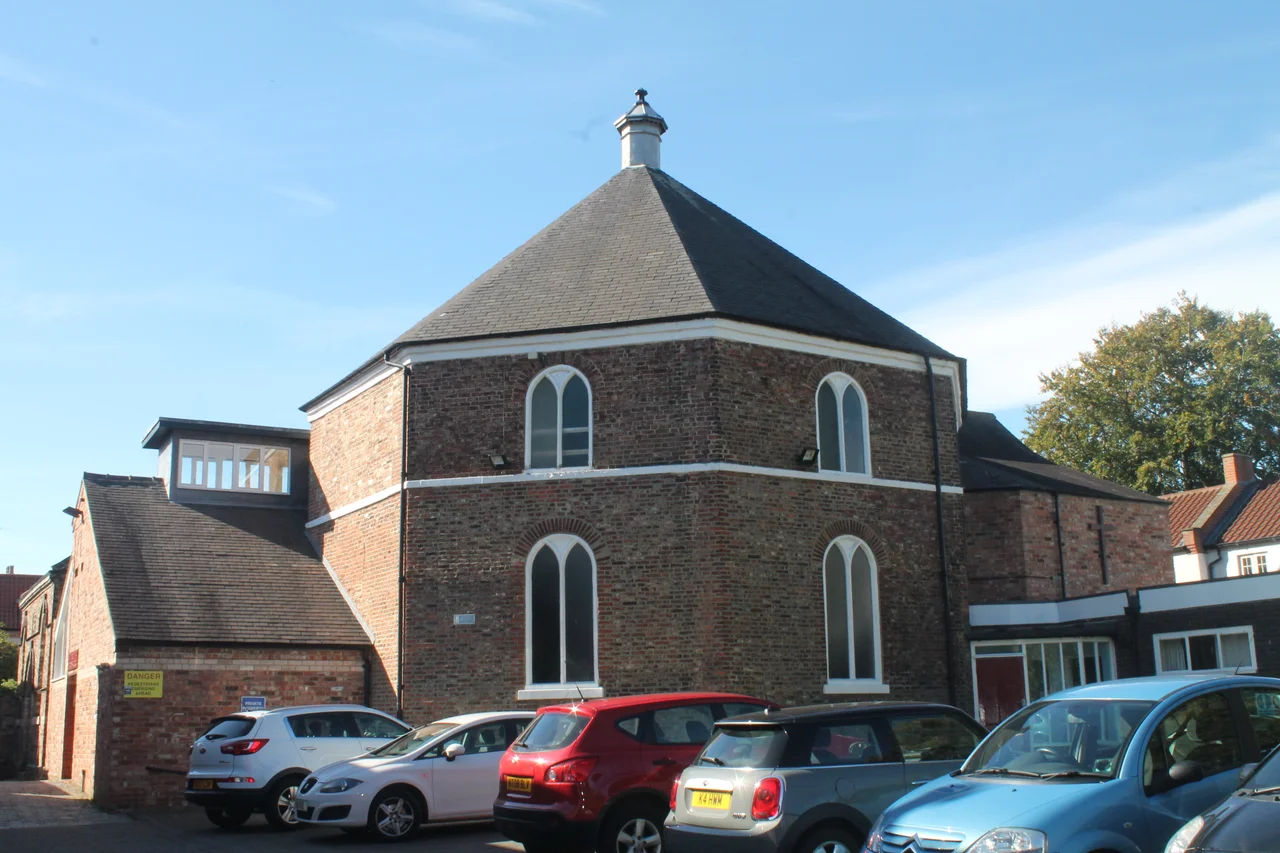
Tom Brown was born around 1705 and raised in Yarm. His house at the south end of the High Street, built around 1480, is the oldest standing dwelling in what used to be the County of Cleveland. On 27 June 1743, at the Battle of Dettingen in Bavaria, Brown was a dragoon when his unit lost its colours to French cavalry. Brown rode after the standard, was wounded multiple times, had two fingers cut from his bridle hand, and brought the colour back. King George II, on the field that day in the last battle ever personally commanded by a British monarch, knighted him on the spot. Brown is generally remembered as the last man knighted on a battlefield. His house still stands. Yarm also produced Janick Gers, the guitarist who joined Iron Maiden in 1990 and has been with the band ever since. Yarm Methodist Church, an octagonal building from 1763, is the oldest octagonal Methodist church still in use anywhere in the world.
From the Air
Yarm sits at 54.51°N, 1.35°W on a tight meander of the River Tees in North Yorkshire, about 5 miles south of Stockton and 11 miles east of Darlington. From the air, the meander and the seven-million-brick viaduct are unmistakable, with the High Street's grid of red pantile roofs lining the inside of the loop. Teesside International Airport (EGNV) is about 3 miles west; Newcastle (EGNT) is roughly 40 miles north. The A19 north-south runs a few miles east, the A66 east-west passes north of town. The Cleveland Hills and the North York Moors rise to the southeast, with Roseberry Topping the most distinctive landmark on the horizon.
Nearby Stories
- Raby Castle 3.1 km away
- Crook Hall 3.4 km away
- Middleham Castle 4.8 km away
- Seaham Hall 7.4 km away
- Rievaulx Abbey 9.9 km away
- Whitby 12 km away
- Scampston Hall 17 km away
- German submarine U-2367 48 km away