.jpg)
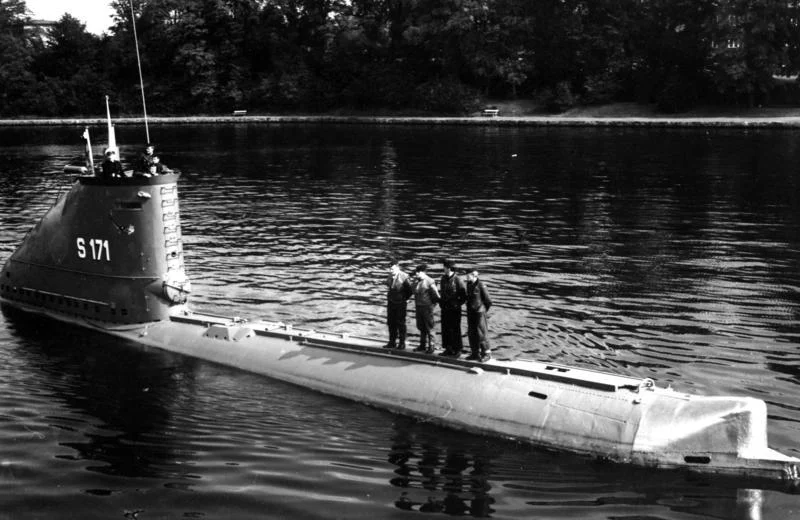
German submarine U-2367
U-2367 was commissioned on 17 March 1945 - fifty-one days before Germany surrendered. There are war records, and then there are war records like that one, where you can read a launch date and a sinking date and realise the entire operational career fits between two pages of a calendar. The Type XXIII was the Kriegsmarine's last-throw small-coastal submarine: fast underwater, hard to detect, devastating in concept. By the time U-2367 came down the slip at Hamburg in early 1945, the war was lost. Heinrich Schroeder took command anyway. Seven weeks later, the boat collided with another German submarine off the Schleimuende beacon and went under. Germany's formal surrender at Reims came two days after.
Type XXIII
The Type XXIII was a wartime answer to a wartime problem. By 1943 the Battle of the Atlantic had turned against Germany, partly because Allied anti-submarine warfare had become brutally effective. The XXIII was a small coastal U-boat designed for fast underwater work in confined waters - the North Sea, the Mediterranean, the Baltic - rather than long Atlantic patrols. She displaced 234 tonnes surfaced, 258 tonnes submerged, and was just 34.68 metres long. The single MWM six-cylinder diesel made 575 horsepower; a double-acting AEG electric motor pushed 580; a small BBC silent-running motor handled creeping. Top submerged speed was 12.5 knots - faster underwater than on the surface, which was a remarkable inversion for the time. She carried two 53.3cm torpedo tubes and just two preloaded torpedoes. No deck gun. Crew: 14 to 18.
Hamburg to Commissioning, In Six Months
U-2367 was ordered on 20 September 1944 and laid down at Deutsche Werft AG in Hamburg on 11 December 1944 as yard number 521. She was launched on 23 February 1945 and commissioned on 17 March under Oberleutnant zur See Heinrich Schroeder. The build had taken three months and one week. The pace reflects both the simplicity of the Type XXIII design and the desperation of late-war German production - assembly was being attempted at a speed that pre-war shipyards would have considered reckless. By the time U-2367 was commissioned, Allied armies were across the Rhine, the Soviets were at the Oder, and the Hamburg yards themselves were operating under Allied bombing. The crew that boarded her had been trained for a war that was already nearly over.
Collision Off Schleimuende
On 5 May 1945, Grand Admiral Karl Doenitz - newly appointed Reichsprasident after Hitler's suicide - issued Regenbogen, the order for German U-boats to be scuttled rather than handed to the Allies. Many crews carried it out. Many others were already trying to escape across the Baltic, ferrying refugees away from the advancing Soviet armies. In the chaos of that day, U-2367 collided with another unidentified German U-boat near Schleimuende, at the eastern entrance to the Schlei fjord. She sank. The crew, by most accounts, survived the incident. The ceasefire for German forces in northwest Europe had taken effect that same day; the formal surrender at Reims was three days away. The wreck settled into the shallow Baltic at a position that has been precisely recorded but not widely published.
Raised, Renamed, Sailed Again
U-2367 did not stay on the seabed. In August 1956, with West Germany now a NATO member and rebuilding a small navy as the Bundesmarine, divers raised her from the Baltic. Eleven years on the bottom had done less damage than might have been expected to the simple Type XXIII hull. She was overhauled and commissioned on 1 October 1957 as Hecht - the German word for pike, a name appropriate to a small fast hunter. She served the new navy until 30 September 1968, when she was struck from the list and broken up at Kiel in 1969. Her career thus reads in two halves: 51 days as a Kriegsmarine boat that never saw combat, and eleven years as a Bundesmarine training submarine, learning the trade of postwar submarining for a country that had decided not to start any more wars.
From the Air
The site of U-2367's loss is in the western Baltic near Schleimuende, the lighthouse and beacon at the mouth of the Schlei fjord on Germany's Baltic coast - the source coordinate of 55.0 degrees north, 0.0 degrees east is a placeholder rather than an accurate position. The actual sinking site is closer to 54.67 degrees north, 10.04 degrees east, well inside German waters. From 2,000-3,000 feet the broad opening of Kiel Bay is visible, with the city of Kiel to the west and the Danish island of Als to the north. Hamburg Airport (EDDH) is roughly 50 nautical miles to the south-west; Kiel-Holtenau (EDHK) is the closest GA field. The Baltic here is shallow, around 20 metres in most places, which made the postwar recovery of U-2367 considerably more practical than it would have been in deeper waters.
Nearby Stories
- Staithes 14 km away
- Breagh Gas Field 26 km away
- Whitby Abbey 34 km away
- HMS Unity (N66) 39 km away
- River Wear 42 km away
- Raid on Scarborough, Hartlepool and Whitby 44 km away
- HMS Nottingham (1913) 76 km away
- Alexander L. Kielland (Platform) 222 km away