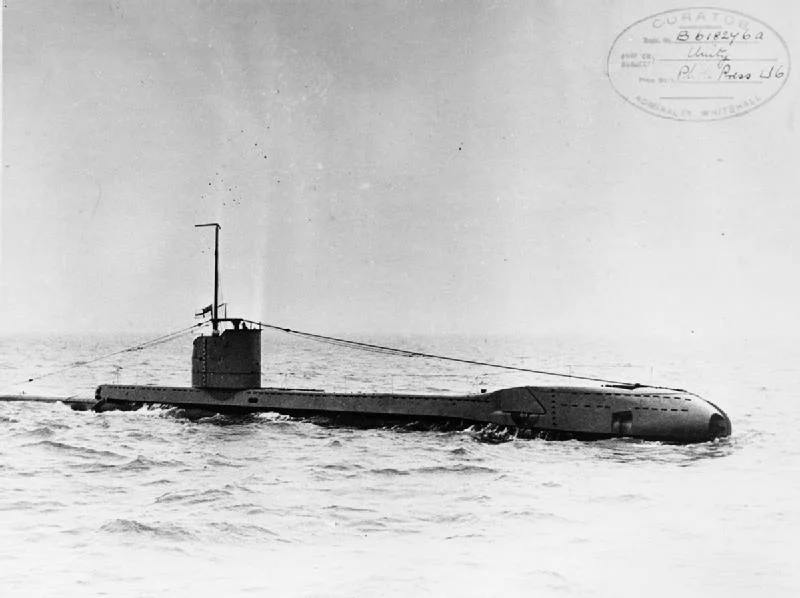

HMS Unity (N66)
Lieutenant John Low and Able Seaman Henry Miller did not have to stay. When the Norwegian freighter Atle Jarl came out of the haze and slammed into HMS Unity off the Northumberland coast on 29 April 1940, the submarine had perhaps five minutes left on the surface. Low and Miller knew the layout of the control room better than anyone else aboard. They knew which valves had to be held, which doors needed someone to manage them, what had to happen for the rest of the crew to get out through the hatch above. So they stayed below, working in seawater, while their shipmates climbed up. The submarine slid under. Both men went with her.
A Small Boat for a Big War
HMS Unity was a U-class submarine, the first group of that compact pre-war design built for the Royal Navy. She was laid down at Vickers Armstrong in Barrow-in-Furness on 19 February 1937 and commissioned on 5 October 1938, less than a year before the war that would dictate her short career. The U-class was small by submarine standards - manageable in coastal waters, useful for training and patrol work - and Unity joined the 6th Submarine Flotilla. When war came in September 1939, the flotilla deployed to its war bases at Dundee and Blyth on the Northumberland coast, and Unity began the kind of patrol work that would keep her in home waters: looking for German shipping in the North Sea, returning empty-handed more often than not.
Rescue and Near-Loss
Two incidents in the spring of 1940 hint at the texture of those patrols. On 25 March, Unity came across the survivors of the Dutch fishing vessel Protinus and pulled them aboard. The fishermen had been adrift after their boat was lost; the Royal Navy submarine became, for a few hours, a rescue ship. Less than three weeks later, on 11 April, Unity was herself the target. A German Type IIa coastal submarine, U-5, under Kapitanleutnant Lehmann, spotted her and fired a steam-powered T1 torpedo. Unity's lookouts caught the bubble trail in time. She crash-dived in heavy seas. U-5 attempted an underwater shot with a T2 electric torpedo and lost contact in the rough water. Unity escaped unharmed. The patrol continued.
The Collision Off Blyth
On 29 April 1940, Unity sailed from Blyth for a patrol off Norway, where the Germans had recently invaded and where Royal Navy submarines were trying to interdict the supply lines feeding the invasion. She did not get far. In poor visibility just off Northumberland, the Norwegian freighter Atle Jarl came across her at speed. Submarines on the surface in 1940 were essentially small low-profile steel boats and very easy to miss in a sea way. Whether the ships saw each other in time has been debated; either way, the collision was decisive. The freighter's bow opened the pressure hull and water flooded in fast. Within five minutes Unity was on her way to the bottom. Her crew began the climb out through the conning tower hatch while Low and Miller, in the flooded control room, held the boat together long enough to let them go.
What the Wreck Holds
The Unity wreck lies in relatively shallow water off the Farne Islands, between roughly 48 metres and the seabed. Technical divers can reach her, and do. She is one of a small constellation of Second World War submarine wrecks in the North Sea that mark not great battles but the everyday hazards of wartime sailing: collisions, mines, accidents in poor weather, the friction of operating warships at speed in shared sea lanes. Lieutenant Low and Able Seaman Miller are commemorated in the formal Royal Navy lists alongside the dozens of other British submariners lost in 1940. Their names also appear, by tradition and through the work of submarine veterans, whenever the story of Unity is told. The act they performed in the flooded control room is the reason most of their crew survived to be told about.
From the Air
The site of HMS Unity's loss lies near 55.22 degrees north, 1.32 degrees west, in the southern North Sea off the Northumberland coast, with the wreck resting off the Farne Islands. At 3,000-5,000 feet on a clear day the Farne archipelago is identifiable as a string of small rocky islands roughly 1.5 nautical miles offshore. Newcastle International (EGNT) is the nearest major airport, about 18 nautical miles to the south-west; Blyth itself, where Unity was based and from which she sailed on her final patrol, lies south down the coast. The area is part of the Northumberland coast Site of Special Scientific Interest, with seabird colonies and grey seal populations clustered on the offshore rocks.
Nearby Stories
- George Stephenson's Birthplace 5.4 km away
- Cragside 8.8 km away
- Marsden Rock 10 km away
- German submarine U-1274 12 km away
- Lindisfarne Castle 14 km away
- German submarine U-2367 45 km away
- Whitby Abbey 89 km away
- Alexander L. Kielland (Platform) 258 km away