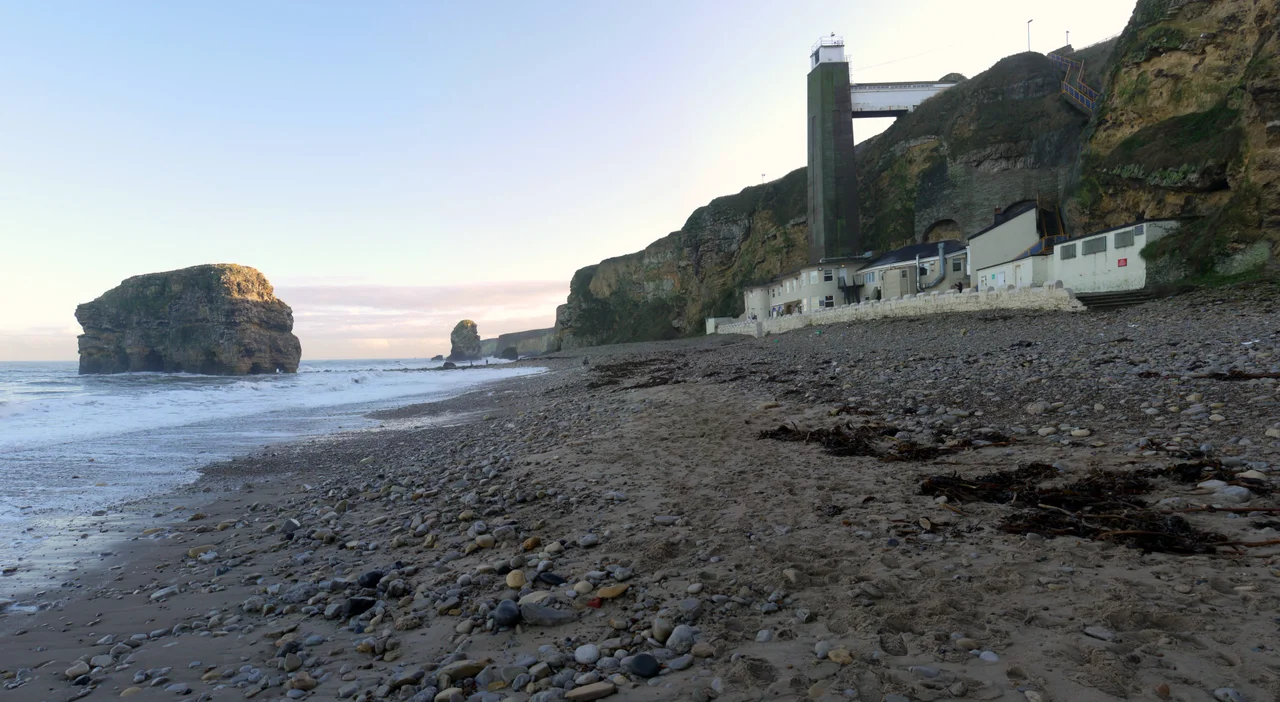

Marsden Rock
For two centuries, ships at high tide could sail right through Marsden Rock. The arch was that big. By the late 1800s, the limestone sea stack standing off the South Shields coast had become one of the most-painted, most-photographed, most-postcarded landmarks in north-east England. Thomas Bewick engraved it in 1798. John Jackson engraved it again in the 1830s. The Marsden Lodge Banner used it as a symbol of the pitmen of Whitburn Colliery beneath the phrase Firm as a rock we stand. Then in early 1996, after a winter of brutal storms, the top of the arch collapsed.
Deep Time, Tropical Swamp
Two hundred and fifty million years ago, Marsden was a desert in the southern hemisphere. The continent that now holds Britain sat on the equator during the Carboniferous Period, covered in tropical swampland that would eventually compress into coal. Continental drift carried the land north. Around 260 million years ago the area lay under the Zechstein Sea, a saline inland sea that periodically dried and flooded across what is now northern Europe. The Magnesian Limestone that Marsden Rock is carved from precipitated out of that ancient sea in the Permian period, about 250 million years ago. The continent continued its slow drift north for the next quarter-billion years until it arrived where Britain is now. The ice age that ended around fifteen thousand years ago shaped the cliff line into something close to what you see today.
The Winter the Arch Came Down
Marsden Rock has been falling apart in stages for centuries. In 1865 a five-ton section of rock broke off and crashed through a building below. The natural arch carved by wave action had been growing since the 1800s when it first became navigable by sailing boats at high tide. In early 1996 the top of that arch collapsed. The single stack became two. The smaller of the two stacks was inspected and judged unstable - in danger of collapsing onto the beach below. The National Trust demolished it in 1997 in the interest of public safety. The remaining stack still stands at ninety feet high, ninety yards offshore, reachable on foot at low tide and completely surrounded by water at high. A 2020 survey called the rock broadly stable. Local cave collapses remain possible. The arch is not coming back.
Where the Seabirds Nest
The Magnesian Limestone cliffs around Marsden Rock are among the most important seabird breeding colonies in north-east England. In summer the cliffs and the rock itself fill with fulmars, cormorants, kittiwakes, herring gulls, and razorbills. Kittiwakes nest in noisy white-and-grey cliffs of birds clinging to ledges only inches wide. Razorbills - black-and-white relatives of the puffin - prefer the higher shelves. The colony is loud, smelly, and one of the great natural spectacles of the English east coast. The birds were here long before the smugglers and the pubs and the tourists with their postcards. They will be here when the next stack collapses.
Eccentrics and Engravings
The rock attracted strange residents. Jack the Blaster Bates moved into a cave at its base around 1782 after declaring he was finished with landlords. Peter Allan built a fifteen-room cave-home in the cliff beside it in the 1820s, then turned Allan's improvised excavations into stairways up the side of the rock itself. By 1887 thousands of holidaymakers had climbed those stairs to stand on top of the stack. The view across Marsden Bay was already a Victorian tourist destination. The artists came too - Thomas Bewick's 1798 wood engraving appeared in his celebrated Book of British Birds in 1804. John Lodge wrote an Ode to Marsden Rock for his 1842 poetry collection dedicated to Prince Albert. John Young published The Legend of Marsden Rock in 1800, a four-part poem and ghost story about a hermit called Little Spottee said to live on the stack. Catherine Cookson's televised dramas used the rock as backdrop more than a century later. A piece of coast can carry that much meaning. It can also lose its arch in a single winter.
From the Air
Marsden Rock stands offshore at 54.978 N, 1.375 W, about 90 metres off the South Shields coast. Cruise at 1,500-3,000 feet to take in the full sweep of the cliff line from Souter Lighthouse to South Shields; the rock is unmissable as a freestanding limestone tower offshore. Marsden Grotto sits on the cliff directly opposite. Newcastle International (EGNT) lies 8 nautical miles west-north-west; Durham Tees Valley (EGNV) 27 nautical miles south. The seabird colonies are most active March through July. Approach from the south for the classic postcard angle that the Victorian engravers used.
Nearby Stories
- Seaton Carew 2.7 km away
- HMS Unity (N66) 6 km away
- George Stephenson's Birthplace 6.1 km away
- Raby Castle 9 km away
- Cragside 15 km away
- Whitby Abbey 21 km away
- German submarine U-2367 46 km away
- Alexander L. Kielland (Platform) 277 km away