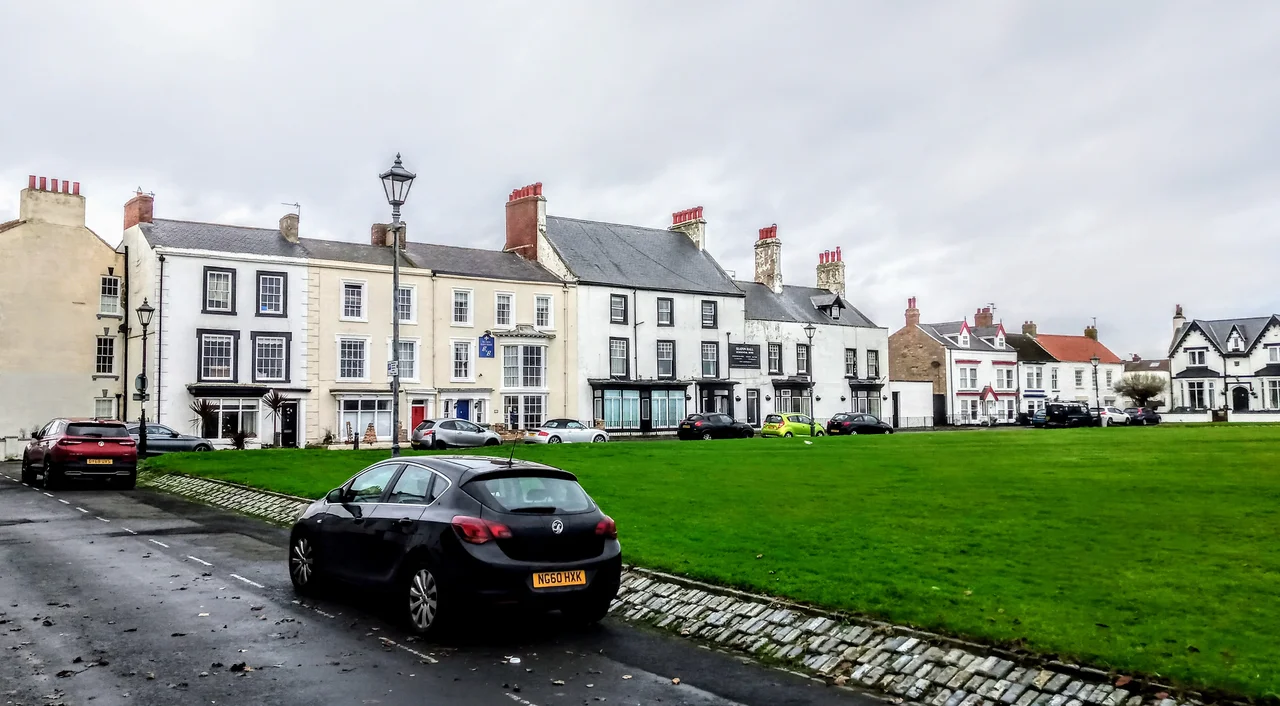

Seaton Carew
On the night of 27 November 1916, Lieutenant Ian Pyott of No. 36 Squadron lifted his BE 2C biplane off the airstrip at Seaton Carew and chased a Zeppelin into the dark. Five miles out over the North Sea, he caught it. The airship L 34 was at about ten thousand feet, returning home after bombing Hartlepool. Pyott fired bursts into its hull. Something inside ignited. The L 34 caught fire, fell out of the sky engulfed in flames, and went into Tees Bay with the loss of all crew. The flash was seen from Melton Mowbray, almost 200 miles away. Today the airstrip is gone, replaced by an industrial estate, and Seaton Carew is back to being what it was before the war: a Durham coast seaside resort with four miles of sand, a Grade II Art Deco bus station, and views north to Hartlepool.
Carew, Carrowe, Carew
The settlement is older than its Victorian seafront suggests. Roman coins and building remains turn up on the beach. During the reign of Henry I, the manor came into the hands of Robert de Carrowe, and Seaton picked up his family name. By the medieval period, salt extraction had become a local industry, the ash from boiling sea water dumped on North Gare where it now forms grass-covered mounds on the golf course. A Gilbertine cell linked to Sempringham Priory existed somewhere in the area, though no trace has been found. The town's identity flipped in the early nineteenth century when sea bathing became fashionable and middle-class visitors built rows of stucco houses around The Green, a turfed square facing the North Sea. The Durham and Yorkshire Golf Club, now Seaton Carew Golf Club, was founded in 1874 by Duncan McCuaig and is the tenth-oldest in England. Alister MacKenzie advised on the course redesign in 1925.
Lighthouses, Lifeboats, and a Zinc Smelter
In 1838, the Tees Navigation Company built a pair of leading lights at Seaham Carew to guide ships into the river. The Low Light stood on what is now Coronation Drive, the High Light over a thousand yards inland at the end of Windermere Road. They were decommissioned in 1892. On 31 January 1907, the steamship SS Clavering ran aground at North Gare in a northerly gale, and the Seaton Carew and Hartlepool lifeboats together pulled thirty-nine people off her in a 31-hour rescue. Coxswains Shepherd Sotheran and John Franklin both received RNLI Silver Medals. A zinc smelter operated at North Gare from 1907 onward, processing tailings shipped from Broken Hill in New South Wales. The mineral was roasted to extract zinc, lead, and silver, with sulphuric acid as a byproduct. The works passed through Central Zinc, the Sulphide Corporation, and the Imperial Smelting Corporation.
The Canoeist Who Came Back
In March 2002, John Darwin's canoe washed up on Seaton beach. He was presumed drowned, his life insurance paid out, his wife Anne living in their seafront home in Seaton Carew. In December 2007, Darwin walked into a London police station and reported himself a missing person. He had spent five years hiding, much of it next door to his own house and his own wife. The fraud investigation that followed reached across the world and into Panama, where the Darwins had been planning their next life. A local prankster put up a sign near the railway station: 'Welcome to Seaton Canoe - Twinned with Panama.' The Hartlepool Town Council, less amused than most of the country, had it removed. The Stig on Top Gear later got a backstory line: 'Some say that he once lost a canoe on a beach in the north east.' Seaton Carew remains the only seaside resort in England with an internationally recognised satirical sister-town in Central America.
Beach, Bus Station, and Buried Boats
Four miles of sand stretch north from the Tees estuary to Hartlepool Marina. The Environment Agency rated the main beach 'excellent' for bathing water in 2019, and Keep Britain Tidy gave it a Seaside Award. The Art Deco bus station in southern Seaton Carew is a Grade II listed survivor of 1930s seaside ambition, its clock tower newly restored. Just south of it, a beachside car park overlooks the Seaton Carew Wreck, the timber bones of an eighteenth-century collier emerging from the sand at low tide. There are other wrecks here too, in the beach and just offshore. The Danish schooner Doris hit Longscar Rocks in a gale in September 1930 and her remains lie embedded in the sands at North Gare. Hartlepool Nuclear Power Station sits a couple of miles south on Seaton Channel. Frutarom, formerly Oxford Chemicals, still makes 'High Impact Aroma Chemicals' for the food industry at the end of Zinc Works Road. The promenade now runs all the way north to Hartlepool Marina.
From the Air
Seaton Carew sits at 54.66°N, 1.19°W on the County Durham coast, on the north side of the Tees estuary, with Hartlepool just north and Middlesbrough/Teesport across the river to the south. From above, the four-mile sand beach, the breakwaters at North Gare, the bulk of Hartlepool Nuclear Power Station, and the buried wreck visible at low tide are the key features. Nearest airports: Teesside International (EGNV) about 15 miles southwest, Newcastle (EGNT) 35 miles north. The Durham Coast Line railway runs immediately west of the town. North Sea visibility on a clear day reaches almost as far as Whitby down the Yorkshire coast.
Nearby Stories
- Raby Castle 3.1 km away
- Crook Hall 3.4 km away
- Middleham Castle 4.8 km away
- Seaham Hall 7.4 km away
- Rievaulx Abbey 9.9 km away
- Whitby 12 km away
- Scampston Hall 17 km away
- German submarine U-2367 48 km away