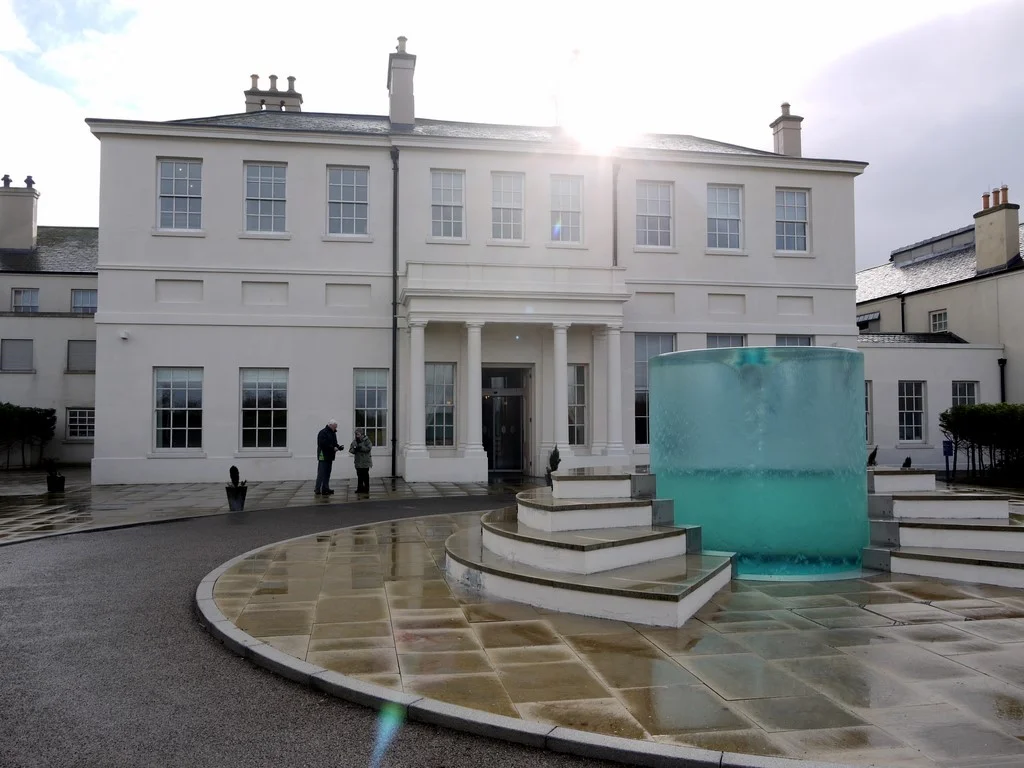

Seaham Hall
On 2 January 1815 the most famous and scandalous poet of the age stood in the drawing room of Seaham Hall and married Anne Isabella Milbanke. Lord Byron was 27. The bride was the daughter of Sir Ralph Milbanke, sixth Baronet, who had built the hall in the 1790s. The marriage was a disaster within a year, but its single daughter, Ada, would grow up to write what is now considered the first computer program. Ada Lovelace was conceived under this roof. The building survives, currently rebranded as a five-star spa hotel.
Byron's Brief Stay
Sir Ralph Milbanke built Seaham Hall in the 1790s as a substantial country house on the County Durham coast, looking out toward the North Sea. His daughter Annabella was a serious-minded young woman with a strong interest in mathematics, the precise opposite of the man she chose to marry. Byron's biographers have argued for two centuries about why he proposed, and why she accepted. What is certain is that the wedding happened in this house, the couple honeymooned for a fortnight nearby, and their daughter Augusta Ada was born in December that year. Within weeks of Ada's birth Annabella had left Byron, taking the baby. Byron fled England for the Continent the following spring and never saw his daughter again.
The Londonderry Years
In 1821 the estate was sold for £63,000 to Charles Vane, third Marquess of Londonderry, who had recently married Lady Frances Vane-Tempest. She was one of the greatest heiresses of the age, standing to inherit nearly 65,000 acres in her own right. The Londonderrys turned Seaham into a development project, building the harbour town of Seaham itself on the cliffs nearby as a coal-export port designed to rival Sunderland. The Viscount Seaham title was created as a courtesy designation for their eldest son, who later inherited the senior Londonderry titles when the fourth Marquess died without children. For all the family's investment in the place, however, the Londonderrys preferred their other houses. Benjamin Disraeli visited in 1861. Otherwise the hall stood quietly most of the year while its owners lived at Plas Machynlleth in Wales or at Mount Stewart in County Down.
Hospital and Decline
When the sixth Marquess died in 1915, the seventh Marquess offered Seaham Hall to the authorities for use as a wartime hospital. Wounded soldiers from the trenches of the Western Front were brought to this Durham coast country house to recover. The hospital function continued long after the war, becoming a general hospital that served the surrounding area until it finally closed in 1978. For the next several years the building stood empty and deteriorating, its grand rooms stripped of fittings, its grounds going to ruin. The fate that befell so many British country houses in the twentieth century seemed about to claim Seaham Hall as well.
Five Stars on the Cliffs
Rescue came in stages. In 1984 the Jalal family of Sunderland acquired the hall and undertook the rebuilding, reopening it as the Seaham Hall Hotel in 1985. Six years later they sold to a local doctor, Mohinder Singh Mullea, who converted the building to a residential home for elderly people. In June 1997 the businessman Tom Maxfield and his wife Jocelyn bought the property and undertook a deeper transformation, turning the rundown structure into a luxury five-star hotel and spa with views across the North Sea. Guests today walk corridors where Byron once paced, dine in rooms where the Londonderrys entertained, and bathe in spa pools the original architect could not have imagined. The hall has outlived its scandals, its wars, and its decline.
From the Air
Seaham Hall sits at 54.848 north, 1.346 west on the County Durham coast just north of Seaham town and about 5 miles south of Sunderland. Recommended viewing altitude 1500 to 2500 feet. From the air the substantial country house and its grounds stand on the clifftop overlooking the North Sea, with the harbour town of Seaham to the south. Nearby airports: Newcastle International (EGNT) is roughly 19 nautical miles north-northwest; Durham Tees Valley (EGNV) is about 17 nautical miles south. The Durham Heritage Coast runs along the bluffs immediately east. Coastal weather features frequent easterly winds in winter and sea fret in spring.
Nearby Stories
- Seaton Carew 2.7 km away
- HMS Unity (N66) 6 km away
- George Stephenson's Birthplace 6.1 km away
- Raby Castle 9 km away
- Cragside 15 km away
- Whitby Abbey 21 km away
- German submarine U-2367 46 km away
- Alexander L. Kielland (Platform) 277 km away