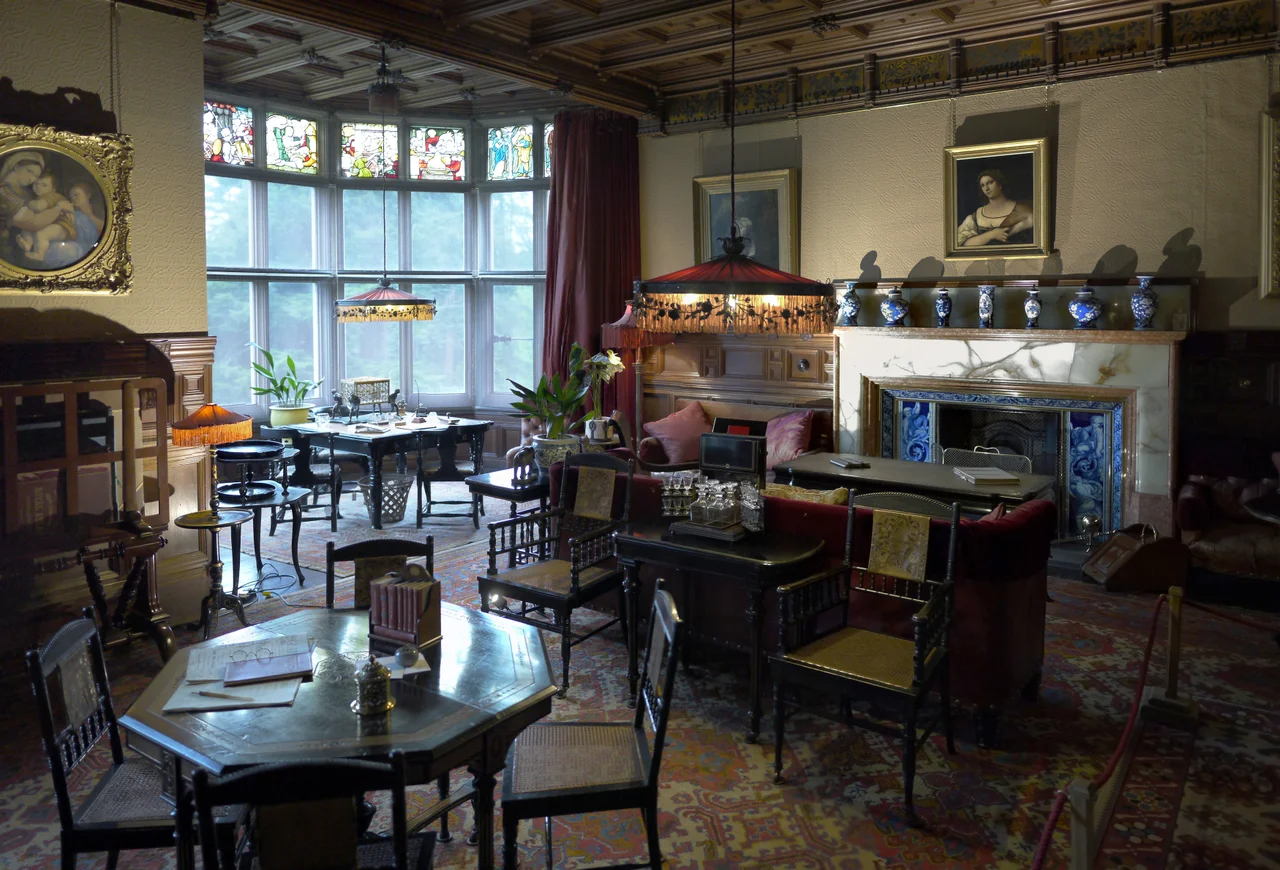

Cragside
In 1878, an arc lamp came on in a picture gallery at Cragside in Northumberland. The current was generated by water - a stream flowing through a series of artificial lakes that William Armstrong had had carved into the hillside, driving a turbine in a powerhouse below. Two years later, in 1880, Joseph Swan replaced the arc lamp with his new incandescent bulbs in what Swan himself called 'the first proper installation' of electric lighting anywhere. Historic England describes Cragside as the first house in the world to be lit by electricity derived from water power. The house belonged to a man who had made his fortune building artillery. He used it to build a future.
Armstrong's Idea of a Country House
William Armstrong made his money at Elswick Works on the Tyne, manufacturing hydraulic machinery, cranes, and naval guns. He was an engineer first, a baron second. The house at Cragside, designed by Richard Norman Shaw and extended over decades, was Armstrong's working laboratory as much as his retreat. He chaired the meeting at the Literary and Philosophical Society of Newcastle upon Tyne at which Joseph Swan first presented his new incandescent lamps. He knew Swan personally. When the time came to wire his own house, he had the inventor of the bulb on hand. Cragside was lit when Buckingham Palace was still burning gas. The water that powered the lights ran through a series of artificial lakes Armstrong had constructed on the hillside, then through a turbine, then back to the lake system. The same hydropower drove a hydraulic lift, a rotating spit in the kitchen, and a hydraulic dishwasher. It was a working demonstration of what a wealthy engineer could do with falling water.
Seven Million Trees
When Armstrong bought the original site, it was bare moorland. By the 1880s the gardens and grounds had grown to about 1,700 acres, with his wider estate including agricultural holdings extending to 15,000 acres according to Henrietta Heald's 2012 biography, and over 16,000 acres according to David Cannadine. The traditional claim, recorded by David Dougan, is that Armstrong planted over seven million trees in the gardens and parkland. The plantings include the tallest Scots pine in Britain, measured by the BBC and others at 131 feet. Over a century after planting, the writer Jill Franklin described the woodland as having become 'a protective barrier' around the house. The estate is now a sanctuary for some of the last remaining red squirrel colonies in England - grey squirrels having mostly displaced the natives elsewhere. Walking through the grounds, you are walking through a Victorian engineer's vision of what a managed landscape should look like, fully matured.
The Iron Bridge and the Clock Tower
Northwest of the house, the glen of the Debdon Burn is crossed by an iron bridge that Armstrong designed himself and had cast at his Elswick Works in the 1870s. It is a Grade II* listed structure. The National Trust restored it and reopened it to the public in 2008-2009. The gardens themselves are Grade I listed - the highest grade. Several of the architectural and technical structures around the estate have their own separate historic listings. The Clock Tower, which regulated the rhythm of work on the estate, dates from the early days of the original shooting lodge that Armstrong's house grew out of. It is not by Shaw. It may have been designed by the same unknown architect as the original lodge. It is possible Armstrong designed the clock mechanism himself - he was capable of it, and the estate's records suggest he often did such things. The formal gardens, where his greenhouses once stood, were long separated from the main estate but have now been reunited with it under National Trust ownership.
Modern Appearances
Cragside has had a busy second career on television and film. It featured in an Open University Arts Foundation course, in Jonathan Meades's documentary series Abroad Again in Britain, on BBC One's Britain's Hidden Heritage, on Glorious Gardens from Above, on Great Coastal Railway Journeys, on Hidden Treasures of the National Trust, and on ITV's Inside the National Trust. The 2017 biographical film The Current War, about the Edison-Westinghouse rivalry, was partly filmed at the estate. There is a particular rightness to that - the house that first married water power and electricity used as the set for a film about the war between the first two great electrical grid technologies. Cragside also stood in for Lockwood Manor in Jurassic World: Fallen Kingdom, a less obvious match. The house remains substantially as Armstrong left it. The bulbs are still lit by the same water that lit them in 1880.
From the Air
Cragside sits at 55.31 degrees north, 1.89 degrees west, on a wooded hillside just north of Rothbury in central Northumberland. Newcastle International Airport (EGNT) lies approximately twenty-two nautical miles south-southeast. From altitude, look for the dramatic break between the Coquet valley around Rothbury and the higher moorland rising to the north - Cragside is on the south-facing slope, surrounded by mature woodland that conceals the house itself but reveals the artificial lakes and the Debdon glen. The Cheviot Hills rise to the west; the North Sea is fifteen nautical miles east. Visibility over the central Northumberland uplands is often outstanding on northwesterly flows.
Nearby Stories
- MS Oslofjord (1937) 2 km away
- Aydon Castle 5.2 km away
- German submarine U-1274 5.9 km away
- Battle of Homildon Hill 7.6 km away
- SM UB-115 7.8 km away
- Kielder Forest 9.4 km away
- Smailholm Tower 9.7 km away
- Battle of Arfderydd 29 km away