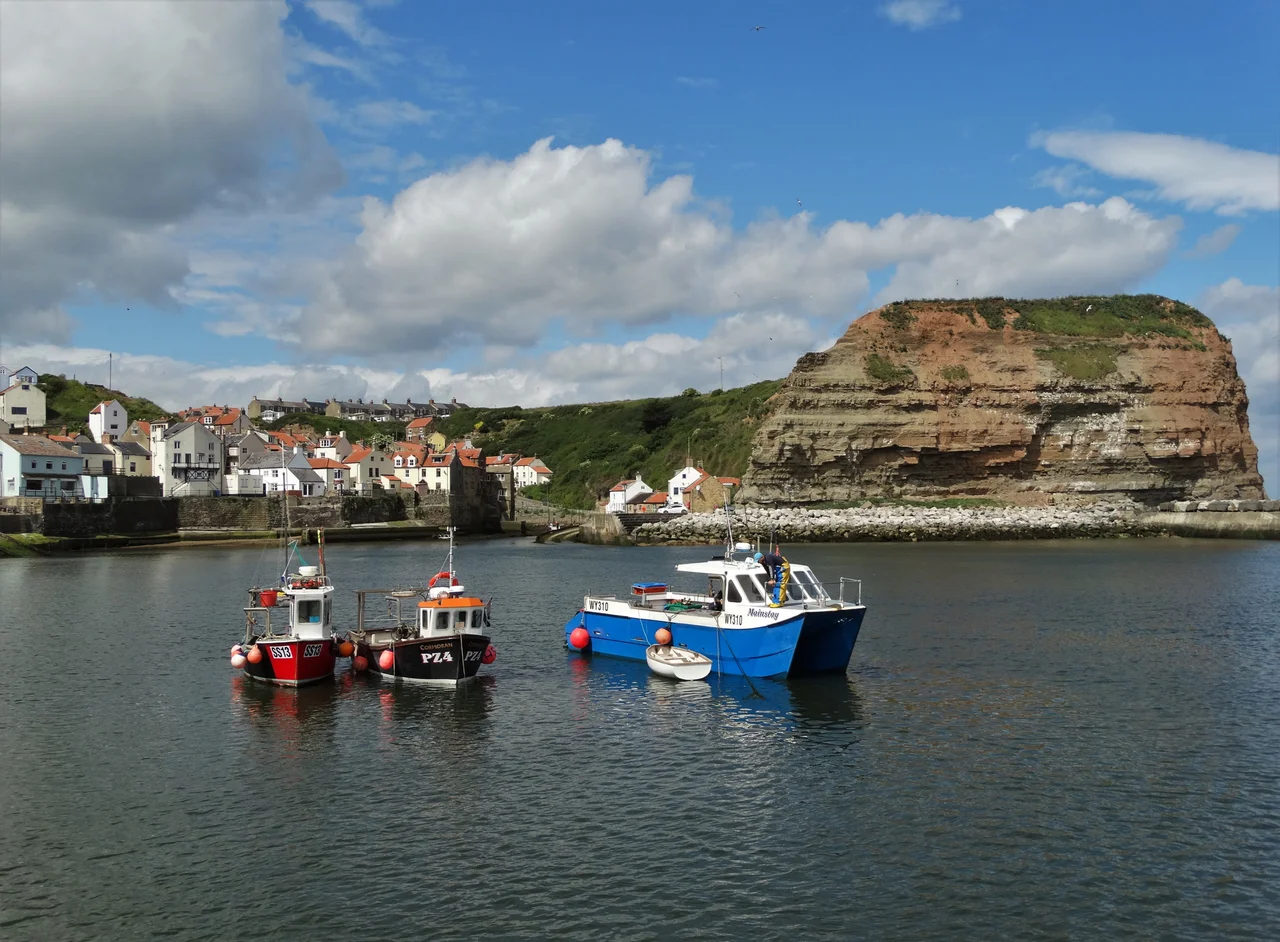

Staithes
In 1745, a sixteen-year-old farmer's son from the moors named James Cook came down to Staithes to apprentice himself to a grocer and haberdasher called William Sanderson. He stood behind a counter for eighteen months, weighed out tea and tobacco, watched the cobles pull in and out of the harbour, and decided that retail was not going to be his future. He bound himself instead to a Whitby shipowner and went to sea. The shop where Cook had wasted his time was eaten by a storm tide around 1850; some of its timbers were salvaged and built into Captain Cook's Cottage on Church Street, where they still are. The village he ran away from is a tighter, stranger, more enclosed place than Whitby - and that is precisely why he had to leave.
A Cleft in the Cliff
Staithes is wedged into a narrow ravine where the small Staithes Beck cuts the coast. Two long breakwaters protect the harbour from the North Sea swell. High cliffs rise immediately behind the village - Cowbar Nab to the north, Penny Steel to the south. The old village, the part the tourists come for, is so steep that motor traffic is essentially impossible. Houses are stacked one above another in red pantile and limewashed stone. There are alleys here so narrow that the Royal Mail asked residents in 1997 to start numbering their houses instead of using names, because relief postal staff could not find anything. The most famous of those alleys, Dog Loup, is just 18 inches wide - claimed locally as the narrowest alley in the world.
Eighty Boats, Then None
At the turn of the twentieth century, eighty full-time fishing boats put out from the Staithes harbour. The crews used cobles - a flat-bottomed, high-prowed wooden boat designed specifically for being launched and landed through surf, a North Yorkshire design unlike any other on the British coast. A hundred years later there are still a few part-time fishermen working out of Staithes, but the industry that defined the village has effectively gone. What replaced it is tourism. The narrow streets, the harbour, the seventeenth-century cottages - these have become an asset rather than a livelihood. Bob Mortimer and Paul Whitehouse filmed a Christmas special of Gone Fishing here in 2020. A local guide told the Guardian that interest in the village afterwards had gone, in her exact word, ballistic.
Don't Say the Word
Among Staithes fishermen, there is a superstition you do not say aloud the word pig. To say it brings bad luck. A fisherman who heard it would refuse to go to sea that day. If you needed to refer to the animal, you used a different word: grecian, grunter, oinker, four-legged creature - or you spelled it out, letter by letter. The substitute term grecian has no connection to Greece; local historians think it might come from Old Norse, but they cannot prove it. The taboo, which once applied to all four-legged animals, narrowed over time to pigs alone, and survives in the village in the twenty-first century. There is, naturally, a pig farm on the cliff overlooking Staithes - placed there by a non-believer at some unrecorded date - which the more superstitious villagers will not look at directly.
The Mermaids' Curse
There are also mermaids in the Staithes story. The legend, as told by Robert Brown to the Staithes Study Group in 1924 and published that year in the Whitby Gazette, runs like this: two mermaids came to Staithes; the villagers captured and imprisoned them; they escaped. As one mermaid was leaving, she cursed the village - one day, she said, the sea would flow as far as Jackdaw's Well. When the other mermaid scolded her for revealing this, she answered: I have not told them what the egg broth comes to. The egg-broth motif is genuinely strange and has puzzled folklorists. Sarah Peverley and Chloe Middleton-Metcalfe argue it points to an older origin for the legend - perhaps the eighteenth century, when negative associations between eggs, witches and mermaids were better understood. Jackdaw's Well itself was eaten by a landslide before Brown ever told the tale, which adds to the unreliability.
The Northern Impressionists
From around 1880 to 1914, about fifty painters made Staithes their summer home, working en plein air in oils and watercolour - inspired by the French Impressionists, painting the working fishing village around them. They were called the Staithes Group, or sometimes the Northern Impressionists. Dame Laura Knight and her husband Harold Knight were the most famous, but the colony also included Edward E. Anderson, Joseph R. Bagshawe, Thomas Barrett, James W. Booth and many others. The light off the North Sea, the women in their distinctive black bonnets mending nets, the cobles drawn up on the slip - all of it was painted thousands of times in those decades, and some of those paintings now sell at major auctions for serious money. The village still looks largely the way they painted it. The Staithes Festival of Arts and Heritage, held every September since 2012, descends from this legacy directly.
From the Air
Staithes sits at 54.5564 degrees N, 0.79561 degrees W, on the North Yorkshire coast roughly 10 miles north of Whitby. Nearest aviation reference is Teesside International (EGNV) about 40 km west-northwest. From 2,000 to 3,000 ft AGL the village reads as a tight knot of red pantile roofs jammed into a steep gorge between Cowbar Nab and Penny Steel, with the harbour breakwaters making a clear V shape into the sea. Boulby Cliff is two miles west - at 203 m, the highest cliff on the east coast of England, with the visible scars of old alum workings. Best light is mid-morning when the eastern sun reaches into the narrow harbour mouth.
Nearby Stories
- Ryedale Folk Museum 3 km away
- 1892 Thirsk Rail Crash 5.5 km away
- Penshaw Monument 6.5 km away
- Darlington 12 km away
- Filey Brigg 12 km away
- German submarine U-2367 28 km away
- Seaham Hall 30 km away
- Battle of Flamborough Head 49 km away