
Darlington
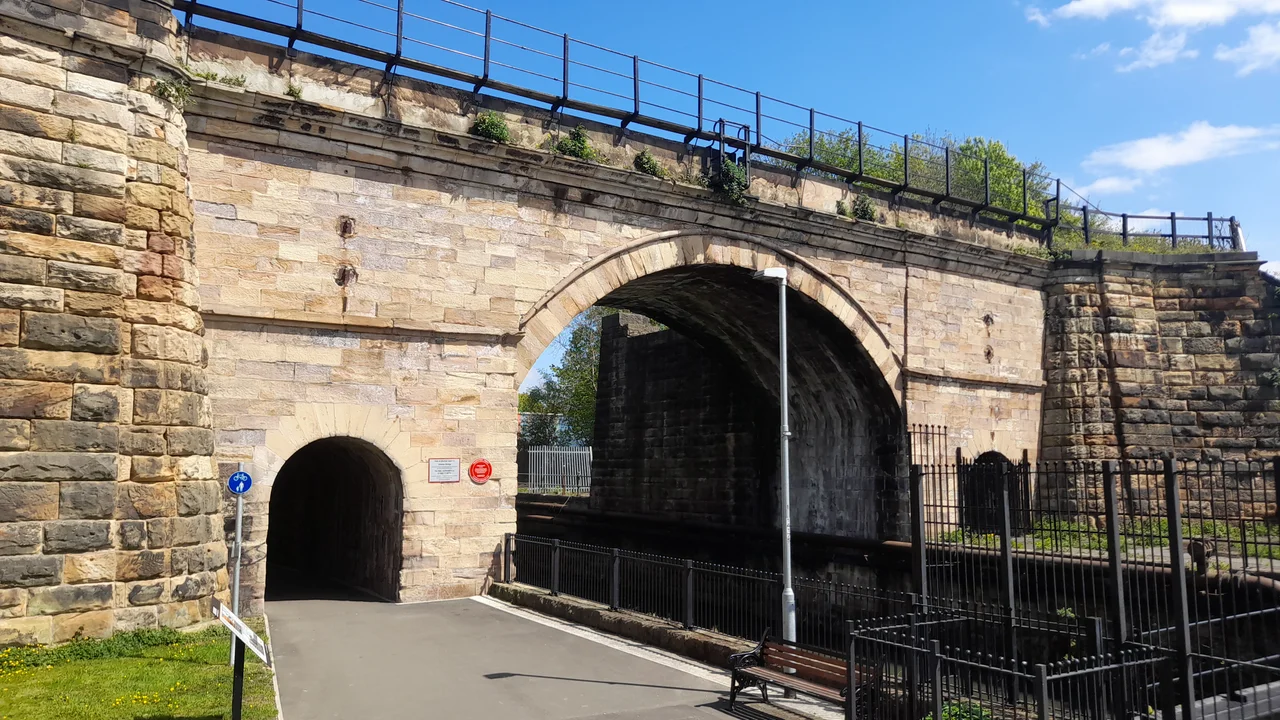
On 27 September 1825, a crowd of perhaps 40,000 people lined the route between Shildon and Stockton-on-Tees to watch a strange contraption pass through Darlington. George Stephenson stood at the controls of Locomotion No. 1, an iron engine that hissed steam and dragged twenty-one coal wagons and a single passenger coach behind it. By the time the train reached the wharves at Stockton, the modern world had been invented. Every railway since, every commuter line, every freight train, every metro across every continent, traces its lineage back to this market town on the River Skerne.
Before the Steam
Long before the locomotives arrived, Darlington was an Anglo-Saxon settlement called Dearthington, the place of Deornoth's people. By Norman times it had softened to Derlinton, and the residents themselves often called it Darnton well into the 18th century. Daniel Defoe stopped here on his travels and praised the town for its linen bleaching, noting that cloth from Scotland was sent south to be whitened in Darlington's waters. He was less kind about the streets, complaining the town had "nothing remarkable but dirt." St Cuthbert's Church, built in 1183 and Grade I listed, predates almost everything Defoe would have seen, its spire still rising over the market square. The Durham Ox, a steer born here in the early 19th century, became so famous for its proportions that it helped define the Shorthorn breed standard followed by cattle farmers to this day.
The Quaker Town
Darlington's transformation into a railway powerhouse was not engineered by industrialists but by Quakers. The Pease family and the Backhouse family, both members of the Religious Society of Friends, built the businesses, the banks, and the philanthropic networks that financed the Stockton and Darlington Railway. Joseph Pease gave the town its clock tower in 1864, its face crafted by T. Cooke & Sons of York, its bells cast by John Warner & Sons in nearby Norton-on-Tees. Three years earlier the Backhouses had bankrolled South Park's 91 acres of green space. Even Darlington Football Club is nicknamed The Quakers in honour of this peculiar civic inheritance. In 1853, the Friends' Meeting House was rebuilt on Skinnergate, where Quakers had been gathering since 1678. The architect Alfred Waterhouse, later famous for London's Natural History Museum, designed the Old Town Hall and the Backhouse's Bank building that still stands as a Barclays branch.
Iron Works and Iron Men
Once the railway opened, Darlington became one of the great engineering centres of the British Empire. Three major works grew up alongside the original line. The North Road Shops, opened in 1863, churned out locomotives until 1966. Robert Stephenson & Co., known locally as "Stivvies," moved here from Newcastle in 1902 and built engines until English Electric absorbed them and shut the works in 1964. Faverdale Wagon Works pioneered mass production techniques for goods wagons in the 1950s. The Northern Echo newspaper launched in 1870, and its most famous editor, William Thomas Stead, died on the Titanic in 1912. A pub on Priestgate still bears his name. Bridge building was another speciality: spans built in Darlington carry traffic across the Nile and the Amazon.
The Brick Train and the Real One
Walk along the A66 today and you can see David Mach's 1997 sculpture Train, a life-size brick locomotive emerging from a tunnel built from 185,000 Accrington Nori bricks. It cost £760,000 and commemorates everything Darlington gave the world. But the town did not stop building real engines either. Starting in 1993, the A1 Steam Locomotive Trust began constructing Tornado, the first new steam locomotive built in Britain since the 1960s. They assembled it in the old 1853 Stockton and Darlington Carriage Works at Hopetown, the same buildings that had built the Peppercorn Class A1 engines back in the late 1940s. Tornado steamed out of Darlington in January 2008, numbered 60163, the 50th member of a class that had otherwise been extinct for decades.
The Town Today
Modern Darlington still revolves around its railway station, a principal stop on the East Coast Main Line with a tall Victorian clock tower visible from much of the town. The Darlington Economic Campus opened in 2022 brought HM Treasury and several other UK government departments north from London. EE employs 2,500 people, Amazon another 1,300 at a warehouse opened in early 2020. The Hippodrome, formerly the Civic Theatre, reopened after a £12.3 million renovation. In 2001 Darlington became the first place in England to allow same-sex civil ceremonies, and it now hosts an annual Pride festival. The town has won status as both a sustainable travel demonstration town and a cycling demonstration town, the only place in Britain to claim both.
From the Air
Darlington sits at 54.52 degrees north, 1.56 degrees west, on the flat coastal plain between the Pennines and the North Sea. Teesside International Airport (ICAO: EGNV) is 5 miles east of the town centre. Newcastle Airport (EGNT) lies 42 miles north, Leeds Bradford (EGNM) 62 miles south. From cruising altitude, look for the East Coast Main Line slicing north to south through the town, the River Tees forming the southern border with Yorkshire, and the A1(M) motorway bypassing the western edge. The Pennines rise to the west; the North York Moors to the south-east. Visibility in the Tees Valley can drop quickly when sea fog rolls inland from the coast.
Nearby Stories
- Gisborough Priory 4.9 km away
- Beamish Museum 6.9 km away
- Hutton-le-Hole 9 km away
- Battle of Stainmore 9.8 km away
- Jervaulx Abbey 12 km away
- Hadrian's Wall Path 21 km away
- Gordale Scar 27 km away
- German submarine U-2367 70 km away