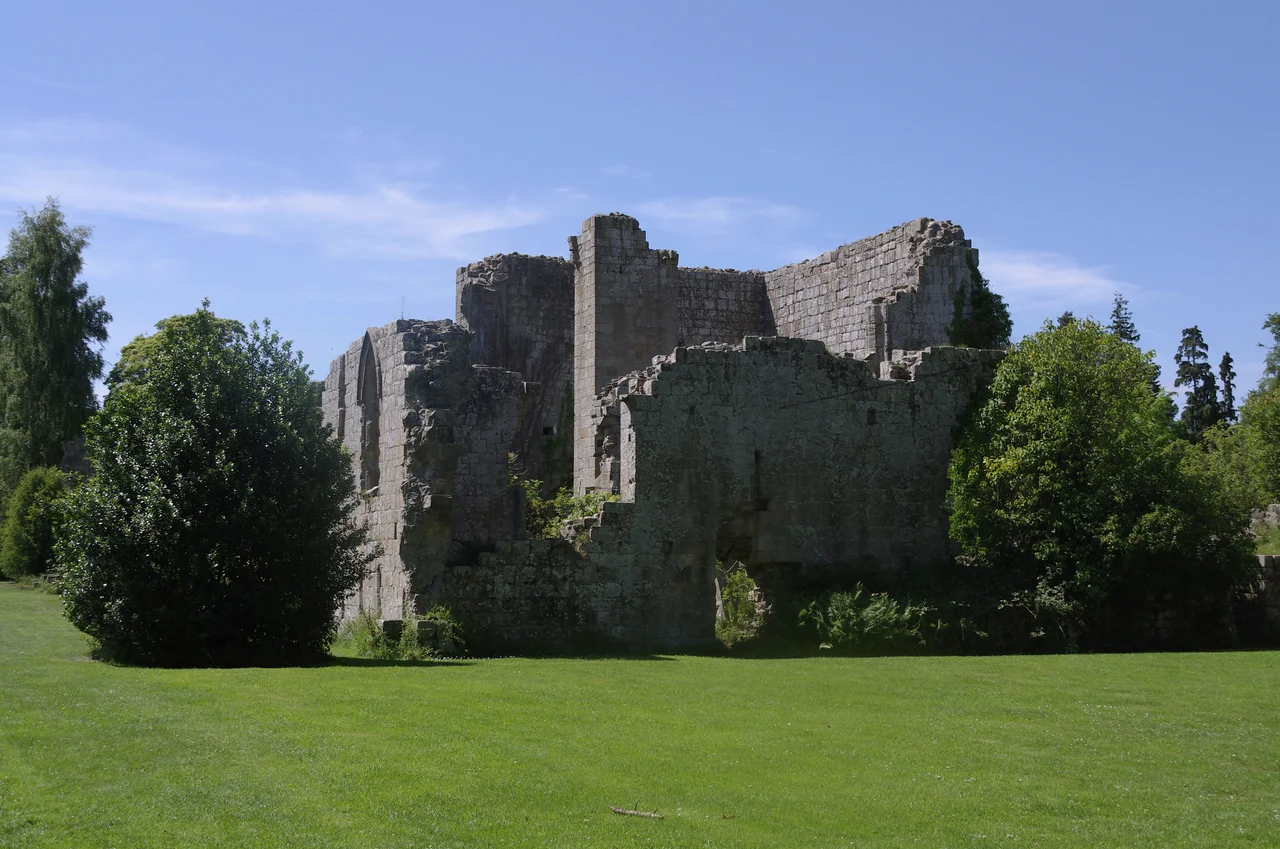

Jervaulx Abbey
Wensleydale cheese began here. Not in a marketing campaign, not in a Wallace and Gromit sketch - here, in a Cistercian abbey on the banks of the River Ure, made with ewes' milk by white-robed monks from Savoy and Burgundy. The recipe travelled with them when they came north in the 1150s. The abbey they built grew rich on sheep, wool, and horses. Eight centuries later the abbey is a ruin held together by ivy and the cheese is one of England's most famous regional foods. The connection is direct. The dale - the valley - was once called Yoredale, the Ure-dale. Jervaulx is just the French version of the same name: Jor-valle.
From Normandy to the Ure
The abbey was founded in 1145 at Fors near Aysgarth, a remote and unforgiving site. The first monks were Savigniacs from Normandy, sent by Akarius Fitz Bardolph, Lord of Ravensworth, who had granted them the land. They struggled. Serlo, the Abbot of Savigny, disapproved of the foundation - he had not authorised it - and refused to send more monks. He proposed instead that the Cistercian community at Byland take over. Monks were sent from Byland and endured what the records call great hardships from the meagreness of their endowment and the sterility of their lands. In 1156 Conan, son of Alan the 1st Earl of Richmond, rescued them. He increased their revenues substantially and moved them to a better site downstream in East Witton. There they built a new monastery and dedicated it, like most Cistercian houses, to St Mary. The Savignac order had by then been absorbed into the Cistercians, so Jervaulx became Cistercian by inheritance.
Sheep, Cheese, and Horses
By its prosperous mid-medieval peak Jervaulx owned roughly half of Wensleydale. Cistercian houses were famous across Europe for their agricultural innovation, and Jervaulx was no exception. They bred horses, beginning a tradition that survives in Middleham today, where racehorse trainers still exercise strings across the same hills the abbey monks once watched. They made cheese from ewes' milk, a dense crumbly white cheese suited to the dale's climate. The recipe became the ancestor of modern Wensleydale, which switched to cow's milk in later centuries but kept the name and the character. The abbey church itself, when it was completed around 1180-1200, ran 270 feet long by 63 feet wide, comparable in scale to the surviving great church at Byland. Monks sang the nine Canonical Hours - matins, lauds, prime, terce, sext, none, vespers, compline, and the night office - inside it for nearly four centuries.
Tyburn
In 1279 the abbot Philip of Jervaulx was murdered by one of his own monks. His successor Thomas was initially accused but acquitted by a jury, and the actual killer fled under outlawry. Two and a half centuries later the abbey faced an even bigger crisis. The last abbot, Adam Sedbar, joined the Pilgrimage of Grace - the great northern rebellion of 1536 against Henry VIII's dissolution of the monasteries. He fled to Bolton Castle for sanctuary but was captured. In June 1537 he was hanged at Tyburn, the king's execution ground in London. The abbey was suppressed. Its church was blown up with gunpowder later that year, which is why almost nothing of the building above ground survives apart from the elaborate south-west door through which the lay brothers had once entered the choir. The lordship of East Witton was granted by Henry to Matthew Stuart, 4th Earl of Lennox, the king's nephew by marriage. The site passed through several families, including the Bruces who became Earls of Ailesbury, before being sold in 1887 for £310,000 to the wool merchant Samuel Cunliffe Lister.
A Picturesque Ruin
Jervaulx was bought in 1971 by Major and Mrs W.V. Burdon. Their youngest son Ian still runs the abbey today, which remains in private ownership rather than under English Heritage or the National Trust. The ruins are extensive but, unusually, have never been cleared of vegetation. Where Fountains and Rievaulx have been stripped to clean masonry like architectural specimens, Jervaulx has been allowed to remain part of a Picturesque garden landscape. Ivy climbs the south-west door. Wildflowers grow from the broken cloister. A side altar in the transepts still bears its five consecration crosses, the small Greek crosses inscribed into the stone at the dedication of the building 850 years ago. Some surviving elements of the abbey have travelled. The pulpitum screen and part of the choir stalls can now be seen at St Andrew's Church in Aysgarth, and one of the abbey's windows was reused at St Gregory's parish church in Bedale. The watermill still stands near the river, a quiet ghost of the working monastery that fed and clothed a thousand sheep-keeping years.
From the Air
Located at 54.267 N, 1.738 W in East Witton, North Yorkshire, in lower Wensleydale on the north bank of the River Ure. About 4 nm south-east of Middleham Castle. Best viewed at 1,500-3,000 feet AGL. The ruins are surrounded by parkland and trees, with the Ure visible to the south. Recognizable as a cluster of roofless stone walls partly hidden by mature trees, with extensive lawns and gardens. Leeds Bradford (EGNM) lies about 35 nm south, Teesside (EGNV) about 25 nm north-east. The site sits just outside the Yorkshire Dales National Park boundary.
Nearby Stories
- Darlington 3.8 km away
- Gisborough Priory 4.9 km away
- Nunnington Hall 5.8 km away
- RAF Elvington 7.1 km away
- Battle of Stainmore 8.3 km away
- Harewood House 8.4 km away
- Sawley Abbey 16 km away
- Gordale Scar 18 km away