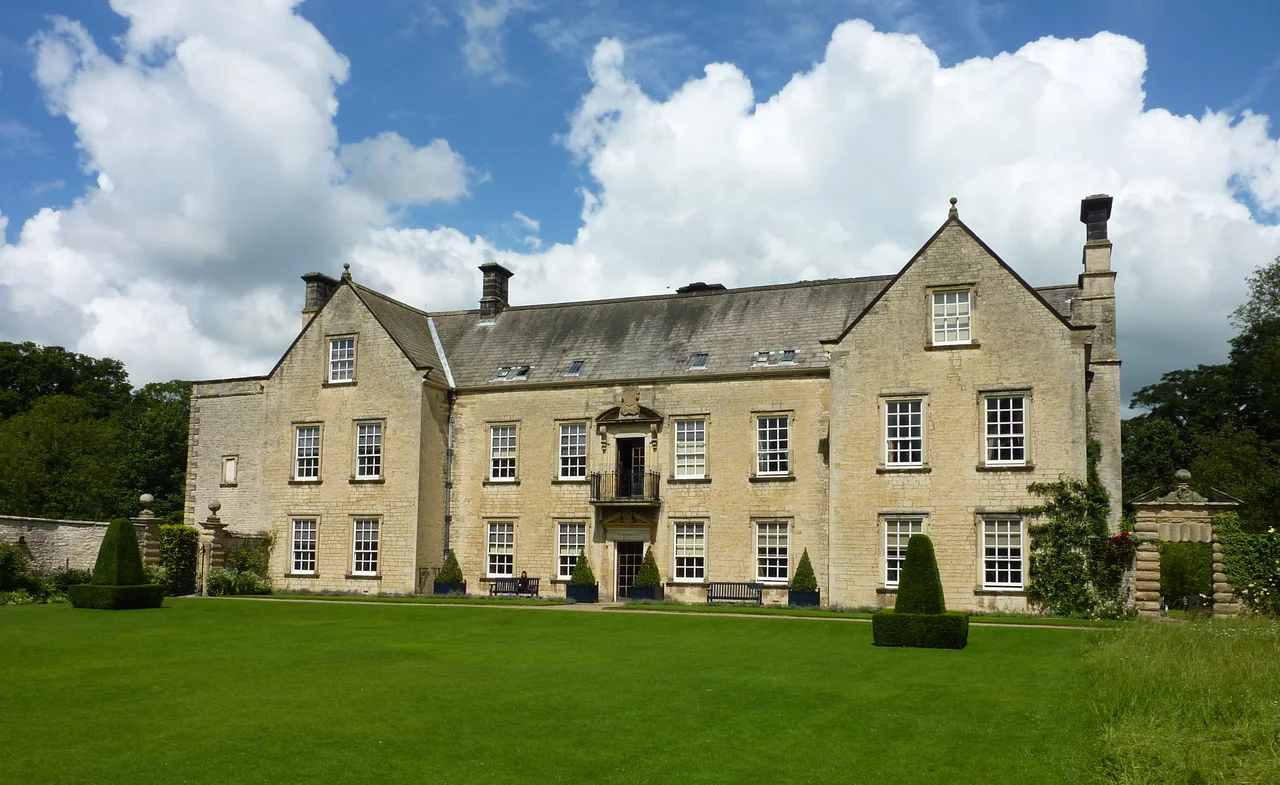

Nunnington Hall
Dr Robert Huicke had drawn the short straw. As personal physician to Elizabeth I, it fell to him to tell the Queen what no courtier dared to say: she would never bear children. The conversation must have been one of the more dangerous in Tudor England, conducted with whatever delicacy a sixteenth-century doctor could muster. Huicke kept his head, kept his post, and at one point even held the lease on a quiet estate above the River Rye in North Yorkshire. He never lived there. Stewards ran the place. But Nunnington Hall counted that man among its owners, along with kings' brothers-in-law, Jacobite conspirators, and a peacock named Bluey who in 2007 died, the National Trust solemnly recorded, under suspicious circumstances.
The Long Roll of Owners
Nunnington takes its name from a nunnery dissolved around 1200, before the building of the present hall began. William Parr, 1st Marquess of Northampton and brother to Henry VIII's last queen Catherine Parr, raised the oldest surviving sections of the house. He lost everything in 1553 for backing Lady Jane Grey on the throne. After Parr came tenants, sub-tenants, sales, and resales. By 1655 the manor changed hands for 9,500 pounds. The buyer's nephew, Sir Richard Graham, became 1st Viscount Preston in 1681 and gave Nunnington the shape it largely still wears. Preston was later attainted for trying to join the exiled James II in France, imprisoned in the Tower, and eventually pardoned. He spent the rest of his life at Nunnington, presumably grateful to be out of London.
What Preston Built
The Oak Hall is where Lord Preston signed his name on the architecture. Split pediments, finely carved doorcases, an enormous cartouche bearing the Graham coat of arms above the fireplace, all attributed to John Etty, the master carpenter from York. The fireplace itself is carved from Hildenby stone. The floor pattern, intersecting squares and hexagons in stone flags, came from Walter Gedde's 1615 Book of Sundry Draughts, which itself borrowed from Sebastiano Serlio's Renaissance architectural treatises. Preston's house was a quiet province getting the same Italian-French pattern books that London was using, executed by Yorkshire craftsmen at the highest level. The Stone Hall, oldest part of the building, now displays Colonel Fife's hunting trophies and World War II souvenirs: elephant heads beside a German tank crewman's helmet.
A Turner Found in the Attic
In the early 2000s, housekeepers cleaning a storage rack at Nunnington came across a small picture in oils on board. On the back, a faint inscription emerged after cleaning: Presented to me by JM Turner, 1832. J Harding. Five years of investigation by National Trust and Tate specialists followed. Researchers identified J. Harding as James Duffield Harding, a watercolourist and friend of Turner's. The handwriting matched manuscripts at the Royal Watercolour Society. The painting closely resembled Turner's 1811 watercolour Lyme Regis, Dorsetshire: A Squall held in Glasgow. Shrimpers at Lyme Regis is now attributed to Joseph Mallord William Turner and hangs in the Drawing Room above the Oak Hall. It came home in 2006, gift from one of England's greatest painters, recovered from a back-room rack at a Yorkshire country house.
Cromwellian Defacement
The Panelled Bedroom still bears the marks of soldiers. Civil War-era Cromwellian troops were billeted at Nunnington, and the panelling around the window shows their work: gouges, scratches, defaced carving. The room and its small adjacent Oratory are reputed to be haunted by a presence that passes over the bed and through the wall. Margaret Rutson Fife, who inherited Nunnington in 1920, undertook a major restoration in the 1920s with the architect Walter Brierley. She stripped the paint from the Oak Hall panelling, bringing it back to bare wood in the Edwardian fashion. She bequeathed the entire estate to the National Trust in 1952 along with 25,000 pounds for upkeep, and the house opened to the public. Eight acres of organic walled gardens, orchards run as wildflower meadows, and resident peacocks complete the inheritance.
Flight Context
Nunnington Hall sits at 54.21 N, 0.97 W in the Vale of Pickering, just south of the North York Moors National Park. The honey-coloured stone hall is visible from low cruising altitude along the River Rye, with the village of Nunnington and its stone bridge to the north. Caulkley's Bank ridge separates the property from the Vale of York. Nearest airport is Teesside International (EGNV), roughly 35 miles north-west. Leeds Bradford (EGNM) lies about 40 miles south-west. Best viewing altitude is 2,000 to 4,000 feet AGL in clear afternoon light when the south-facing walled garden catches the sun.
From the Air
Nunnington Hall is at 54.21 N, 0.97 W on the southern edge of the North York Moors. Best viewed from 2,000-4,000 feet AGL. Teesside International (EGNV) about 35 NM north; Leeds Bradford (EGNM) about 40 NM south-west. River Rye and the village stone bridge make good visual landmarks.
Nearby Stories
- 1892 Thirsk Rail Crash 4.3 km away
- Filey Brigg 5.6 km away
- Yorkshire Air Museum 7.2 km away
- Staithes 8.9 km away
- Darlington 10 km away
- Harewood House 11 km away
- Burton Constable Hall 20 km away
- Breagh Gas Field 56 km away