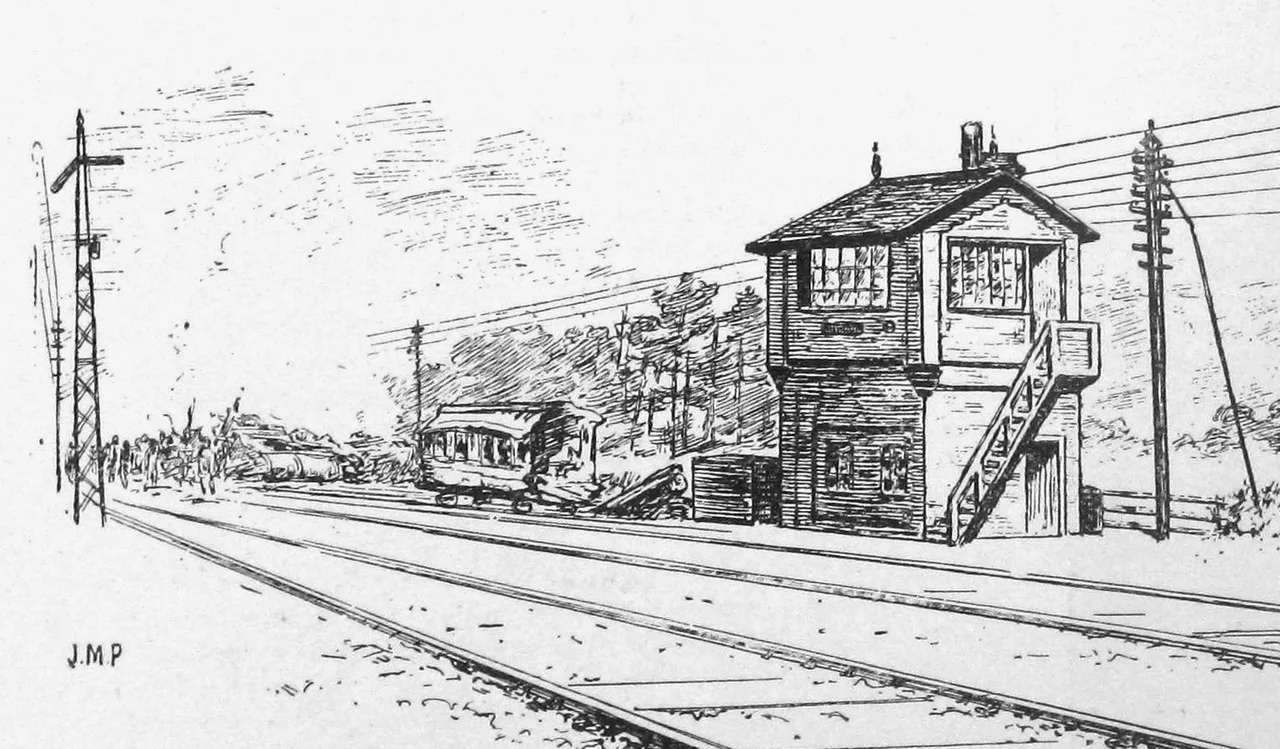

1892 Thirsk Rail Crash
James Holmes's daughter Rose died on the morning of 1 November 1892. He had been awake all night, walking miles in the dark to find the local doctor, who was not at home, then returning to comfort his wife as the child slipped away. He told his stationmaster at Otterington he could not work his shift that evening. The stationmaster passed the request up the line as a routine call for a relief signalman, without explaining that Holmes had reported himself unfit. The Assistant District Signals Inspector at York, harassed by other emergencies, replied that no relief was available. His superior agreed. Holmes walked to Manor House signal box that night anyway. He had been awake more than 36 hours when his shift began.
Manor House Signal Box
Manor House stood about three miles north of Thirsk on the North Eastern Railway, part of what would become the East Coast Main Line. There were no junctions or sidings nearby. The block was one of the shortest and straightest stretches in the country. Holmes had told his colleague Henry Eden at Otterington that he was already exhausted before the shift began. He was also waiting for his mother, who had been telegraphed asking her to come and look after his grieving wife. She had not been on the six o'clock train. She had not been on the seven thirty-seven. He had walked to the station twice that day to meet her, adding miles to his exhaustion. The night thickened from mist into fog. A heavy goods train came to a stop just outside the signal box. Then Holmes fell asleep at his post.
Thirteen Minutes
He slept for thirteen minutes. When Eden's bell from Otterington roused him, the instruments still showed a train on the line - the goods train that had stopped outside, which Holmes had completely forgotten. He thought he had simply failed to clear the previous express. He cleared the instruments. He accepted the second portion of the southbound express. Then doubt caught him. He telegraphed Otterington on the speaking instrument, the single-needle telegraph, asking Eden to stop the express, but it was already too late. The express thundered out of the fog at 60 miles an hour and into the back of the goods train, which had just begun to move off again at walking pace. The Pullman carriage at the rear, heavier than the wooden carriages in front of it, tore into them like a hammer through a matchbox.
The Dead
Ten people were killed: nine passengers and the guard of the goods train, George Petch. Among the dead was Charlotte Hamilton, five years old, travelling with her aunt and uncle to Australia. Her aunt Ann McCullough died beside her. Her uncle David survived. Captain Duncan MacLeod of the 42nd Highlanders, on his way to a posting in Gibraltar, was killed. So were John Lee, a potato merchant from Spitalfields Market; James Anderson, an insurance salesman carrying policies worth £2,750; and Mrs McKenzie of Edinburgh, whose husband Alexander told reporters he had found her body in the wreckage but could not save it before fire swept through. Two bodies were never recovered. Workers clearing the site found calcined bones and lumps of flesh, with coins fused to remains by the heat. Thirty-nine other passengers and four crew were injured, including the express driver Ronald Ewart, who broke his thigh, and the Marquess of Huntly, severely bruised.
The Inquiry
Board of Trade Inspecting Officer Francis Marindin was scathing about how the railway company had handled a man who had clearly told them he was not fit to work. There was contributory negligence on multiple fronts. Eden at Otterington had known Holmes's condition and done nothing when the box went silent for nearly fifteen minutes. The goods train crew had stopped for several minutes outside Manor House without sending a crewman to the signal box under Rule 55, the regulation that required them to verify their train was protected. Marindin also noted that the lighter carriages had been placed between the engine and the heavier Pullman at the rear. When the Pullman compressed forward in the impact, it shredded the lighter coaches in front of it. The whole accident could have been prevented by track circuits - electric devices that would have refused to let Holmes clear the signals while the goods train sat on the line - but in 1892 the technology was new and Manor House had been judged a low-priority installation. The signalman's mistake was overdetermined: exhaustion, grief, fog, an unhelpful railway hierarchy, and a stretch of line so simple it was assumed nothing could go wrong.
From the Air
Located at 54.267 N, 1.407 W approximately 3 miles north of Thirsk, North Yorkshire, on what is now the East Coast Main Line between London King's Cross and Edinburgh. The Manor House signal box site is just south of Otterington. Best viewed at 2,000-3,000 feet AGL. The crash site is now a quiet stretch of mainline running through flat agricultural land east of the A19. Teesside (EGNV) lies about 20 nm north, Leeds Bradford (EGNM) about 35 nm south-west. The line runs dead-straight through here - the same featureless geometry that made the 1892 disaster easier to imagine impossible.
Nearby Stories
- Darlington 3.8 km away
- Gisborough Priory 4.9 km away
- Nunnington Hall 5.8 km away
- RAF Elvington 7.1 km away
- Battle of Stainmore 8.3 km away
- Harewood House 8.4 km away
- Sawley Abbey 16 km away
- Gordale Scar 18 km away