
Gisborough Priory
Thomas Chaloner came back from Rome in the 1590s with a secret and a problem. He had visited the Pope's alum works at Tolfa, noticed that the soil there matched the soil on his estate at Guisborough, and decided to break the papal monopoly on the mordant that fixed dye to wool. Workmen were smuggled out of Italy to set up alum production at Belman Bank, just below the old priory ruins. Chaloner was excommunicated for his troubles. The priory itself was already a wreck by then, dissolved by Henry VIII in 1540, but its single surviving wall - the soaring eastern gable of the presbytery, pierced by its great empty window - had become something stranger than a ruin. It had become beautiful.
The Wall That Survived
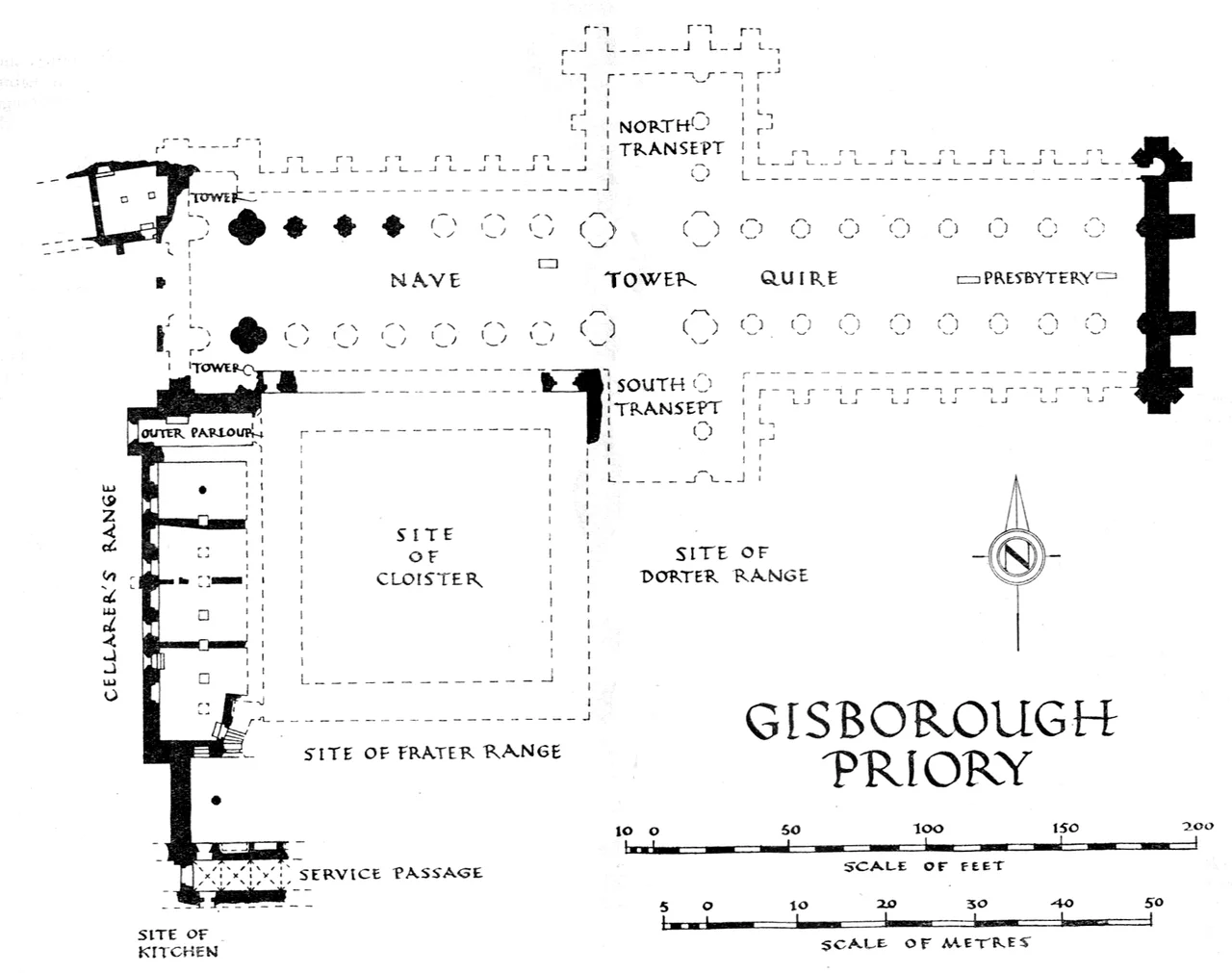
When Henry VIII's commissioners came for Gisborough Priory in 1540, they took everything: the lead off the roof, the bells from the tower, the gold leaf from the painted vaulting bosses. Twenty-four priors had ruled here since William de Brus founded the Augustinian house in 1119. A devastating fire in 1289 had melted the bell into a shattered lump and fused lead, silver and iron into a slag that penetrated the floor - and the canons had rebuilt anyway, larger and grander. The 107-metre church that rose from those ashes had a ridge line 29.6 metres above the ground, naturalistic foliage on its capitals, and stained glass in seven major lights. After 1540 it became a quarry. Only the east wall stood, alone in the field, holding up its empty window against the sky.
An Early Taste for Ruins
Before the eighteenth century, a ruin was simply an unfinished demolition. Then came Romanticism, and Claude Lorrain, and the fashion for picturesque landscapes. Suddenly the nobility wanted ruins on their estates. Gisborough's east window was one of the first monastic remains in England to be deliberately kept for its beauty rather than mined for stone. The Chaloners, who had bought the site, laid out the East Lawn in front of it. They removed the window's sill so the view wouldn't be interrupted. J.M.W. Turner sketched the gable in 1801 during a Yorkshire tour, and his rendering helped fix the priory's image in the national imagination. By then the wall had become exactly what the new taste wanted: not a building, but the suggestion of one, framed against grass and sky.
Dragons on the Steps
The Chaloners built their landscape around the ruin. A long terrace ran the length of the grounds. A ha-ha kept the cattle out. Two carved sea-wolves flanked a flight of steps - heraldic creatures from the family coat of arms - but locals were sure they were dragons, and the steps became known as the Dragon Steps. Old Gisborough Hall came down around 1825; a new mansion went up half a mile east in 1857. In 1854, when the Crystal Palace needed a medieval cloister for its English National Art Court, surviving columns from Gisborough were taken to London. The priory had become source material - a place from which other places borrowed their authenticity.
The Ghost and the Treasure
Local folklore insists the priory is haunted. A monk in a black habit returns every year at midnight on the year's first new moon, lowering a ghostly drawbridge across a vanished moat to check that the buried treasure of Gisborough is undisturbed. Another legend places that treasure in an underground passage running from the priory to a cave in the hills, where a raven stands guard over a chest of gold. In 1966 and 1967, a hundred people gathered to watch for the monk, and a few claimed to see a cowled figure. In 1968, almost nobody came, and nothing was seen. The ghost, like the priory, perhaps needs an audience to appear.
Bones in the Soil
When Captain Thomas Chaloner and William Downing Bruce cut a trench across the site in 1865, they found a stone coffin holding the skeleton of a tall man, thought to be Robert de Brus, one of seven members of the Bruce family buried here. They found the remains of forty-seven people - twenty-one men, seventeen women, six children, three of indeterminate sex - some buried with gold rings and jet crosses. Two priests had been laid out with chalices and patens. They also found the physical scars of the 1289 fire: scorched paving, broken grave-slabs, the shattered bell. The bones were later cremated and scattered in the Monks' Walk, a quiet path through the Priory Gardens. Beneath the lawn, geophysical surveys hint at more buildings still waiting underground.
From the Air
Gisborough Priory sits at 54.5362 degrees N, 1.04722 degrees W, in the town of Guisborough at the northern foot of the North York Moors. Nearest aviation reference is Teesside International (EGNV) about 25 km west-northwest; Durham Tees Valley terminal traffic operates in the area. From 2,500 to 4,000 ft AGL on a clear day the single soaring east gable stands out beside the grey-stone parish church of St Nicholas at the eastern edge of town, with the moors rising green-brown to the south. Best light is morning, when the rising sun pours straight through the empty window from the east.
Nearby Stories
- Ryedale Folk Museum 3 km away
- 1892 Thirsk Rail Crash 5.5 km away
- Penshaw Monument 6.5 km away
- Darlington 12 km away
- Filey Brigg 12 km away
- German submarine U-2367 28 km away
- Seaham Hall 30 km away
- Battle of Flamborough Head 49 km away