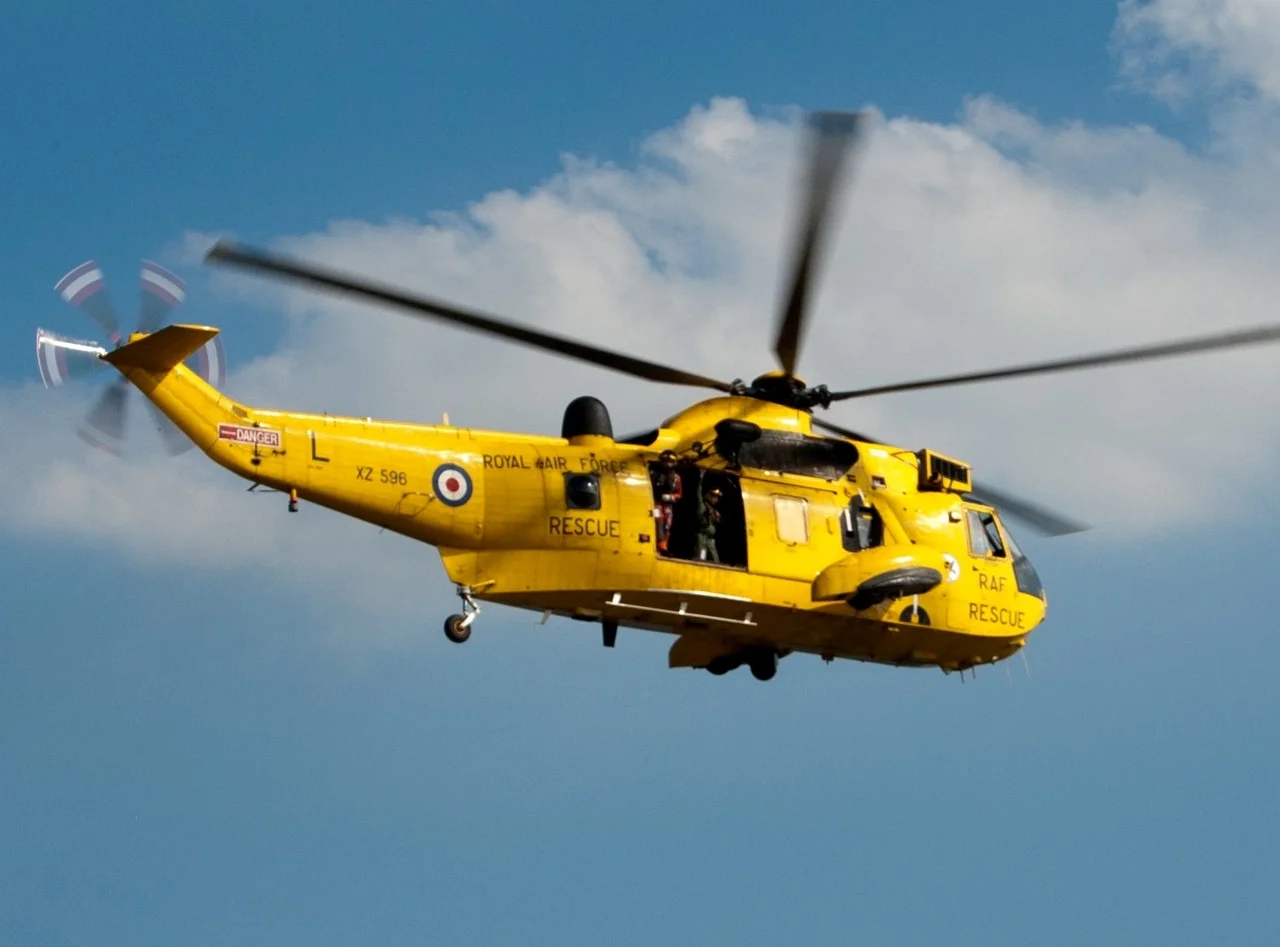

RAF Leconfield
On the night of 3 September 1939, the first night of the Second World War, ten Armstrong Whitworth Whitley bombers from this airfield outside Beverley became the first British aircraft to penetrate German airspace. They were not carrying bombs. They were carrying leaflets. The crews flew through the dark over the Reich and pushed bundles of paper out of the bomb bays, an act somewhere between symbolism and propaganda, and came home. The airfield they returned to had opened less than three years earlier, on 3 December 1936, as part of RAF Bomber Command. Over the next four decades RAF Leconfield would host Spitfires during the Battle of Britain, Halifaxes in the strategic bombing offensive, two Polish squadrons that came here to rest and re-form, the Blue Diamonds aerobatic team, and finally the Lightnings of the Cold War interceptor force. It closed as an airfield in 1977 and as a flying station in 2015.
Opening, then immediately at war
Leconfield's first aircraft were Handley Page Heyford biplane bombers of No. 166 Squadron, which moved in during January 1937. By June 1939 the squadron had converted to the new Whitley monoplane. In October 1939, a month after the leaflet raids, the station was transferred from Bomber Command to Fighter Command, and the Supermarine Spitfire Mk I aircraft of 72 Squadron arrived from Church Fenton. During the Battle of Britain the airfield became a rest-and-reorganise station, with squadrons rotating in for a few weeks at a time to recover from the air fighting over the south. A decoy airfield was built at nearby Routh to confuse Luftwaffe targeters. Leconfield itself was not heavily attacked. No. 234 Squadron reformed here in October 1939 and worked through three different aircraft types before settling on Spitfires by May 1940. No. 610 Squadron, No. 466 Squadron from the Royal Australian Air Force, and No. 640 Squadron all passed through in turn.
The Polish pilots
Two of the most distinguished Polish squadrons of the war had Leconfield in their service records. No. 302 Squadron, the Poznanski squadron, was formed at the airfield. No. 303 Squadron, the Kosciuszko squadron, came here to rest and re-equip after its furious turn in the defence of London during the Battle of Britain. 303 had the highest claimed kill ratio of any squadron in the Battle, with 126 claimed German aircraft destroyed for the loss of seven Polish pilots killed in action. Tadeusz Sawicz flew with 303 from Leconfield. He survived the war, lived to be the last surviving Polish pilot of the Battle of Britain by the time he died in 2011 at the age of 97. The Polish pilots had escaped a country overrun first by Germany and then by the Soviet Union, and many of them, including those at Leconfield, would never be able to return home after the war.
Cold War and the Lightnings
After the war Leconfield was a nominated dispersal base for the RAF's V-bomber force during the early Cold War. Bristol Sycamore helicopters of No. 275 Squadron arrived in 1957, replaced by Westland Whirlwinds in 1959. On 29 June 1959, No. 19 Squadron arrived with Hawker Hunter F.6 fighters. By December 1962 they had converted to the English Electric Lightning F.2, one of the fastest and most demanding interceptors the RAF ever flew. No. 92 Squadron, the Blue Diamonds aerobatic team, also flew Hunters from Leconfield before moving on. The base became home to No. 60 Maintenance Unit, responsible for the heavy servicing of the entire Lightning fleet. In the 1970s the control tower acquired a reputation for being haunted by a flight lieutenant killed in a Meteor 7 crash on approach in 1956. RAF Leconfield closed as a station on 1 January 1977.
Search and rescue, then driving school
After 1977 the airfield kept flying in another guise. RAF Search and Rescue ran Westland Wessex and later Sea King helicopters from Leconfield, scrambling to ditched aircraft and cliff incidents along the Yorkshire coast for decades. A private company took over services in the early 2000s. Flying operations finally ended on 1 April 2015 when the last two Sea Kings departed and the search and rescue role was transferred to the Maritime and Coastguard Agency at Humberside Airport. The site itself did not close. It is now the Defence School of Transport, the largest such school in Europe, where the British armed forces train every category of driver from light vehicle to heavy goods to amphibious. Group Captain John Paddy Hemingway, a former commanding officer of RAF Leconfield and the last surviving RAF pilot of the Battle of Britain, died on 17 March 2025, at the age of 105. The runways are quiet now, but the parade grounds and driving courses keep the buildings full.
From the Air
RAF Leconfield is at 53.877 degrees north, 0.4375 degrees west, two miles north of Beverley in the East Riding of Yorkshire. From the air the former airfield's runway pattern is still visible on satellite imagery, with the main runway running roughly north-south. The nearest active civil field is Humberside (EGNJ), 20 nautical miles south across the Humber estuary; Leeds Bradford (EGNM) is 47 nautical miles west; RAF Linton-on-Ouse is 37 nautical miles west-northwest. Beverley Minster's twin towers two miles south are a good visual landmark. Recommended altitude 2,500 to 4,500 feet AGL gives a clear view of the airfield outline, the Westwood common at Beverley, and the open agricultural country of the East Riding.
Nearby Stories
- Battle of Fulford 6.3 km away
- Humber Lifeboat Station 8.5 km away
- Newburgh Priory 8.7 km away
- Scampston Hall 10 km away
- Doncaster Minster 11 km away
- Westermost Rough Wind Farm 13 km away
- Battle of Hatfield Chase 27 km away
- Arctic Viking (H452) 29 km away