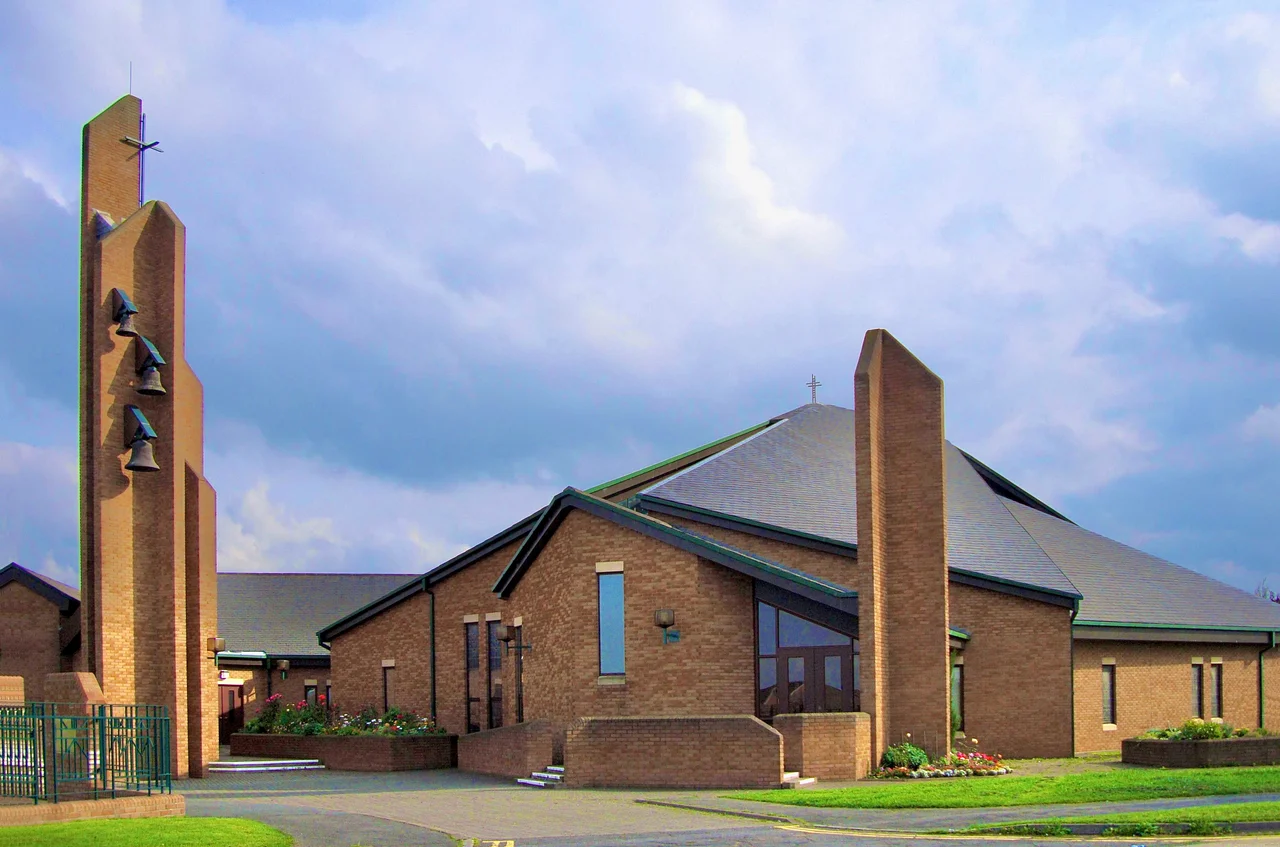

Middlesbrough Cathedral
The original burned in May 2000, and a group of children playing inside set it off. By then the Cathedral Church of Our Lady of Perpetual Succour on Sussex Street was already crumbling, structurally unsound, its Grade II listing the only thing standing between it and the demolition crews. Structural problems had been reported as far back as 1984, but it was the fire that decided the matter. Today's Saint Mary's Cathedral, the seat of the Bishop of Middlesbrough, stands four miles away in Coulby Newham, on the southern edge of town. It opened in 1988, designed for an entirely different kind of worship than its predecessor, and it looks the part.
A Diocese Without a Cathedral
The original cathedral wasn't built to be a cathedral. When construction began in 1876, the Diocese of Middlesbrough didn't yet exist. The Sussex Street church, opened on 21 August 1878, was simply meant to seat 1,500 people in the old St. Hilda's district. Then everything changed at the end of that same year. In December 1878, Rome carved a new diocese out of Beverley, and Middlesbrough's parish church was suddenly elevated to cathedral status. On 18 December 1879, Richard Lacy was consecrated there as the first Bishop of Middlesbrough. For just over a century, that improvised cathedral served the diocese, until structural failures and the 1984 fire made its loss inevitable.
Vatican II in Concrete and Light
The new cathedral at Coulby Newham was conceived as a building of its moment. The Second Vatican Council had reshaped Catholic worship, demanding altars visible to everyone and liturgy that all could hear. Architect Frank Swainston drew up the outline plan, but he died before completing the work. His assistant Peter Fenton finished the drawings and designed the furnishings, advised by J.O. Tarren and Professor Patrik Nuttgens. Augustine Harris, Bishop of Middlesbrough, blessed the foundation stone on 3 November 1985 and consecrated the completed building on 15 May 1988. The result is modern and luminous, sharing a family resemblance with the Roman Catholic cathedral in Liverpool. Sanctuary, nave, Blessed Sacrament chapel, sacristy, church hall, narthex, and campanile all sit within one continuous building complex.
The Organ from Belgium
The cathedral's organ was built by the firm of Schumacher in Belgium, working to a specification developed by Dr John Rowntree of the Organ Advisory Group. It has two manuals and pedals, sixteen stops, and mechanical key and stop action. The case is ash, matching the rest of the cathedral furnishings, and its asymmetric shape acknowledges that the instrument sits off the central axis of the building, fitted to the geometry of the internal roof lines. The Choral Foundation, led by the Cathedral and Diocesan Director of Music, encompasses the Cathedral Choir with its Senior Choristers and Choral Scholars, the Cathedral Consort, and the Cathedral Junior Choristers. They sing the main Solemn Mass on Sunday mornings. Choral Vespers and Benediction fall on Wednesday evenings.
Standing on the Edge of Town
Coulby Newham is residential Middlesbrough's southern frontier, a 1970s expansion of suburbs and shopping that wraps around the cathedral site. The building is approached not through medieval streets but past parking lots and arterial roads. There is something honest about that. The diocese it serves stretches across North Yorkshire and East Yorkshire, encompassing fishing ports, market towns, the moors, and the coast. The cathedral itself has no ancient stones, no gothic vaults, no centuries of accumulated grime and memory. What it has instead is light, room for everyone to see the altar, and a community in continuous use of the space. For a building tradition that has been about permanence for two thousand years, this insistence on the present is its own kind of statement.
From the Air
Coulby Newham sits at 54.52°N, 1.21°W on the southern edge of Middlesbrough's built-up area, on slightly higher ground than the town centre to the north. The cathedral's campanile is the most visible landmark; from above you'll spot the building's modern footprint surrounded by suburban housing and shopping. Nearest controlled airport is Teesside International (EGNV), about 12 miles west. Durham Tees Valley airspace, the A19/A66 interchange, and the River Tees lie to the north. From cruise, the cathedral is part of the wider Teesside conurbation visible against the dark expanse of the North York Moors to the south.
Nearby Stories
- Raby Castle 3.1 km away
- Crook Hall 3.4 km away
- Middleham Castle 4.8 km away
- Seaham Hall 7.4 km away
- Rievaulx Abbey 9.9 km away
- Whitby 12 km away
- Scampston Hall 17 km away
- German submarine U-2367 48 km away