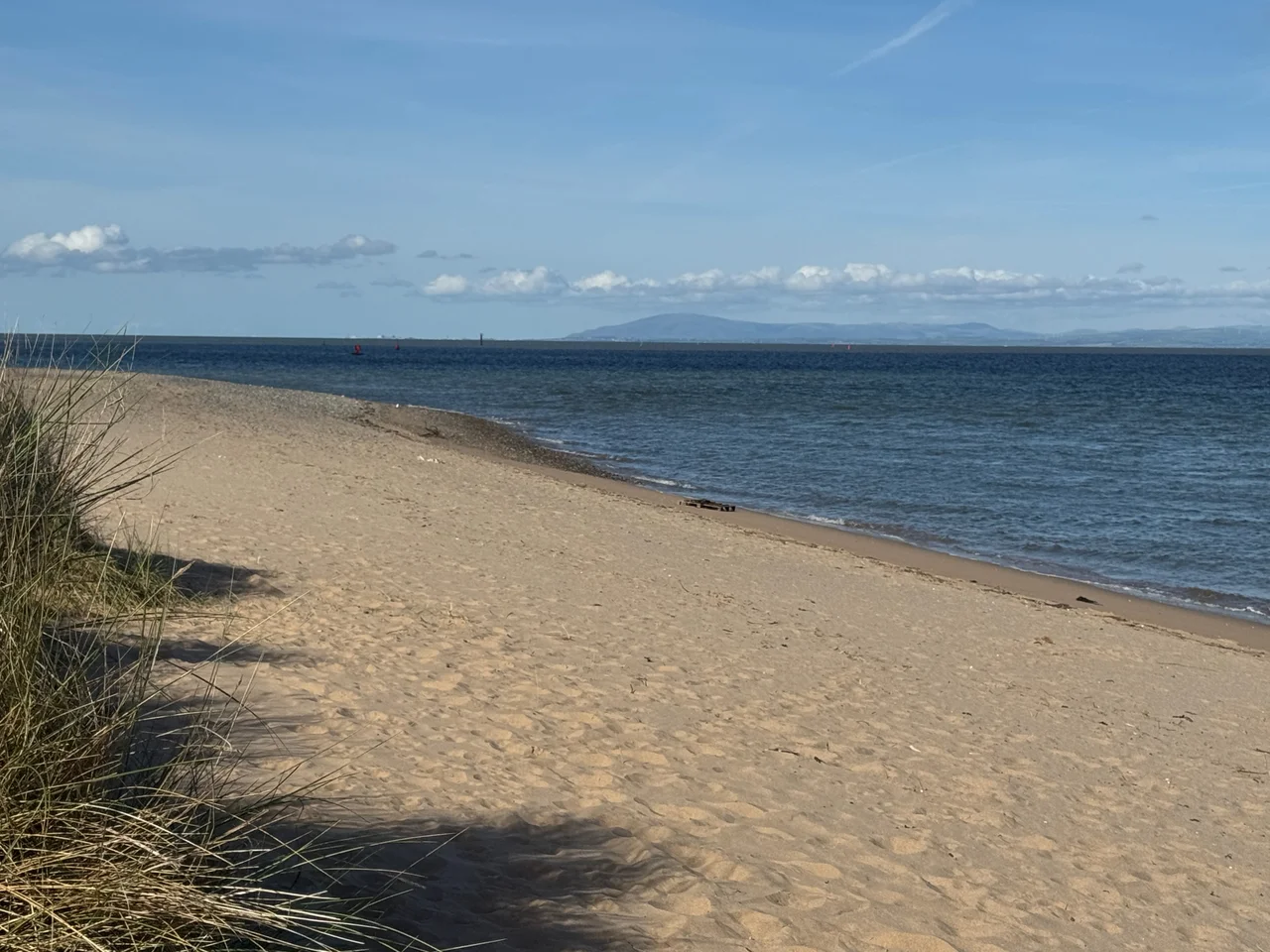

Fleetwood
Peter Hesketh-Fleetwood went bankrupt building this town. In 1831 he changed his name to add Fleetwood to it, and by 1835 the architect Decimus Burton was drawing up plans for the first planned town of the Victorian era. Hesketh-Fleetwood wanted Fleetwood to be a transfer point between the railway from London and the steamers to Scotland, before the western mainline through Shap Fell existed. He pictured Queen Victoria taking her crew through here on the way north. She actually did, in 1847. But the railway over Shap soon followed, the steamer trade collapsed, and by the late 1850s the new town's strategic purpose had already vanished.
Decimus Burton's Wheel
Burton's master plan used the largest sand dune on the north-facing shore as the focus of a half-wheel street layout. The dune itself became known as the Mount; main streets radiated like spokes from it; the commercial street, Dock Street, formed the rim. The oldest surviving building - the 1836 Custom House, later the Town Hall, now Fleetwood Museum - dates from the very first year of construction. The North Euston Hotel from 1841 still curves elegantly along the seafront. Two of Burton's Fleetwood lighthouses still operate: the Pharos, which functions as a traffic roundabout (the only lighthouse in the United Kingdom built in the middle of a street), and the Lower Lighthouse, which mariners line up with the Pharos to navigate the Wyre channel. A third lighthouse, Wyre Light - the first screw-pile lighthouse ever lit anywhere in the world, designed by the blind engineer Alexander Mitchell and first illuminated on 6 June 1840 - now stands derelict offshore. No other UK town has three lighthouses.
Cardinal William Allen
Long before Burton's drawings, the manor of Rossall stood at what is now the southwest of Fleetwood. In 1532 William Allen was born here - the future Catholic priest who would flee Elizabethan England, found the English College at Douai to train missionary priests, supervise the Douay-Rheims Bible translation, and eventually become a Cardinal. His old family seat ended up housing Rossall School from 1844, when the Reverend St Vincent Beechey took over the leased hall to create a Northern equivalent of Marlborough. The school still occupies the site, now co-educational and taking pupils from ages five to eighteen. The local Catholic high school, Cardinal Allen, is named for the boy who left this parish to die in Rome in 1594.
The Cod Wars
By the 1920s Fleetwood was one of England's three great fishing ports, alongside Hull and Grimsby. Over 9,000 people worked the industry directly. The first steam trawler, the Lark, had launched here in 1891. By the early twentieth century James Marr's fleet had transformed the fishery by going after hake, until then considered an undesirable catch. The huge October 1927 flood put 90% of the town under water. The fishing endured. Then came the Cod Wars. Britain and Iceland fought three disputes between 1958 and 1976 over the right to fish North Atlantic waters. Iceland won. The last deep-sea trawler left Fleetwood in 1982. Within a decade 8,000 jobs had gone. Today only inshore fishing remains, although fish processing is still a substantial employer. A pair of bronze figures on the promenade by the old pier site depicts families welcoming the fishermen home - a memorial to a way of life that ended within living memory.
A Lozenge That Saved a Town
Fleetwood's largest employer today is Lofthouse of Fleetwood Ltd., a small family company founded in 1865 by the chemist James Lofthouse to help local fishermen with chest complaints. The lozenge - a powerful mix of menthol, eucalyptus and liquorice - became known as Fisherman's Friend, and is now exported to over a hundred countries. In Japan it is especially popular. After the fishing industry collapsed, Lofthouse's became one of the few major employers left in town, and one of the very few exporting from a deprived seaside coast to global markets. The Hillhouse ICI works was once the third-largest employer, after fishing and tourism; it closed in 1999, costing 4,500 more jobs. Three of Fleetwood's five wards still rank among the 10% most deprived in England. But a national-scale brand still ships from the docks.
Trams, John Lennon and Alfie Boe
Fleetwood marks the northern terminus of the Blackpool tramway, which has run since the 1890s along Lord Street and North Albert Street, sharing road space with cars - the only town in Britain where trams still run the full length of the main street. Tram Sunday, held on the third Sunday in July since 1985, is a festival of vintage vehicles led by historical tramcars. The Marine Hall complex from 1935 hosts the Fylde Folk Festival, established 1971 and run for forty-two years by folk singer Alan Bell until his retirement in 2014. John Lennon spent childhood summers in Fleetwood with a cousin and the Beatles played the Marine Hall on 25 August 1962. Operatic tenor Alfie Boe grew up here; his first public performance was at the Marine Hall aged fourteen, working there as a stage technician. Fleetwood Town F.C., the Cod Army, reached the Football League in 2012 and League One in 2014 - the first time a club from this town had ever played in the league.
From the Air
Fleetwood sits at 53.92 N, 3.02 W at the northwest corner of the Fylde Peninsula, on the western bank of the River Wyre mouth. The town fills a peninsula about 2 miles wide, bounded by the Irish Sea to the west, Morecambe Bay to the north, and the Wyre estuary to the east. From altitude the Pharos Lighthouse mid-town and the Lower Lighthouse near the seafront line up clearly. The North Wharf sandbank extends north into Morecambe Bay and is dramatic at low tide. EGNH Blackpool is 7 nm south along the coast; the Blackpool tramway runs the entire length of the seafront between the two towns. EGNL Barrow/Walney Island (private) sits 25 nm north across Morecambe Bay. Manchester (EGCC) is 40 nm southeast. Best viewing is at low tide when the sandbanks and the river channel show clearly; westerly winds typical of this coast give the lifeboat station plenty of work.
Nearby Stories
- RAF Cark 3.1 km away
- Bolton Steam Museum 3.2 km away
- Clitheroe Castle 4.5 km away
- Scarisbrick Hall 4.5 km away
- Hawes Junction Rail Crash 24 km away
- Abergele Rail Disaster 37 km away
- Egremont Castle 38 km away
- Celtic Array 60 km away