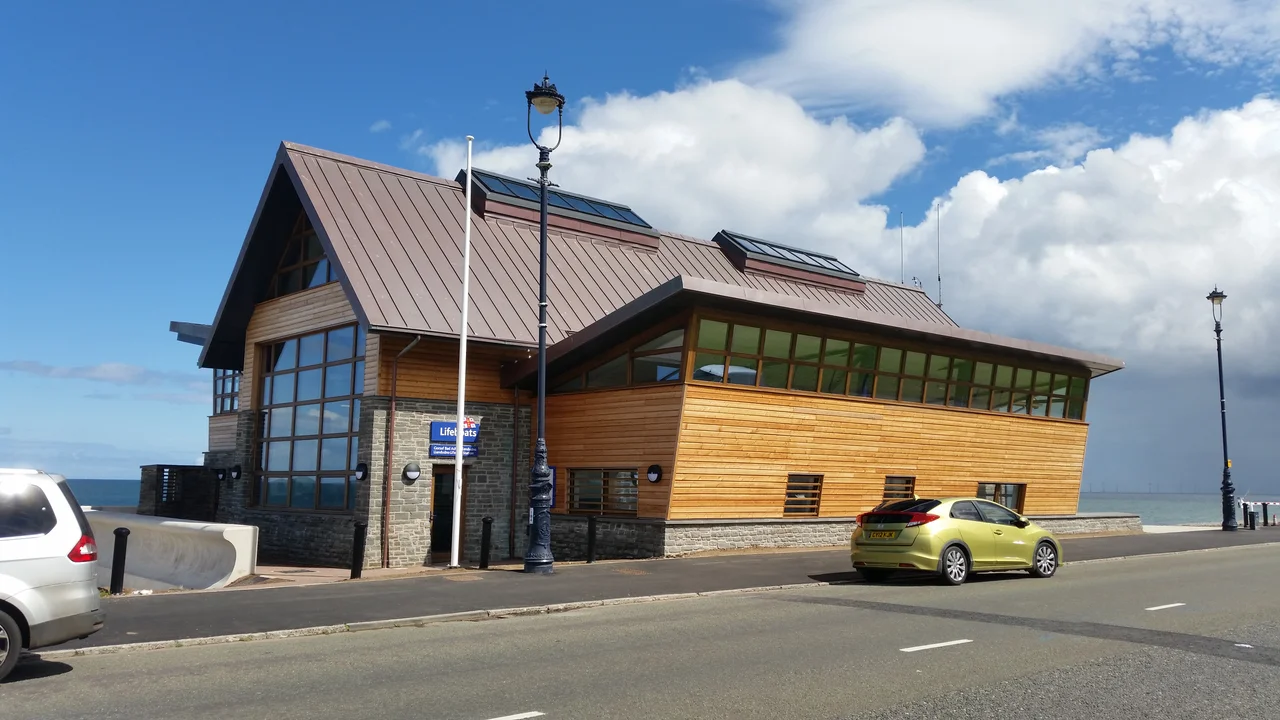

Llandudno Lifeboat Station
For more than a hundred years the Llandudno lifeboat was kept on a street in the middle of town. The boathouse on Lloyd Street was nowhere near the sea - approximately seven hundred metres in either direction from the North Shore or the West Shore. The boat was towed along the streets to the launching point, the crew running alongside in oilskins, a journey that averaged twelve to fifteen minutes depending on traffic. It was the only inland lifeboat station in the United Kingdom. The arrangement worked because Llandudno sits on an isthmus: a narrow waist of land between the Great Orme and the mainland, with a beach on each side. A boat in the middle could reach either shore. In 2017 the station finally moved to a purpose-built boathouse at Craig-y-Don on the North Shore - but for one hundred and fifty-six years, the most unusual lifeboat station in Britain was in the middle of a Victorian seaside town.
1861: Sisters Memorial
The case for a Llandudno lifeboat was made in 1859 by Reverend M. Morgan of Conwy and Mr John Jones of Llandudno, both writing to the RNLI. After a year of committee meetings and a site visit by the Inspector of Lifeboats, the institution agreed in August 1860 to establish a station. The funding came from the Misses Browne of Toxteth Park in Liverpool, who donated two hundred pounds in memory of a deceased sister and asked that the new boat be called the Sisters Memorial. A 32-foot self-righting pulling-and-sailing lifeboat costing one hundred and ninety pounds was built and arrived in Llandudno on 14 January 1861, brought free of charge by the London and North Western Railway. The following day she was named and launched on demonstration. The station was first called Ormes Head Lifeboat Station, for the great rocky headland it was built to serve; it was renamed Llandudno Lifeboat Station in 1893.
The Great Orme
What the Llandudno boat existed to handle was the trap geography sets at the mouth of the Mersey. The Great Orme is a sheer limestone headland rising 207 metres straight out of Liverpool Bay, with shallow waters, strong tides, rocky shoals, and a habit of generating its own weather. The shipping lanes to Liverpool's docks ran past it. Vicious chop builds quickly when wind opposes tide. The Llandudno lifeboat covered a stretch of coast that included not just Llandudno itself but Rhos-on-Sea, Colwyn Bay, the Little Orme, and the dangerous tidal sands of West Shore - which still trap walkers and families today. Two lifeboats from the station, the original Sisters Memorial in 1867 and a successor of the same name in 1885, capsized in service. The crew lists kept at the station record the names of those lost. Lifeboat service is not abstract heroism; it is a steady cost paid by working people.
Streets to sea
In 1903 a new boathouse was built on Lloyd Street at a cost of one thousand three hundred pounds. It sat almost exactly between the two shores. Crews launched in the middle of town, hauled the boat through busy streets to whichever beach needed her, and launched her into the surf. For most of the twentieth century this was simply how Llandudno worked. Local residents complained about the ground shaking when the boat was launched. Local hoteliers, when relocation was proposed, objected to anything that might block the sea view from their front rooms. The crews carried on regardless, their inshore boat on twenty-four-hour call alongside Conwy's, especially for the West Shore sands. Llandudno's inshore lifeboat has handled cases ranging from the routine - capsized kayaks, walkers cut off by tide - to the unforgettable: in 2005 the inshore boat was launched to a humpback whale that had become tangled in mooring ropes off Rhos-on-Sea, and the crew managed to cut it free.
The 18-hour rescue
In September 2008 the Llandudno all-weather lifeboat went thirty-four miles offshore in gale-force winds to reach a couple whose boat had been anchored to the sea bed by fishing nets. Coxswain Graham Heritage commanded. Crew member Tim James was put aboard the casualty and spent an hour and a half being repeatedly submerged by waves while he freed the boat from the nets. The whole service lasted eighteen hours. James later received the North Wales 'Champion of Champions' award, and the crew were named the year's Champions Team. It was the kind of service that explains why the Llandudno station was kept open and re-equipped even when its location was awkward. In 2011 Dan Jones, a former Llandudno coxswain, was awarded an MBE for his dedication to the service.
2017: Craig-y-Don
The decision to move came when the RNLI scheduled Llandudno for a new Shannon-class all-weather lifeboat - too large for the Lloyd Street boathouse. Attempts to relocate had failed for years against the resistance of hoteliers. Construction at Craig-y-Don, at the south end of the promenade, finally began in spring 2016 and finished in the summer of 2017. On 24 September 2017 the new lifeboat William F. Yates, ON 1325, arrived at her new station - now actually on the sea. The inshore boat Dr Barbara Saunderson (D-793) had been on station since 2016. The Lloyd Street building, after one hundred and fourteen years of street-launches, no longer launches lifeboats. The station the building it sat in is unique to British history.
Flight Context
The current Llandudno Lifeboat Station sits at 53.322 north, 3.834 west, at the south end of the promenade at Craig-y-Don on the North Shore. The Great Orme rises to the west. Best viewed at 1,500 to 2,500 ft AGL flying along the North Wales coast. Nearest airports: RAF Valley (EGOV) on Anglesey, Caernarfon (EGCK), Hawarden (EGNR) east toward Chester. The Lloyd Street building, the historic inland boathouse, still stands in the middle of town.
From the Air
53.322°N, 3.834°W (Craig-y-Don boathouse). Historic Lloyd Street inland station still standing in town centre. Best viewed at 1,500-2,500 ft AGL. Nearest airports: EGOV Valley, EGCK Caernarfon, EGNR Hawarden.
Nearby Stories
- Caldy 1 km away
- Moelfre, Anglesey 1.2 km away
- Pen-yr-Orsedd Quarry 2.5 km away
- Ysbyty Ifan 7.5 km away
- Birkdale Palace Hotel 9.5 km away
- Wrexham County Borough Museum 12 km away
- Celtic Array 22 km away
- Southport Lifeboat Station 45 km away