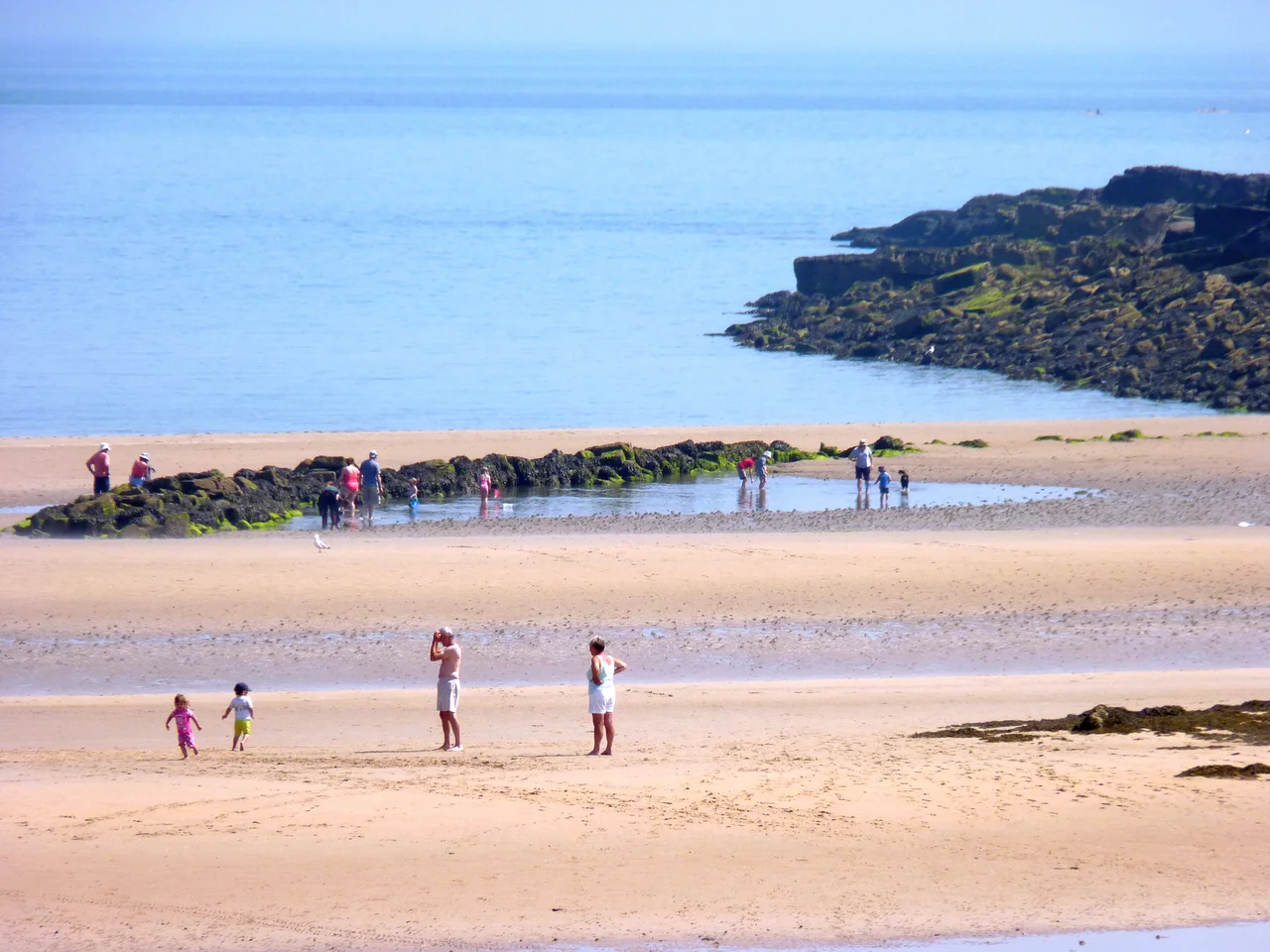

Moelfre, Anglesey
The wind in the second great Moelfre storm came from almost exactly the same compass point as the wind in the first - both autumn easterlies, both at hurricane force, both driving ships onto the same rocky headland north of the village. In 1859 the steam clipper Royal Charter was wrecked here near the end of her voyage from Australia, and more than four hundred and fifty people died within sight of the shore. A hundred years later, in October 1959, the coaster Hindlea was driven across the same waters under bare poles. This time the Moelfre lifeboat, commanded by Coxswain Richard Evans, reached her in time. Evans took the lifeboat alongside the rolling, lurching Hindlea ten separate times in a force-twelve gale, taking off her eight crewmen one or two at a time. Every man was saved. Evans won the RNLI Gold Medal for the rescue. He had already won one for an earlier night's work, and he would serve as Moelfre coxswain for nineteen years inside a fifty-year career on the lifeboats.
The Royal Charter
On 25 October 1859, the iron-hulled steam clipper Royal Charter was within twelve hours of arriving in Liverpool when the gale that would later be called the Royal Charter Storm caught her off Anglesey. She was driven onto the rocks below the headland north of Moelfre. More than four hundred and fifty people - passengers returning from the Australian gold rush and crew - died in the surf. A memorial stands on the headland and an obelisk in Llanallgo churchyard records the lost. Charles Dickens, then editing All the Year Round, came to Anglesey to cover the disaster and stayed long enough to write a vivid essay about the parish priest who recovered bodies from the rocks. The Royal Charter storm killed at least 800 people across the British Isles, more than any single storm of the nineteenth century. The Met Office began issuing the first British storm warnings the following year, partly in response. The wreck still lies on the seabed, where divers occasionally find sovereigns from her famously rich cargo.
Coxswain Evans and the Hindlea
Richard Evans (1905-2001) lived in Moelfre and served on the lifeboat for fifty years. Forty-eight of those years he was on the active crew; nineteen he was coxswain. The Hindlea rescue on 27 October 1959 became the textbook example of small-boat seamanship in extreme conditions. The Hindlea had lost engine power off Moelfre in a force-twelve easterly gale. The Moelfre lifeboat - the wooden Watson-class Edmund and Mary Robinson - launched into seas that were breaking over the boathouse roof. Evans manoeuvred alongside the coaster ten separate times as both vessels pitched and surged on twenty-foot swells, the lifeboat crew snatching one or two Hindlea sailors each time. The whole crew of eight was saved. Evans won his second RNLI Gold Medal. The first he had earned eighteen months earlier for rescuing the crew of the Dutch coaster Saint Kentigern. In 2004 a bronze statue of him in his lifeboat oilskins was unveiled outside the Seawatch Centre by Prince Charles. Evans died in 2001 at ninety-five.
The Confederate and the Painter
Not every famous ship in Moelfre's history wrecked here. On 30 July 1862 the screw sloop Enrica - newly built in Liverpool and about to be commissioned as the Confederate States warship CSS Alabama - sheltered in Moelfre Bay while evading both British customs authorities and the USS Tuscarora, which had been sent to capture or sink her before she could begin her commerce raiding career. The Alabama would go on to sink or capture more than sixty Union ships before the USS Kearsarge finally sank her off Cherbourg in 1864. For a few hours in the summer of 1862, the most consequential commerce raider of the American Civil War rode quietly at anchor in this small Welsh bay. The wildlife artist Charles Tunnicliffe lived on Anglesey for the last decades of his life and painted the Moelfre lifeboat and her crews repeatedly. His pictures - meticulous, lit by the changing northern light - are now considered the standard visual record of the RNLI in the mid-twentieth century.
The Village Today
Moelfre wraps around a small harbour sheltered by a headland and the rocky islet of Ynys Moelfre, where seals haul out and porpoises pass by in the kelp. The 2011 census measured 710 people in the village itself, 1,064 across the wider community that takes in Marian-glas, Llanallgo, Brynrefail and Mynydd Bodafon. The community holds fourteen Scheduled Ancient Monuments - more than any other on Anglesey - including the Neolithic Lligwy Burial Chamber and six Iron Age hut groups. The current lifeboat station houses the Tamar-class Kiwi and an inshore inflatable D-class. The RNLI Seawatch Centre next door tells the village's lifeboat story, with the Evans statue outside watching the sea he watched for fifty years. There were no street lights in Moelfre until well after the Second World War, when they were finally installed as a memorial to the village's war dead - which means that the maritime history of the village is built into its streetlamps.
From the Air
Moelfre village at 53.35 N, 4.23 W, on the east coast of Anglesey. The small harbour and the islet of Ynys Moelfre lie immediately offshore, with the Royal Charter wreck site on the rocky headland just to the north and Lligwy Bay's sandy crescent to the north-west. The Lligwy Burial Chamber and Din Lligwy hut group lie about 2 km inland. Nearest airports: Anglesey/Valley (EGOV) 18 nm west, Caernarfon (EGCK) 18 nm south-west. The east coast of Anglesey faces the Irish Sea and is more sheltered than the west. The Moelfre lifeboat station's roof is visible at the head of the small harbour bay - a recognisable navigation landmark.
Nearby Stories
- Llandudno Lifeboat Station 3.8 km away
- Glynllifon 6.1 km away
- German submarine U-1024 9.4 km away
- Irish Sea Bridge 11 km away
- Ysbyty Ifan 12 km away
- Irish Sea 18 km away
- Celtic Array 18 km away
- Birkdale Palace Hotel 56 km away