
Southport Lifeboat Station
When the Southport lifeboat society sold its first boat at public auction in 1817, the receipts came to thirty pounds. The boat had been judged unsafe; the local fishermen who crewed it had not much liked it; and the people of Southport, for the moment, would have no boat at all. That is how this station begins, in failure, and the next two centuries of lifeboats running off this stretch of Lancashire coast carry that lesson in their bones: the boats matter, but the men who row them out matter more.
The Rescue and the Jessie Knowles
By 1840, Lloyd's agent Lieutenant H. G. Kellock thought Southport needed another try. With the help of local businessman Caesar Lawson, a subscription raised forty pounds. Donations from Lloyd's, the Liverpool Dock Trustees, and the Southport Marine Fund paid for a boat designed by Thomas Costain for the shallow waters of the Mersey. Cato of Liverpool built her, and Kellock became Honorary Secretary. She was named Rescue, and from a wooden boathouse opposite what is now Coronation Walk she put out an estimated twenty-five times in twenty-one years and saved around 175 lives. In 1860 the RNLI took over the station. The first proper RNLI boat, a 32-foot self-righting pulling-and-sailing lifeboat, was hauled through the town in a grand procession on 7 September 1861 and christened Jessie Knowles after the youngest daughter of Mr J. Knowles of Bolton, who had paid for everything. On 29 October 1863, she rowed three hours to reach the barque Tamworth aground on Trunk Hill Bank and brought off seventeen men.
The Night of the Mexico
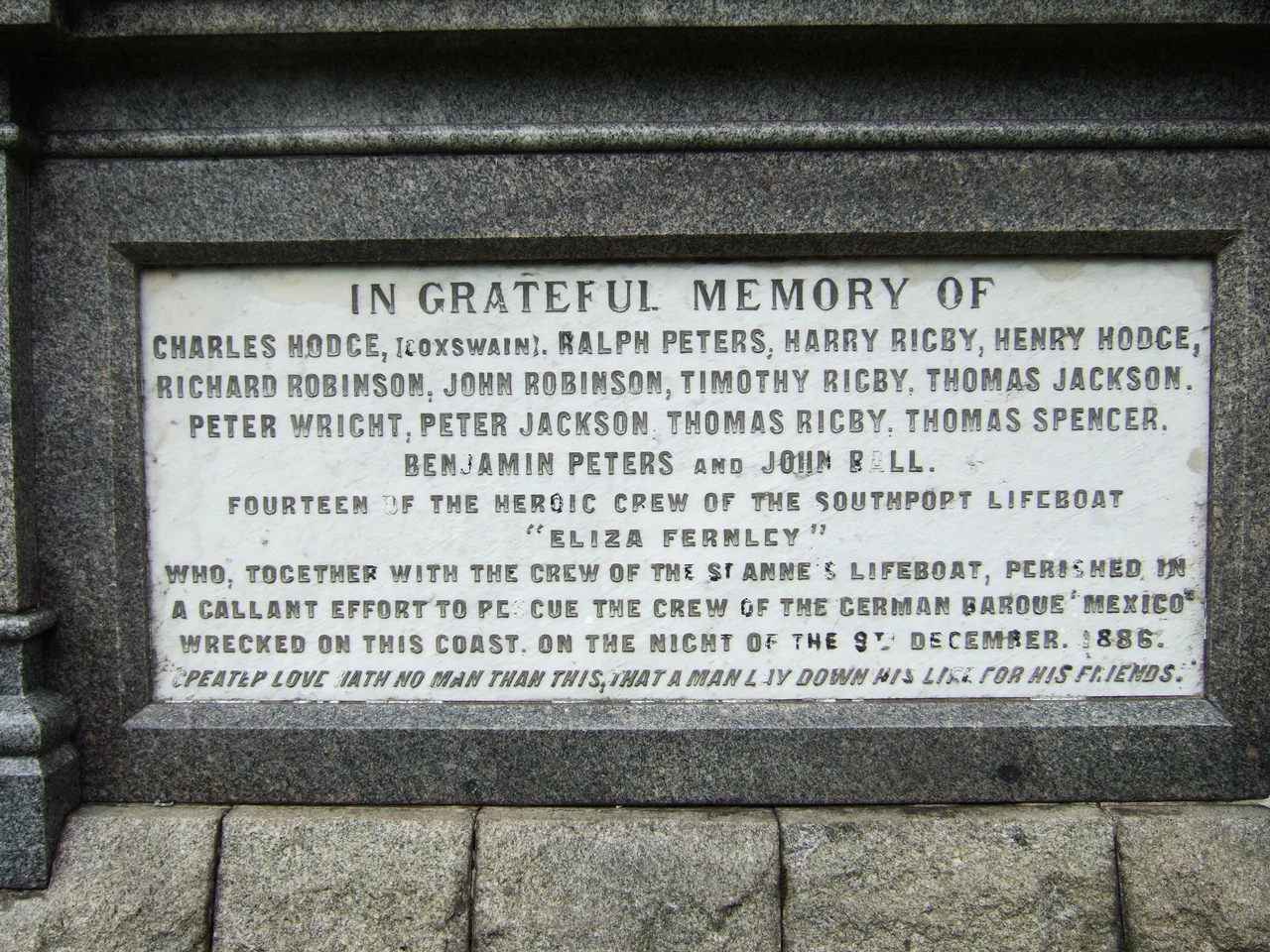
The Hamburg-registered barque Mexico ran aground on a sandbank off Ainsdale on the evening of 9 December 1886, in a gale that the Lancashire coast still remembers. Three lifeboats launched into the dark: the Eliza Fernley from Southport, the Laura Janet from St Annes, and the Charles Biggs from Lytham. The Charles Biggs reached the wreck and saved the twelve men aboard the Mexico. The Laura Janet was lost with all thirteen of her crew. The Eliza Fernley was hauled three and a half miles by horse-drawn carriage and launched just after eleven that night under Coxswain Charles Hodge with sixteen men aboard. As she prepared to anchor and veer down toward the wreck, a breaking wave capsized her. She did not self-right. Only two men, Henry Robinson and John Jackson, came back to shore alive, trapped under the upturned hull. Fourteen Southport lifeboatmen drowned. Across both stations, twenty-seven men died that night, leaving sixteen widows and fifty children without a father. It remains the worst single-incident loss in the history of the Royal National Lifeboat Institution. The Eliza Fernley was hauled in, returned to headquarters, and quietly broken up.
After the Disaster
A new boat, the Mary Anna, was on station by 22 December 1886, less than a fortnight after the funerals. The grief did not lift that fast. A relief fund opened immediately and within weeks held over thirty thousand pounds for the widows and children. The Southport coxswain William Rockcliffe, by then long retired, had been awarded the institution's silver medal in 1852 and again in 1873 for his service in earlier years; a 1863 silver medal from King Carl XV of Sweden and Norway also hung in his name. Mary Anna was housed in a new boathouse at the south end of the promenade, completed in 1887, that still stands. She launched only twice in the next eighteen years. The channel was silting up. By 1925 the lifeboat could put out only during a two-hour window at high tide, and the station closed on 30 April that year.
Coming Back
Volunteers ran small inshore boats from the beach through the late twentieth century. In 1988 the Southport Offshore Rescue Trust formalised the work, naming its first rigid inflatable Geoff Clements after one of the young men who had died in a 1987 accident. His mother, Kathleen Wilson, became a founding member and the principal fundraiser. Bessie Worthington arrived in 1995. The Arctic 24 Heather White entered service in May 2007. Quad bikes were added for beach searches. A charity shop in Birkdale, opened in 2005, kept the kit current. The new Southport Lifeboat Station opened on Marine Drive in January 2022, dedicated to Kathleen Wilson, who had funded most of the building through that lifeboat shop. In August 2025, the trust announced that a new FRC903 lifeboat, based on the Dutch Nikolaas class, is being built in the Netherlands and is due in 2026. The boats and the people who run them are independent of the RNLI now, but they are doing what the Eliza Fernley's crew were doing on that December night in 1886: going out so that other people can come back.
From the Air
Southport Lifeboat Station sits on Marine Drive at approximately 53.6473 N, 3.0188 W, on the Lancashire/Merseyside coast just south of the Ribble Estuary. Liverpool John Lennon (EGGP, LPL) lies about 18 nm to the south; Blackpool International (EGNH, BLK) is about 14 nm to the north. From altitude the long curve of beach between Crosby and Lytham St Annes is the dominant feature, with Southport Pier, Marine Lake, and the lifeboat station visible at the western end of the town grid. The Ainsdale dunes, where the Mexico was wrecked in 1886, stretch a few miles south. The estuary opens west into Liverpool Bay; the Welsh hills are sometimes visible across the water in clear conditions.
Nearby Stories
- Kingsway Tunnel 3.1 km away
- Helmshore Mills Textile Museum 8.3 km away
- Heysham Port 9 km away
- Tatton Park 13 km away
- Abergele Rail Disaster 18 km away
- Malham Cove 23 km away
- Llandudno 47 km away
- Egremont Castle 57 km away