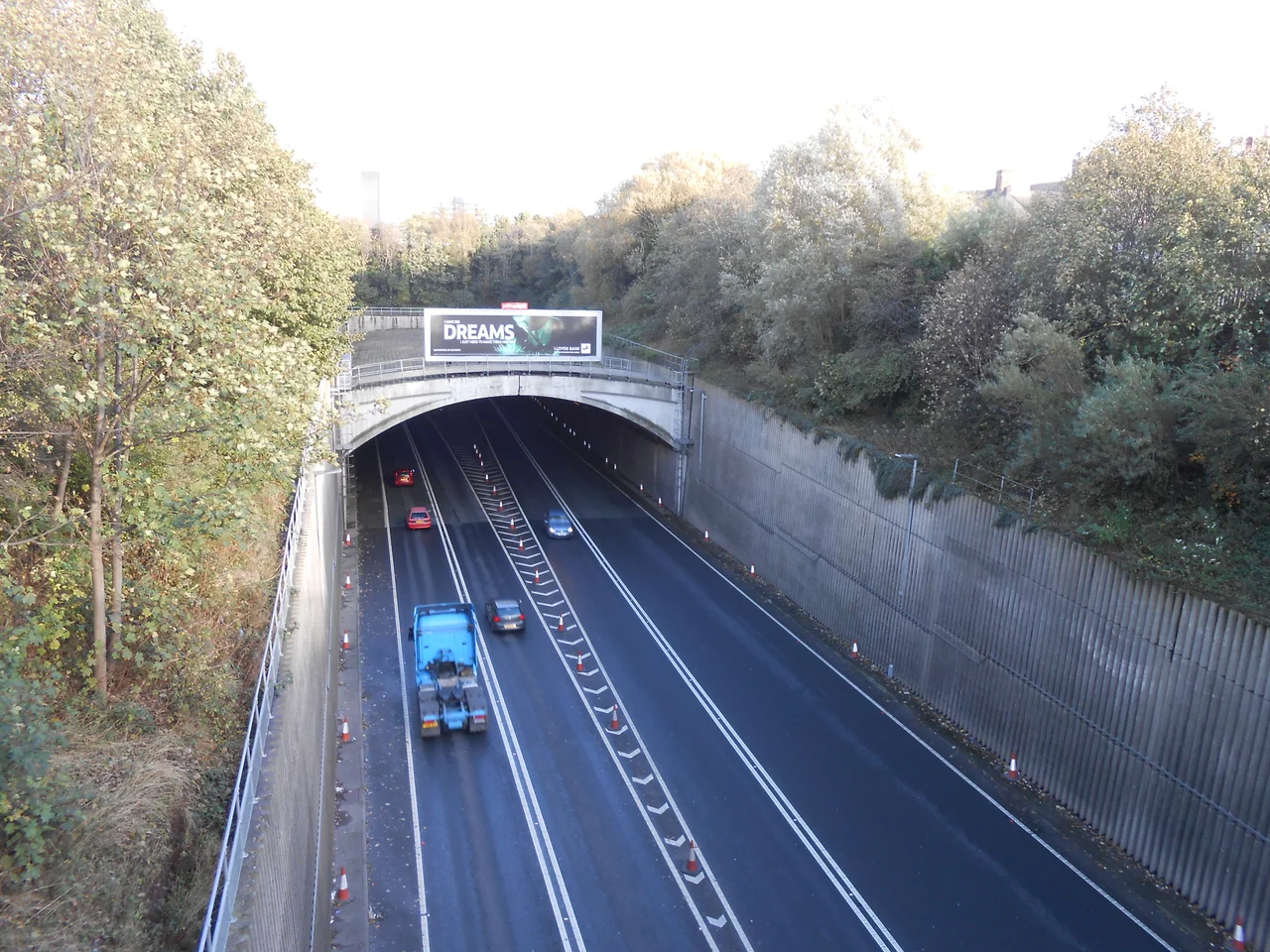
.JPG)
Kingsway Tunnel
The Queensway Tunnel had been hailed as a marvel when it opened in 1934, the longest underwater road tunnel in the world. By 1959 it was suffocating. Annual vehicle usage had exceeded 11 million. Peak-hour queues stretched for miles up the approaches in both Birkenhead and Liverpool, and the tolls were so low that there was no way to throttle demand. Something had to give. After years of arguing about bridges, second tunnels, and even an underwater tube, the conclusion was the simplest one: build another tunnel, this time between Liverpool and Wallasey, and pay for it by raising the tolls. The result, the Kingsway Tunnel, opened on 24 June 1971 under the hands of Queen Elizabeth II, with the name commemorating the king's road that had once led to the same crossing.
Two Tunnels Under the Mersey
Kingsway is not one tunnel but two: identical twin bores, each carrying two 12-foot traffic lanes, running side by side under the Mersey for 1.5 miles between Liverpool and Wallasey on the Wirral shore. At any moment about 45,000 vehicles a day pass through, almost 16.4 million per year. The tunnel carries the A59 trunk road. It is signposted as the Wallasey Tunnel or simply W'sey Tunnel, although the official name commemorates kings rather than seaside resorts. Of the two Mersey road tunnels, Kingsway is the only one capable of carrying heavy goods vehicles, which means a substantial share of the freight moving in and out of Merseyside has to pass through these two parallel bores. A single car journey through the tunnel cost £2.10 as of recent tolls, with staffed and automatic tollbooths on the Wallasey side.
Five Years of Digging
The construction was authorised by the Mersey Tunnel (Liverpool/Wallasey) etc. Act 1965, with the contract going to Edmund Nuttall Limited (now BAM Nuttall). Construction took roughly five years, an extraordinary span for what looks from above like a relatively straightforward dig. The Wirral approach uses the cutting of the former Seacombe branch railway, a piece of infrastructure recycling that saved acres of land acquisition and helped knit the new road into the existing Wallasey street network. When the tunnel opened on 24 June 1971, only the southernmost of the two bores was in service, with one lane in each direction. The second bore was finished three years later and opened to traffic on 13 February 1974. Until then commuters had a slow asymmetric system: two lanes shared by both directions under a Mersey that nobody could see.
Why a Tunnel and Not a Bridge
The choice of a tunnel over a bridge had been argued for years. Bridge schemes were attractive in principle: cheaper to maintain, easier to walk and cycle across, less claustrophobic. But the Mersey at the proposed crossing point is busy with commercial shipping that needs full clearance, and the river is wide enough at the chosen alignment that any bridge with sufficient air gap would have needed enormous towers and approach ramps cutting through dense urban fabric on both sides. A tunnel solved the clearance problem at the cost of going underground, and going underground was a known engineering quantity by the 1960s. The Mont Blanc Tunnel had opened in 1965. Tunnels were no longer unusual. The Mersey's clay and sandstone bed turned out to be hospitable to the digging, which is part of why the project came in on schedule.
Mont Blanc and the EU Inspection
The 1999 fire in the Mont Blanc Tunnel killed 39 people and changed how road tunnels were inspected across Europe. Trucks burning in confined spaces, the inadequacy of safety refuges, the impossibility of escape against smoke moving at running speed: the catastrophe forced regulators to look hard at every major tunnel. The European Union's inspection programme then assessed road tunnels across the continent. Kingsway received a "good" rating, one of only fourteen tunnels in Europe to do so. The rating reflected its emergency cross-passages every 300 yards, its modern fire detection and ventilation systems, and the operations control room that monitors both bores around the clock. In 2016 the tunnel underwent a major lighting upgrade, with over 75 miles of new wiring installed and LED fixtures replacing the older fluorescents, cutting energy costs and improving night-driver visibility.
The Annual 10K Run
Once a year, the Kingsway Tunnel does something it does no other day of the year: it lets people walk and run through it. The Mersey Tunnel 10K starts in Liverpool city centre, goes underground for nearly a mile, comes up at Wallasey, and finishes in New Brighton on the seafront. In 2024 more than 2,000 runners registered for the event. The thing they all remember afterward is the strangeness of running in the tunnel, the curious dome of lights overhead, the slight downhill on the Liverpool side, the deeper hum of the ventilation fans without engines to drown them out. It is the closest the public ever gets to the experience of the engineers who built the tunnel and the maintenance teams who keep it open. The next morning the tunnel returns to its normal job: 45,000 vehicles a day, with no time at all for anyone to look around.
From the Air
The Kingsway Tunnel runs east-west under the River Mersey between Liverpool and Wallasey, with the Liverpool portal at roughly 53.42°N, 2.97°W and the Wallasey portal at 53.42°N, 3.02°W. The midpoint is approximately 53.41°N, 3.01°W. Best viewed from 2,000-4,000 ft. Liverpool John Lennon Airport (EGGP) is 8 nm south-southeast. Look for the portals on each side of the Mersey: the Liverpool side near the docks north of the city centre, the Wallasey side at the head of the old Seacombe railway cutting just inland from the river.
Nearby Stories
- RAF Wrexham 3.3 km away
- Birkdale Palace Hotel 3.7 km away
- Turton Tower 4.1 km away
- Tatton Park 5.6 km away
- Abergele Rail Disaster 9.6 km away
- Diglake Colliery Disaster 13 km away
- Ysbyty Ifan 16 km away
- Celtic Array 62 km away