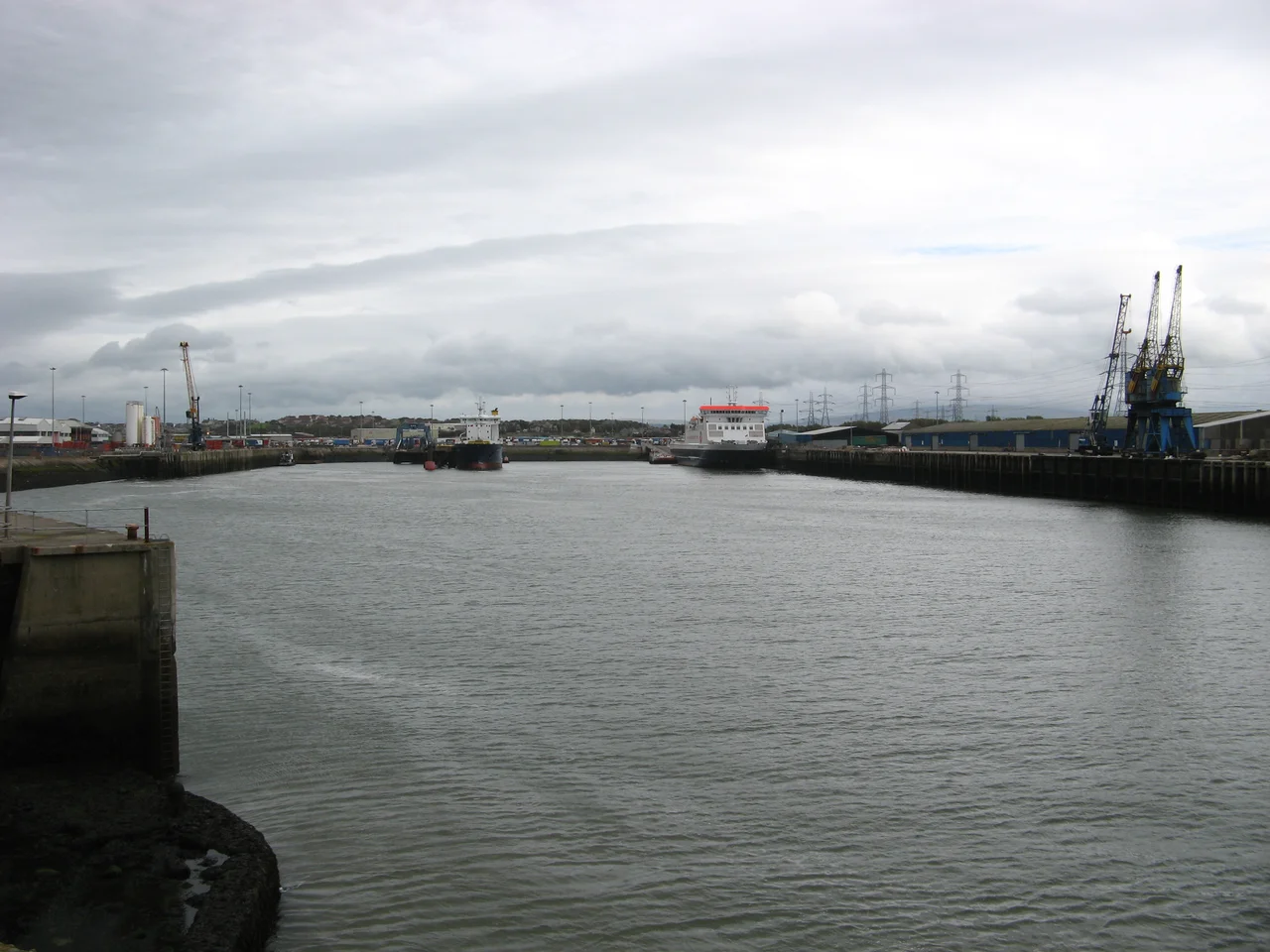

Heysham Port
On the 31st of May 1904, a ship called the Antrim slipped into a brand-new dock on the Lancashire coast — the first vessel ever to tie up at Heysham. She had been built by John Brown of Clydebank, ordered by the Midland Railway for the routes the company was about to launch. Three months later, on the 13th of August, the Londonderry carried the first paying passengers out of the new harbour: a day trip to Douglas on the Isle of Man. A century and a quarter later, the Isle of Man ferries still leave from this same stretch of water, twice a day, on a route that has outlived most of the British shipping industry it was built to compete with.
The Midland Railway's Big Bet
The Midland Railway already ran Morecambe Harbour, four miles to the north-east, and in 1891 it gave notice that it intended to build something bigger at Heysham. The original plan called for an enclosed dock accessed through a lock — an ambitious piece of Edwardian engineering — but it never got beyond the drawing board. In 1895 the consulting engineer James Abernethy and his son returned with a larger scheme, designed with the Midland Railway's own chief engineer. This is essentially what got built, though the full plan was never finished. An enabling Act of Parliament cleared Parliament in 1896, the construction contract was let in July 1897, and roughly three million pounds was spent before the first ship arrived in 1904. The investment was substantial — the kind of money a railway company spent when it believed Ireland and the Isle of Man were going to be the future.
Jetties, Silt, and Wartime Fuel
The harbour entrance silted up faster than anyone had expected. Two jetties had been planned in 1907, one on each side of the entrance, but only the south jetty was actually built, finished in 1909. The north jetty exists only on those original blueprints. A more dramatic addition came in 1941, when a deep-water berth called the Ocean Jetty was built to the north-east of the harbour entrance. It was there to handle tankers too large for the main port, supplying the new Trimpell refinery up the coast at Heysham — a refinery built specifically to produce aviation fuel for the RAF's fighter aircraft during the Second World War. The Ocean Jetty mattered enormously during the war. Once the Tranmere pipeline made it redundant, it sat largely unused, and the structure was finally demolished in 1976.
Where the Ferries Sail
Today, Heysham handles mainly roll-on/roll-off freight, with one passenger line still running. The Isle of Man Steam Packet Company operates a twice-daily sailing to Douglas, a vital link for a Crown Dependency that has no rail connection and a population that still depends on the sea. Three freight routes leave for Ireland: Stena Line sails to Belfast, while Seatruck Ferries — operating under the CLdN RoRo group — runs services to Dublin and to Warrenpoint in County Down. The port was bought by the Mersey Docks and Harbour Company in May 2001, then absorbed by Peel Ports Limited in August 2005 when Peel acquired MDHC outright. Heysham Port railway station connects passengers onward to Lancaster via Morecambe on the Morecambe Branch Line, the kind of integrated rail-and-ferry connection the Edwardian planners had originally dreamed of and which most of Britain has long since lost.
The Sands Beyond the Breakwater
Heysham Port sits at the southern shoulder of Morecambe Bay, looking out across some of the most dangerous tidal sands in Britain. The bay drains 31 miles between high and low tide in places, and the sands have killed walkers, fishermen, and cocklers for centuries. Mariners coming into Heysham from the Irish Sea have always had to read the channel carefully — the silt that drove the south jetty's construction is the same silt that shifts the safe approaches. Adjacent to the dock is Heysham nuclear power station, a more recent neighbour and a more visible landmark from the sea. Together the two installations dominate this stretch of Lancashire coastline: a working freight and passenger port that still moves goods and people across the Irish Sea every day, alongside the steady hum of nuclear baseload, both written into the same sky.
From the Air
Located at 54.03°N, 2.92°W on the southern shoulder of Morecambe Bay, Lancashire. Nearest airport is Blackpool International (EGNH), about 28 km south. Manchester (EGCC) lies 95 km southeast. From the air the port complex and adjacent twin-domed Heysham nuclear power station are unmistakable on the coastline, with the wide tidal sands of Morecambe Bay opening to the north and Morecambe town just up the curve of the shore.
Nearby Stories
- Grizedale Hall 3.4 km away
- Lytham St Annes 5.2 km away
- Hawes Junction Rail Crash 9.1 km away
- Helmshore Mills Textile Museum 14 km away
- Sawley Abbey 17 km away
- Egremont Castle 18 km away
- Egremont, Cumbria 48 km away
- Llandudno 56 km away