
Grizedale Hall
The car park of the Grizedale Forest visitor centre stands directly on top of the foundations of what was, in 1939, one of the strangest buildings in wartime Britain. Grizedale Hall - a 40-room neo-Gothic mansion built in 1905 by a Liverpool shipping magnate - had been requisitioned by the War Office and turned into No 1 Prisoner-of-War Camp (Officers). Because so many of the men inside were survivors plucked from sunken U-boats, the staff and the men themselves quickly nicknamed it the U-Boat Hotel. The hall is gone now. A garden terrace and a few walls are the only things left to look at. But for seven years, between 1939 and 1946, this quiet forest valley held some of the most senior captured officers of the Third Reich.
Three Halls in One Valley
Three different houses have carried the name Grizedale Hall. The first dates from the early 17th century, built by or for the Rawlinson family, who had acquired the estate in 1614. By the mid-eighteenth century it had drifted down to farmhouse status. The Ford family bought part of the estate around 1745 and built Ford Lodge nearby. In 1841, Montague Ainslie - Richard Ford's great-grandson - expanded that lodge into a country house known as Grizedale New Hall. That building, in turn, was pulled down in 1904. In 1903, Harold Brocklebank, third son of Sir Thomas Brocklebank, bought the estate. He commissioned the Windermere architects Walker, Carter & Walker to build a forty-room stone mansion in Gothic Revival style. By 1907 the interior was finished. He lived there with his wife Mary Ellen, three daughters, and two sons until his death in 1936. The Forestry Commission then took on the 4,500-acre estate.
The U-Boat Hotel
When war came in 1939, the War Office picked Grizedale Hall as Britain's first officers' POW camp. The choice was practical - remote, hard to escape from, large enough to hold around three hundred men. Watchtowers went up, a double perimeter fence enclosed the house, and roughly thirty huts were built in the grounds. The camp had a kitchen garden, a football pitch, and a library of German-language books. Among its prisoners was Otto Kretschmer, Germany's most successful U-boat captain at the time of his capture, along with the U-boat commander Werner Lott, the rear admiral Hans Voss, the SS-general Maximilian von Herff, and General Wilhelm Ritter von Thoma. Italian prisoners were also held there, some of them allowed out to do gardening and other work locally. The most famous resident, briefly, was the fighter pilot Franz von Werra, who staged a daring escape attempt in late 1940 - a story later filmed as The One That Got Away in 1957, with the hall itself used as the set just before its demolition.
Men, Not Trophies
It is easy, with sixty years of war films, to treat the inhabitants of an Axis officers' camp as cartoon villains or escape-story heroes. The truth is more uncomfortable. Some of the men held here were career professionals doing what their country told them to do; some had committed or supervised serious crimes; almost all came from a regime that had wrecked the lives of millions. They lived in a hall built by a shipping magnate's family, ate from a kitchen garden, read books from a small library, and waited for a war whose end they could not see. By 1946 the last of them had been repatriated to Germany or Austria. The hall fell silent again. With the Forestry Commission unable to afford its maintenance, the contents - fittings, fireplaces, staircases - were auctioned, and the building itself was demolished in 1957. Grizedale Hall has also drifted into fiction: the 1970 film The McKenzie Break and James Follett's 1989 thriller A Cage of Eagles were both inspired by the camp.
What the Forest Kept
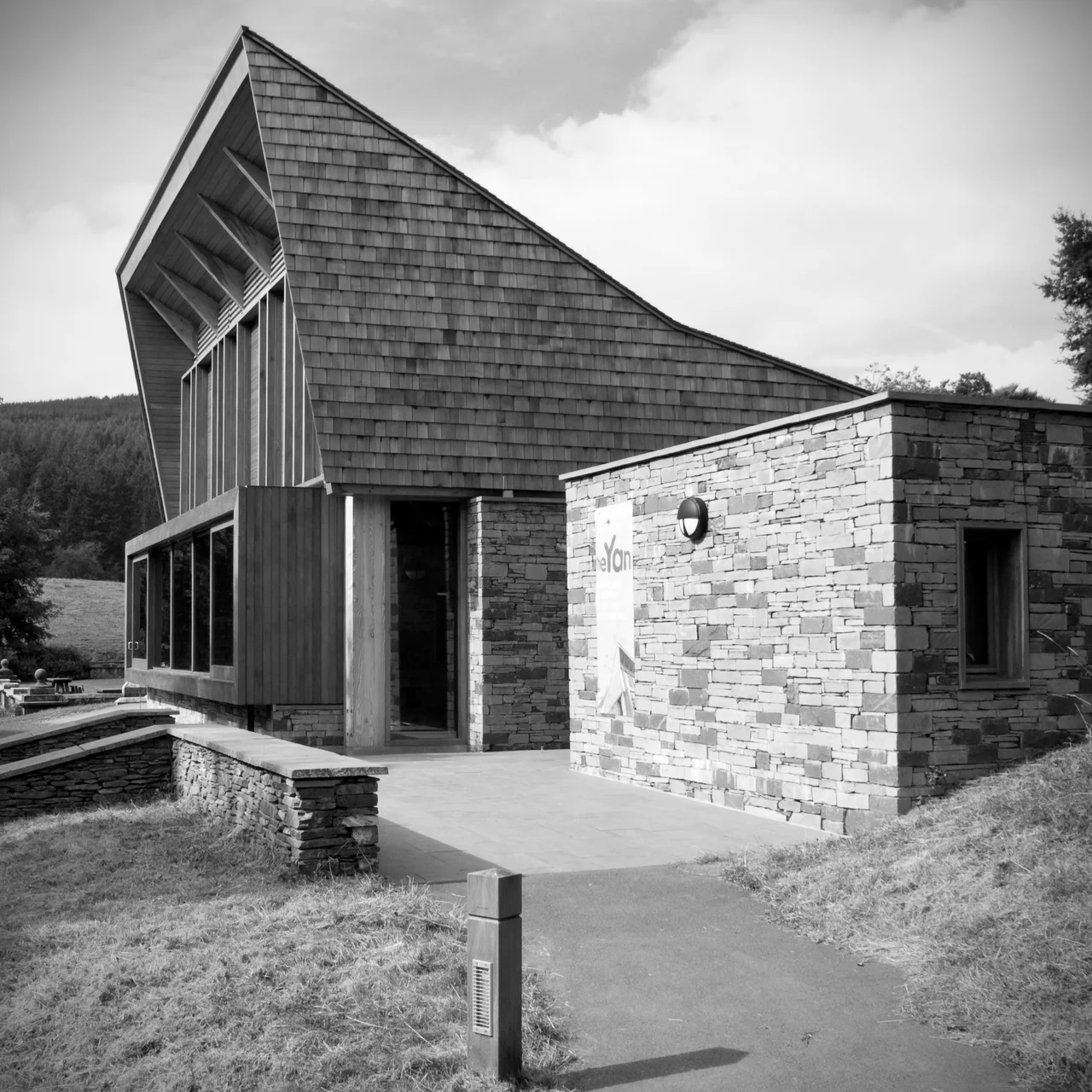
Walk through the Grizedale Forest visitor centre today and the past is mostly absence: a garden terrace whose walls and stairs survived, a stone close with its gates, an annex building that once stood beside the demolished hall. In 2008 a new visitor centre building called The Yan opened in extension of that surviving annex, designed by Sutherland Hussey Architects of Edinburgh in timber and natural stone. The name comes from yan tan tethera, the old shepherds' counting rhyme. Lord Clark of Windermere opened it on 23 June 2008. For some years before, the grounds had been used as a campsite by the Camping and Caravanning Club. Visitors today are mostly mountain bikers, sculpture-trail walkers, and families - few aware that the car park beneath their feet covers the floor of what was, for seven war years, one of the strangest hotels in Britain.
From the Air
Grizedale Hall's former site sits at 54.34 N, 3.02 W in the Grizedale Forest between Coniston Water (to the west) and Windermere (to the east), south of Hawkshead. From altitude the valley is identifiable by the long ribbon of forested ground between the two lakes. Nearest airfield is Walney Island (EGNL), about 25 km south-west on the Furness coast. Carlisle Lake District (EGNC) lies 70 km north. Recommended viewing altitude 2,500-4,500 ft AGL. The forest canopy hides what little is left of the hall; look for the visitor-centre car park as the marker. Hill weather over the Coniston Fells to the west and Claife Heights to the east can change quickly.
Nearby Stories
- Morecambe Bay 4.1 km away
- Caldbeck 8 km away
- Pendragon Castle 8.1 km away
- Egremont Castle 8.5 km away
- Upper Teesdale 13 km away
- Solway Firth 13 km away
- Malham Cove 21 km away
- Santon Railway Station 70 km away