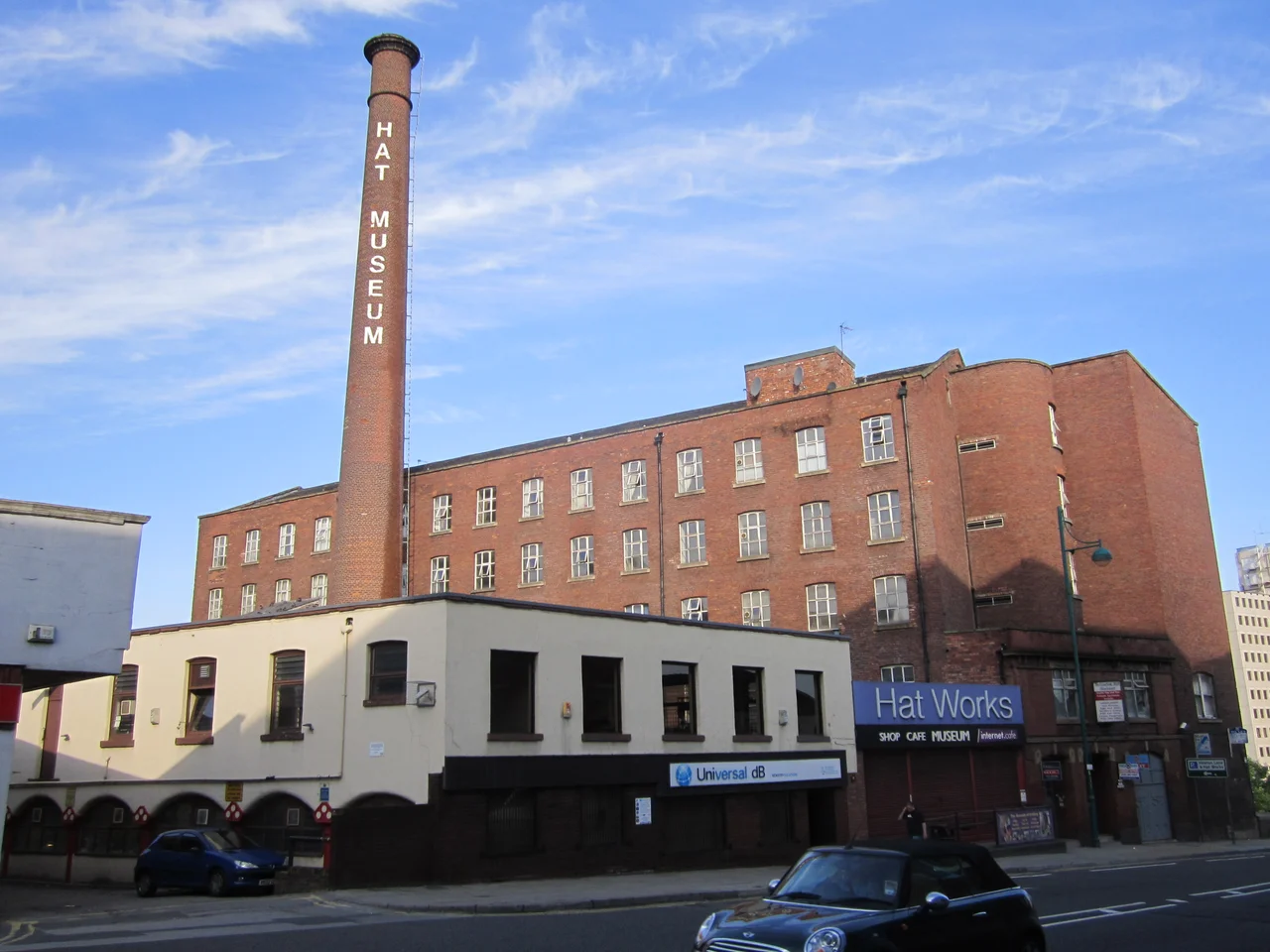

Hat Works
A 200-foot red brick chimney rises above the railway viaduct in Stockport, slender and improbable, looking down on Greater Manchester's bus station. It belongs to Wellington Mill, the seven-storey fireproof cotton mill of 1830 that ended its working life making felt and straw hats. The chimney once vented four Lancashire boilers; today it watches over the UK's only museum dedicated entirely to the hat-making trade. Stockport, after all, was hatting country for more than 400 years.
Iron Bones, Brick Vaults
Wellington Mill was built between 1828 and 1831 for the Marsland family, a 135-foot-long block on Daw Bank in the lee of Stockport's growing industrial sprawl. Its makers were among the early generation of mill builders trying to defeat the great fear of the cotton trade: fire. The frame was cast iron. Two iron pillars supported an iron beam that ran the width of the building, and from those beams sprang shallow brick vaults nine feet across, rising eleven inches above the line of the beam. Wrought iron tie-bars absorbed the outward thrust. The space above each vault was filled with sand, then planked over to form the floor of the storey above. A semicircular stair tower projects from the eastern wall, and the roof, originally clad in blue Welsh slate, sits on six-segment bolted cast-iron arches of 33-foot radius. It was an engineer's mill, as far from architectural showmanship as you can get.
Spinning Mules and Steam
An 1830 beam engine with a 7-foot stroke and a 17-foot beam first turned the line shafts; the position of the engine house took clever advantage of a culvert that already carried water to the family printing works next door, water needed for the condenser. The first engine was replaced in 1835 by a larger one, and four Lancashire boilers eventually supplied the steam that fed it. Power entered the mill on the first floor through the south wall of bay 15, where bevel gears turned a vertical shaft running the full height of the building. From each floor, main shafts and line shafts on hangers drove the machines. The width of the mill, 42 feet, suggests it was designed for self-acting spinning mules patented in 1825. By 1870, when John and George Walthew took over, the mill was running on throstles instead, spinning and doubling cotton for the wider Stockport weaving trade.
From Cotton to Hats
Sarah Ward opened a hat warehouse in 1848, and in 1895 her family's firm, Ward Brothers, moved into the old cotton mill. They were finishers and trimmers, not felters, so they bought their wool bodies ready-made from Denton and Stockport. The mill needed little adaptation. A new central staircase went in, a new eastern facade, and the iron-framed building turned out stiff felts, soft felts, men's and boys' straws, tweed caps, workmen's hats, and children's velvets and plush hats. Ward Brothers stayed until the 1930s. By that point, the Stockport hat trade was already shrinking under pressure from changing fashions and overseas competition, although the local consolidation of 1966, when several firms merged into Associated British Hat Manufacturers, kept things going a little longer.
The Last Felt Hat
Wilson's at Denton closed in 1980. Christy's, the great old name in the trade, held on until 1997. When the door shut behind the last worker, more than 400 years of hatting in the Stockport and Denton area came to an end, and a way of working that had once clothed the heads of soldiers, gentlemen, bus conductors, and bricklayers became something only museums remembered. The Hat Works opened in 2000 inside Wellington Mill, a Grade II listed building given a second civic purpose. Earlier displays had been scattered between the old Battersby factory on Hempshaw Lane and the Stockport Museum; here at last the machinery, the blocks, the conformators, and the finished hats had a single home, with that 200-foot chimney standing guard outside.
What Survives
The mill's original engine houses are gone, and the adjoining six-storey Daw Bank Mill has been demolished. So has the privy tower that once stood beside the stair tower. What remains is the great fireproof block itself, two seven-storey wings beside the stair tower, the round chimney built when the second engine house went up, and the heavy stone window sills and camber-arch lintels that mark each of the 15 bays. Inside, where mules and throstles once thundered, visitors now turn the wheels of small finishing machines, try on a fur-felt topper, and read the names of the firms that disappeared. Stockport spent four centuries making hats. It now keeps the memory in the building that helped make them.
From the Air
Wellington Mill stands at 53.4085 N, 2.1622 W in central Stockport, Greater Manchester, immediately adjacent to the M60 motorway and Stockport viaduct. Manchester Airport (EGCC) lies roughly 8 miles to the south-west; Manchester Barton (EGCB) is north-west. The mill's tall round brick chimney makes a clear visual landmark when crossing the Mersey valley. Recommended viewing altitude is 2,000 to 3,500 feet AGL for the dense Stockport townscape and the long brick viaduct that defines this corner of the city.
Nearby Stories
- Hope Cement Works 1.5 km away
- Liverpool John Lennon Airport 3 km away
- Diglake Colliery Disaster 3.4 km away
- Holt Castle 4.6 km away
- Bank Hall 6.9 km away
- Rochdale Pioneers Museum 8.3 km away
- National Coal Mining Museum for England 9.6 km away
- Belper North Mill 19 km away