
Battle of Rowton Heath
He climbed a tower to watch them die. Charles I of England stood on the city walls of Chester on the afternoon of 24 September 1645, on the tower that would afterwards be named for him, and looked east across the heath at his own cavalry. They were the men he had brought north to save Chester. They were the men who would save his last good port, his lifeline to Ireland, his bridge to whatever shred of his kingdom still answered his name. By dusk, six hundred of them were dead, nine hundred were prisoners, and Charles himself was riding for his life into Wales. From a tower on his own city walls, the King of England watched his cause come apart at three thousand feet of distance.
How a King Runs Out of Ports
Naseby in June had broken the Royalist field army. Langport in July had broken what was left of Goring's western command. By September, Charles I was traveling with the wreckage - some 3,500 cavalry, experienced but exhausted, drifting between failed plans. He had tried to reach the Marquess of Montrose in Scotland and been turned back. He had raided into the Eastern Association and forced the parliamentary siege of Hereford to lift, but the gains were temporary. Then a messenger reached him in Wales: part of the outer defences of Chester had fallen, and the city - his last functioning port for supplies and reinforcements from Ireland - was hours from collapse. He turned the column north. On the night of 23 September, while his cavalry under Sir Marmaduke Langdale camped at Hatton Heath south of Chester, Charles and 600 of his Lifeguard slipped through the parliamentarian siege lines and into the city. The plan was simple enough on paper. The besiegers, only 500 horse and 1,500 foot, would be caught between the King in Chester and Langdale outside it, and broken.
The Force Charles Did Not Know Was Behind Him
Sydnam Poyntz had been chasing Charles for weeks with 3,000 parliamentarian horse, and the King was certain he had lost him. He had not. As Charles crossed into Chester, Poyntz was twelve miles away in Whitchurch, promising that he would advance at first light with everything he had. One of Poyntz's messengers was intercepted by the Royalist Sir Richard Lloyd, who got word to Langdale and the King. They held a hasty Council of War in Chester. The decision was that Langdale would turn south to meet Poyntz, while a relief force under Charles Gerard and Lord Bernard Stewart - Charles's cousin, commander of the Lifeguard - would advance from the city to either join Langdale or block parliamentarian reinforcements from coming out of the siege lines. Charles himself would stay in Chester and watch. He climbed the Phoenix Tower on the eastern walls, the tower that still stands today, and he watched.
The Morning Skirmish
Langdale was good. At Miller's Heath, just before seven in the morning, he ambushed Poyntz's vanguard from hedgerows lined with dismounted dragoons. Poyntz had not expected him there. The parliamentarian column was strung out, the ground boggy beneath them, and they could not deploy. For half an hour the lane became a slaughtering ground at close range, until Poyntz broke off and pulled back. Twenty parliamentarians were dead. Around sixty were prisoners. Langdale had won the morning. But he was three miles from Chester and he needed reinforcements to finish the job, and the messenger he sent, Lieutenant Colonel Jeffrey Shakerley, had to cross the River Dee somehow to get into the city. Shakerley used a washtub. He got across, delivered the message in fifteen minutes, and then he waited. The Royalists in Chester took six hours to issue orders. Six hours, while Poyntz reformed and the Parliamentarians around Chester sent fresh troops out to find Langdale. By the time Gerard's relief column moved, it was too late.
Watching From the Tower
At about two in the afternoon, 350 parliamentarian horse and 400 musketeers under Colonels Michael Jones and John Booth marched out of the siege lines toward Langdale. Gerard's force, hurrying to join him, was intercepted on Hoole Heath by 200 cavalry and 200 infantry. There, in a confused engagement that the chroniclers would describe only briefly, Lord Bernard Stewart was killed. He was twenty-two. He had been with his cousin the King for years, and his death meant that Gerard could not break through to Langdale. By four in the afternoon, Langdale stood alone on the open ground of Rowton Heath against 3,000 parliamentarian horse and 500 musketeers. From the walls of Chester, where the King watched, the cavalry could probably be seen only as moving shapes - the dust of horses, the punctuation of musket smoke. Charles could see the volley fire. He could see Langdale's counter-charge and its failure. He could see the Royalist line buckle as parliamentarian musketeers fired into its rear, and break, and scatter.
What Came Back to the Walls
Some of Langdale's men escaped via Holt Bridge over the Dee. Some retreated toward Chester itself, met Gerard's broken force at Hoole Heath, and tried a last desperate counter-attack that pushed the Parliamentarians briefly back. But there were too few of them and they had no reserves, and they were eventually driven against the city walls. The retreating cavalry choked the streets of Chester so tightly that parliamentarian musketeers, firing from outside, simply shot into the press of horses and men. Six hundred Royalists were killed, including Lord Bernard. Nine hundred were taken prisoner. The next morning Charles I, with 2,400 horse remaining, rode out of Chester for Denbigh Castle and then on toward Newark. He never saw the city again. The siege resumed. On 3 February 1646, Chester surrendered. The remaining Royalist cavalry were destroyed three weeks after the battle when Poyntz ambushed them at Sherburn-in-Elmet. Rowton Heath was not the last battle of the First English Civil War, but it was the day Charles I finally ran out of horses, ran out of ports, and ran out of options - and the day he watched it happen from his own walls.
From the Air
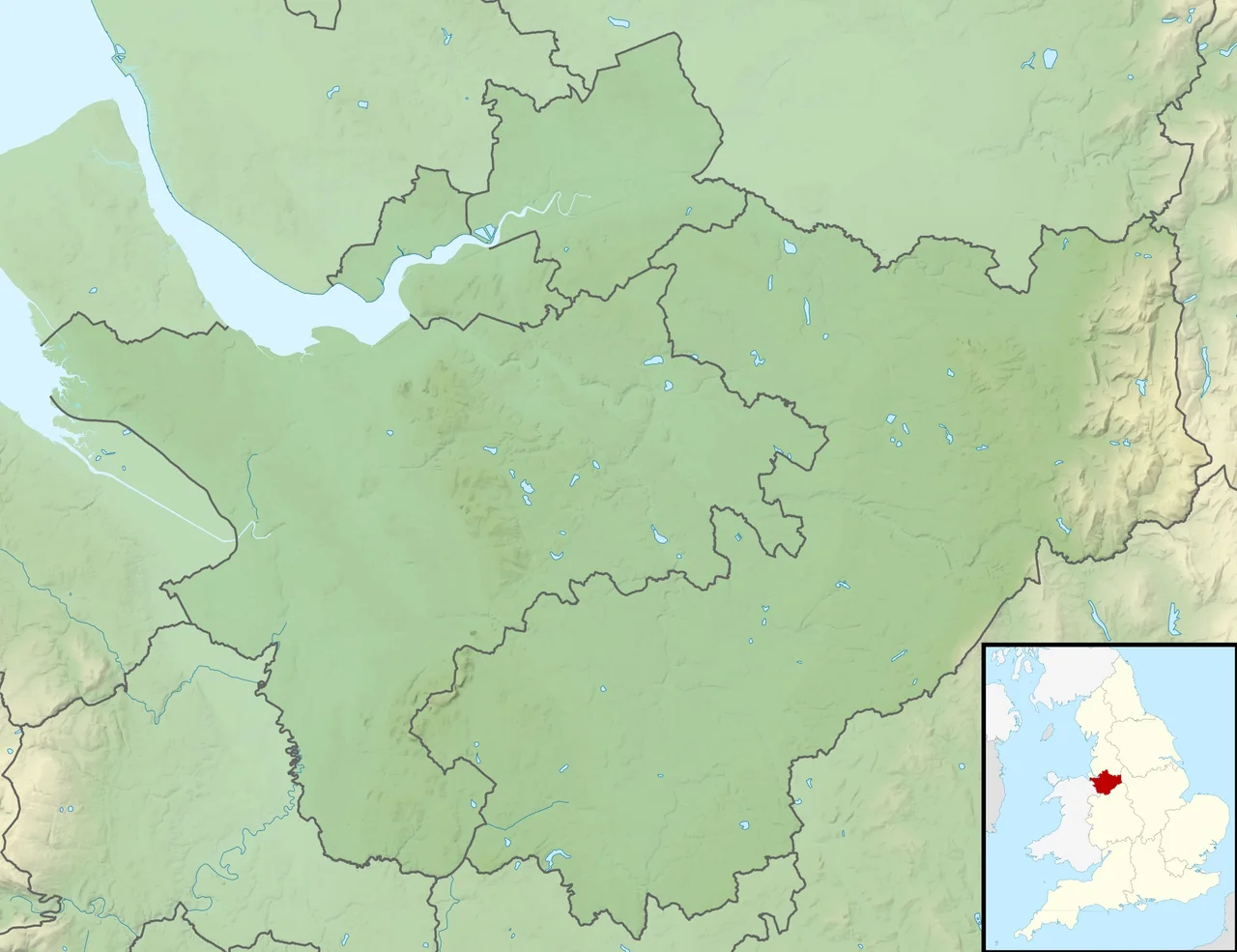
Located at 53.17 degrees north, 2.83 degrees west, just southeast of Chester city centre. Best viewed from 2,000 to 3,500 feet. The battlefield is now mixed farmland and the southern edge of Chester's suburbs; the city walls and Phoenix Tower are clearly visible to the northwest. Hawarden Airport (EGNR) is 5 nautical miles west across the Welsh border, Liverpool John Lennon (EGGP) is to the north, and RAF Shawbury (EGOS) is to the south-southeast. The historic battlefield is on the Registered Historic Battlefields list and parts of the Whitchurch-Chester road still trace the line of Langdale's morning ambush.
Nearby Stories
- Goodison Park 1.5 km away
- First Battle of Middlewich 2.4 km away
- Whittington Castle 4.2 km away
- Worsley 9.5 km away
- Gwrych Castle 14 km away
- Lilleshall Abbey 22 km away
- Cymer Abbey 31 km away
- Celtic Array 70 km away