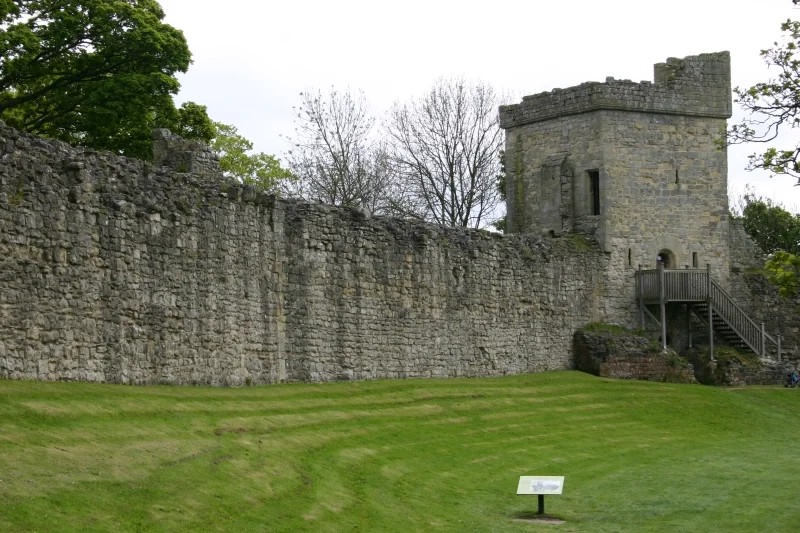

Pickering Castle
Richard II spent his final months as a prisoner inside walls that William the Conqueror's men had begun raising more than three centuries earlier. He arrived at Pickering Castle in 1399, deposed by his cousin Henry Bolingbroke, and was then moved on to Pontefract, where he died. Pickering had become a holding cell for a king the new regime needed kept out of sight. The walls that contained him were the latest version of a fortress that had been refortified, rebuilt, and rebuilt again since 1069, when the Normans wanted a hard point from which to control the rebellious north.
Born of the Harrying
The first castle at Pickering was timber and earth, thrown up in 1069 or 1070 as William the Conqueror's army moved through Yorkshire executing what came to be called the Harrying of the North. Villages were burned, fields salted, populations slaughtered or driven to starvation. The motte and bailey at Pickering existed to make sure none of it came back. By the late twelfth century, timber had given way to stone. Between 1180 and 1187, masons built the inner ward. The keep on top of the motte was rebuilt as a stone shell keep between 1216 and 1236, along with a chapel whose reconstruction visitors can see today. The castle's western side sits on a considerably steep cliff. Anyone attacking from that direction had to climb before they could fight.
Edward II and the Scots
By 1322, Edward II was very nearly captured by the Scots during the chaos of his disastrous northern campaigns. Pickering Castle's defences were hurriedly re-fortified on his orders, and the garrison strengthened. Between 1323 and 1326 builders added an outer ward and curtain wall with three towers, two ditches, a gatehouse, ovens, a hall, and storehouses. The castle that emerged was a serious piece of military engineering for its era, designed for a country at war with itself and its neighbours. Most of what visitors walk today dates from this Edwardian period of construction, the work of a king who had nearly become a Scottish prisoner and wanted no repeat.
The Civil War Strip-Mining
Pickering Castle came through the Wars of the Roses untouched. It might have come through the English Civil War the same way, except that it was held for the king. Cromwell's forces breached the west wall, and three mounds west of the castle are said to mark the positions of their cannon. Most of the west side came down. Then Parliamentary troops occupied the site, and Sir Hugh Cholmeley did something almost stranger than the bombardment: he stripped Pickering Castle of its lead, timber, and iron and shipped the materials to Scarborough Castle for that fortress's defences. Pickering was effectively dismantled to fortify somewhere else. What survived survived because no one bothered to finish the job.
From Ruin to Monument
The dismantled castle entered a long quiet. The Duchy of Lancaster still owns the property, a holdover from the medieval royal administration of northern England, but by the early twentieth century the ruins were a relic without a role. In 1926 the Ministry of Works took possession, the predecessor to English Heritage which manages the site today. It is a Scheduled Monument and open to the public. The shell keep on its motte, the rebuilt chapel, the towers and gatehouse of Edward II's outer ward, and the broken stones where Cromwell's cannon struck all sit in the Vale of Pickering, looking down on the market town below and the steam railway running south from Goathland through Newton Dale.
Flight Context
Pickering Castle is at 54.25 N, 0.78 W on the northern edge of the market town of Pickering, where the Vale of Pickering meets the southern escarpment of the North York Moors. The motte and stone keep are easy to spot from the air, sitting on rising ground above the town centre. Nearest airport is Teesside International (EGNV), about 30 miles north-west. Leeds Bradford (EGNM) is roughly 45 miles south-west. Best viewing is 2,000 to 4,000 feet AGL from the south, where the castle's profile against the moors is clearest. The North Yorkshire Moors Railway runs north from here through Newton Dale, often steaming with vintage locomotives in daylight.
From the Air
Pickering Castle is at 54.25 N, 0.78 W on rising ground above Pickering town. Best viewed from 2,000-4,000 feet AGL on a south-to-north approach showing the castle against the moors. Teesside International (EGNV) about 30 NM north-west; Leeds Bradford (EGNM) about 45 NM south-west. North Yorkshire Moors Railway runs steam services through nearby Newton Dale.
Nearby Stories
- 1892 Thirsk Rail Crash 4.3 km away
- Filey Brigg 5.6 km away
- Yorkshire Air Museum 7.2 km away
- Staithes 8.9 km away
- Darlington 10 km away
- Harewood House 11 km away
- Burton Constable Hall 20 km away
- Breagh Gas Field 56 km away