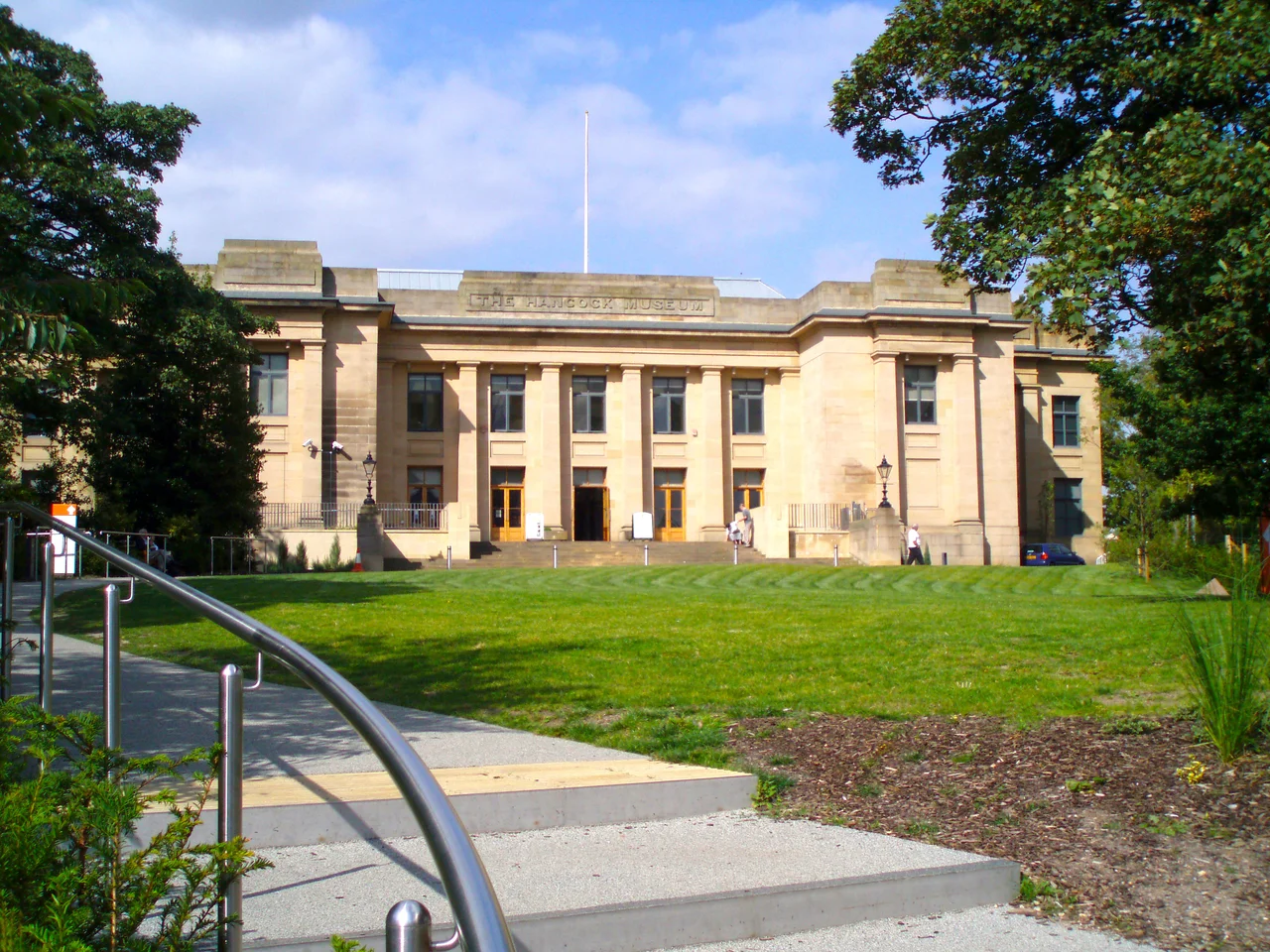

Great North Museum: Hancock
Sparkie was a budgie from Newcastle who learned to recite poetry. He died in 1962. The museum stuffed him. He's still on display today. So is Bakt-en-Hor, an Egyptian mummy with another mummy named Irtyru for company in the next case. So is a life-size cast of an African elephant, made from a real stuffed elephant in a Bonn museum and craned through the wall during construction. So is a full-size T. rex skeleton replica shipped from Canada by Research Casting International, and a wombat that arrived in Europe in the late 18th century as the first complete specimen of its kind to make the journey. The Great North Museum: Hancock holds 240 years of collecting in one Victorian building expanded by Terry Farrell at a cost of £26 million.
Tunstall's Wombat
The collection that became the Hancock Museum can be traced to roughly 1780, when Marmaduke Tunstall began accumulating ethnographic and natural-history specimens in London, then moved them to North Yorkshire. He died in 1790. George Allan of Darlington bought the collection. In 1823 it passed to the Literary and Philosophical Society of Newcastle upon Tyne. The wombat was already in it. The first complete wombat to reach Europe, it predates the formation of the Natural History Society of Northumberland, Durham and Newcastle upon Tyne by six years. That society, founded in 1829 as a scientific offshoot of the Lit and Phil, included among its early members Joshua Alder, Albany Hancock, John Hancock, Prideaux John Selby and William Chapman Hewitson - naturalists whose names still attach to species across northern England and beyond.
Armstrong's Eleven Thousand
The Society's first museum opened on Westgate Road in 1834, but the collection quickly outgrew it. In 1884 the current building opened on its present site, with a £11,500 donation - an enormous sum then - from William Armstrong, the Tyneside industrialist whose firm built much of Britain's late-Victorian arms industry. Armstrong had also founded the College of Physical Science that grew into Newcastle University, which still co-stewards the collections. The museum was renamed in the 1890s after the brothers Albany and John Hancock, the local Victorian naturalists whose work shaped its scientific identity. For more than a century it was simply known as the Hancock. In 2006 it merged with Newcastle University's Museum of Antiquities and Shefton Museum to form the Great North Museum, and in 2009 reopened after a £26 million refurbishment under architect Terry Farrell - a Newcastle native and former Newcastle University student.
Hadrian on the Wall, Hadrian in the Case
Newcastle sits at the eastern terminus of Hadrian's Wall, the 73-mile frontier the Roman Emperor Hadrian ordered built in the 120s AD to mark the northern edge of the empire. The Hancock's Hadrian's Wall gallery is the closest comprehensive interpretation of the wall to its actual line. In September 2008, the museum advertised for a Hadrian lookalike for a photo shoot, looking to install a life-size impersonation in the permanent display. The Shefton Collection holds one of the UK's most detailed assemblages of Greek artefacts. Ancient Egypt features both the Bakt-en-Hor and Irtyru mummies. The Ice Age to Iron Age gallery covers 12,000 years of British prehistory. World Cultures spans ethnographic material from across the globe, much of it collected by Victorian travellers whose lives the modern interpretation is increasingly honest about.
Bio-Wall and Bison Bull
The reopened museum included an interactive Bio-Wall with hundreds of creatures shown surviving in extreme habitats from the Arctic to deserts, a great white shark display, polar bears and giraffes from the historic Hancock collections, and a moa skeleton. Between May and October 2019, the museum hosted Dippy the diplodocus on his UK tour. A 'fine bison bull' was mounted for the museum by Manchester taxidermist Harry Ferris Brazenor in 1908 and remains on display. Within the archives sit the 19th-century botanical paintings of Margaret Rebecca Dickinson, depicting plants from Newcastle and the Scottish Borders region. The library is open to the public on the second floor, housing the Library and Archives of the Natural History Society of Northumbria, the Library of the Society of Antiquaries of Newcastle upon Tyne, and the Cowen Library belonging to Newcastle University.
Six Hundred Thousand Visitors
The reopening on 23 May 2009 - the formal one came later, on 6 November, when Queen Elizabeth II cut the ribbon - blew past the annual target of 300,000 visitors. By August, four months in, more than 400,000 people had been through the doors. By the end of 2009 the figure exceeded 600,000. Triple-jump world record holder Jonathan Edwards is patron of the museum's fundraising campaign; other celebrity supporters include Sir Thomas Allen and Adam Hart-Davis. Donors can have their names permanently engraved on a donor wall. The 2010 Art Fund Prize long-listed the Hancock. Beneath the museum lies a Second World War air-raid shelter opening into the Victoria Tunnel, a 19th-century waggonway that ran from Spital Tongues to the Tyne. The museum that started with a wombat now holds a quiet record of how the North East has tried, century after century, to make sense of the world.
From the Air
54.98N, 1.613W. The Great North Museum: Hancock sits on the Newcastle University campus immediately west of the Great North Road and just north of Newcastle city centre, near Barras Bridge. Recognisable from the air by its Victorian sandstone form attached to Farrell's modern extension. Best viewed at 1,500-2,500 ft AGL. Nearest airport: Newcastle International (EGNT), 4 nm to the northwest. The St James' Park football ground is about 600m southwest.
Nearby Stories
- Cresswell Lifeboat Station 5.2 km away
- Auckland Castle 5.7 km away
- Battle of Otterburn 7.1 km away
- Saltburn Pier 11 km away
- Hadrian's Wall Path 11 km away
- Battle of Stainmore 18 km away
- Saltburn-by-the-Sea 39 km away
- Alexander L. Kielland (Platform) 296 km away