
Saltburn-by-the-Sea
In 1859, the Quaker industrialist Henry Pease was walking along an empty stretch of cliff above the North Sea when, according to family tradition, he had a vision. A new town would rise there - a planned, sober, salubrious seaside resort, with streets named after gemstones, served by his own railway, financed by his own company, and conspicuously short on pubs. He built it. Saltburn-by-the-Sea is the result: a complete Victorian resort dropped onto a coast that previously held nothing but a smugglers' inn called the Ship, the seventeenth-century home of John Andrew, known locally as the King of Smugglers. The Quaker town and the smugglers' hamlet both still stand, separated only by Saltburn Gill and about two hundred years of moral history.
The King of Smugglers
Before Henry Pease, there was only Old Saltburn - a row of fisherman's cottages in the gill at the foot of the cliff, dominated by the Ship Inn, dating to the seventeenth century. The publican John Andrew ran one of the most successful smuggling operations on the northeast coast. Brandy, tea, tobacco - everything taxed by the Crown came in across this beach by night and went out across the moors by packhorse before dawn. The name Saltburn comes from the Old English saltburna, salt stream, after the brine spring that bubbled up nearby. The hamlet had been there for centuries, doing what nobody officially noticed it doing. In 1856, six years before Pease started building above, it still consisted of the inn and a single row of houses occupied by farmers and fishermen.
Pease's New Town
The Pease family of Darlington had built the world's first public passenger railway, the Stockton and Darlington, in 1825. By the 1850s they were the leading industrial dynasty of Teesside - Quakers, abolitionists, philanthropists, and men of unusual energy. Henry Pease's railway pushed east from Middlesbrough toward the new ironstone mines of the Cleveland Hills, and he saw that the same line could open a stretch of coast for a resort. The Saltburn Improvement Company laid out the new town on a grid above the cliff, with streets named after stones - Ruby, Pearl, Diamond, Garnet, Amber - and a strict Quaker prohibition on public houses. Alcohol was served only in the hotels, the bars attached to them, and the various clubs. The first proper independent pub, The Victoria, did not open until 8 December 1982 - more than a century after the town was founded.
Pier and Funicular
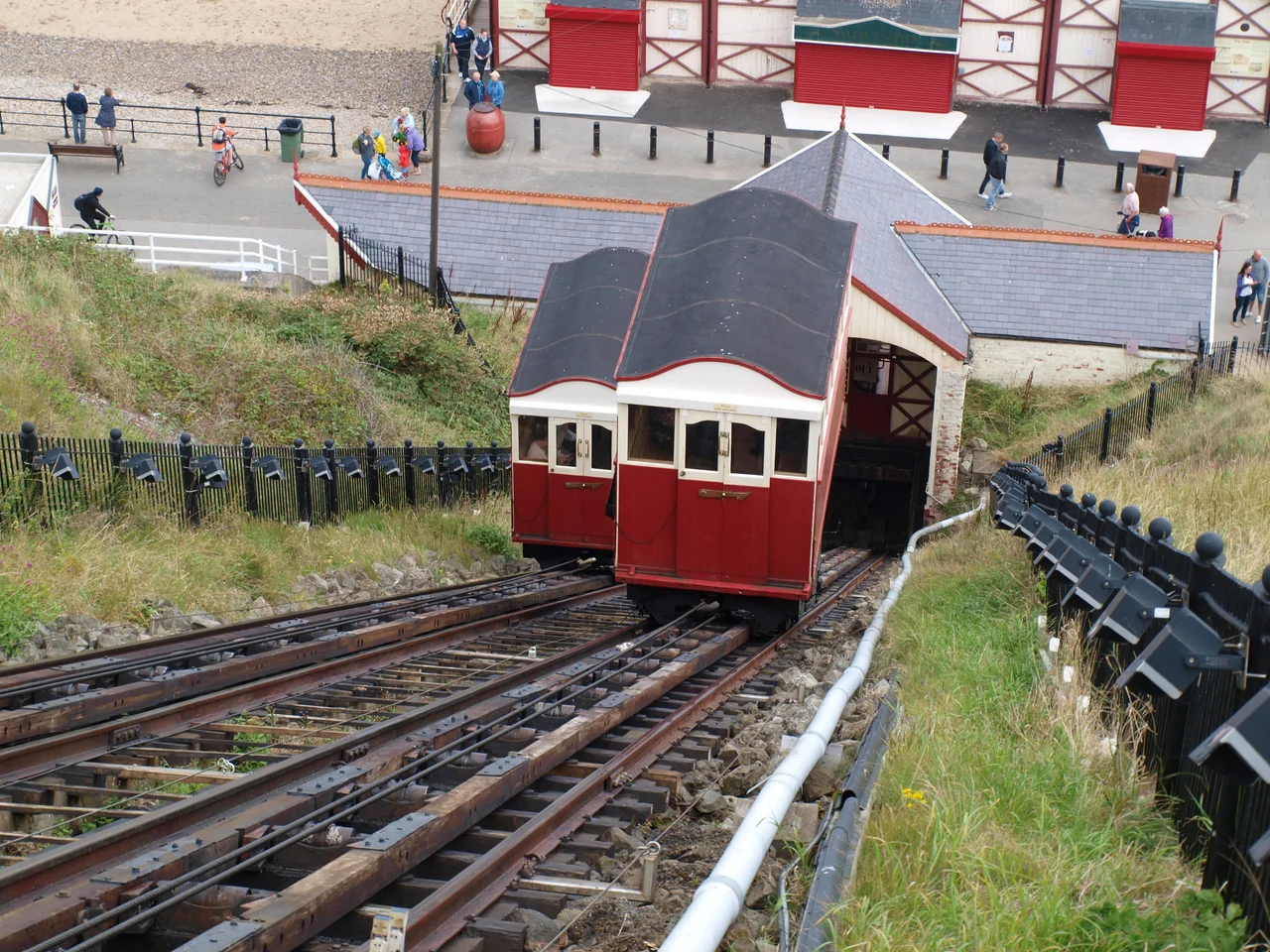
Saltburn Pier opened in 1869, a 1,500-foot iron walkway out into the North Sea - the only pleasure pier left on the Yorkshire coast. Six years later, on the night of 21-22 October 1875, a gale tore 300 feet off the seaward end, taking the landing stage with it. The pier company, caught in an iron-trade slump, decided not to replace it; the truncated 1,250-foot version reopened in 1877. By 1880 the company was bankrupt and the pier was auctioned in the lobby of the Alexandra Hotel for 800 pounds. To get visitors from the town down to the pier, Sir Richard Tangye's company built the Saltburn Cliff Lift in 1884 - a water-balanced funicular, 120 feet high, on a 71 percent incline. It is one of the oldest water-powered funiculars in the world, second only to the Bom Jesus funicular at Braga in Portugal. The water pump has been electric since 1924; otherwise the lift works as it did when it opened.
Speed on the Sands
On 17 June 1922, Sir Malcolm Campbell took his Sunbeam 350HP - already nicknamed Blue Bird - onto the hard sand at low tide on Saltburn Sands. He drove flat out and clocked 138.08 miles per hour. The run was unofficial because the surface wasn't sanctioned, but it was his first speed record, the start of a career that would carry him through nine more, faster ones at Pendine, Daytona and finally Bonneville. The Saltburn run was also a sign of what these long flat northeastern beaches would be used for in the years before tarmac. Today the same sand carries surfers - autumn and winter swell from the North Sea draws competitors from across Britain - and the annual North Riding Duck Race on 1 August, Yorkshire Day, when wooden ducks are released into Skelton Beck and the winner takes the Colin Holt Cup.
Famous Sons
Saltburn's terraces have produced an oddly varied set of famous residents. Erasmus Darwin IV, grandson of the great naturalist, lived on Albion Terrace and died in the First World War in 1915; his name is on the town's memorial. David Coverdale, the lead singer of Deep Purple and Whitesnake, grew up in the Red Lodge on Marine Parade. The astronaut Nicholas Patrick, who flew on two Space Shuttle missions, was born here. So were the footballers George Hardwick, Tony Mowbray and Graeme Murty. The astrophysicist Carole Ann Haswell - discoverer of multiple exoplanets - is also a Saltburn lass. A Quaker railway town with strict rules about pubs has somehow produced a hard-rock vocalist, a NASA astronaut and a planet-finder. Pease, presumably, would be quietly satisfied with the planets and the astronaut, if not the music.
From the Air
Saltburn-by-the-Sea sits at 54.5828 degrees N, 0.9732 degrees W, on the southern shore of the Tees Bay. Nearest aviation reference is Teesside International (EGNV) about 25 km west-southwest. From 2,500 ft AGL the town reads as a Victorian grid laid out on the clifftop, with Hunt Cliff rising 166 m to the east toward Warsett Hill, the pier projecting clean into the North Sea, and the dark line of the funicular running up from the beach. Skelton Beck cuts the wooded Valley Gardens behind the town. Best light is morning, when the cliffs and pier are fully illuminated from the east; afternoon brings haze off the sea.
Nearby Stories
- Ryedale Folk Museum 3 km away
- 1892 Thirsk Rail Crash 5.5 km away
- Penshaw Monument 6.5 km away
- Darlington 12 km away
- Filey Brigg 12 km away
- German submarine U-2367 28 km away
- Seaham Hall 30 km away
- Battle of Flamborough Head 49 km away