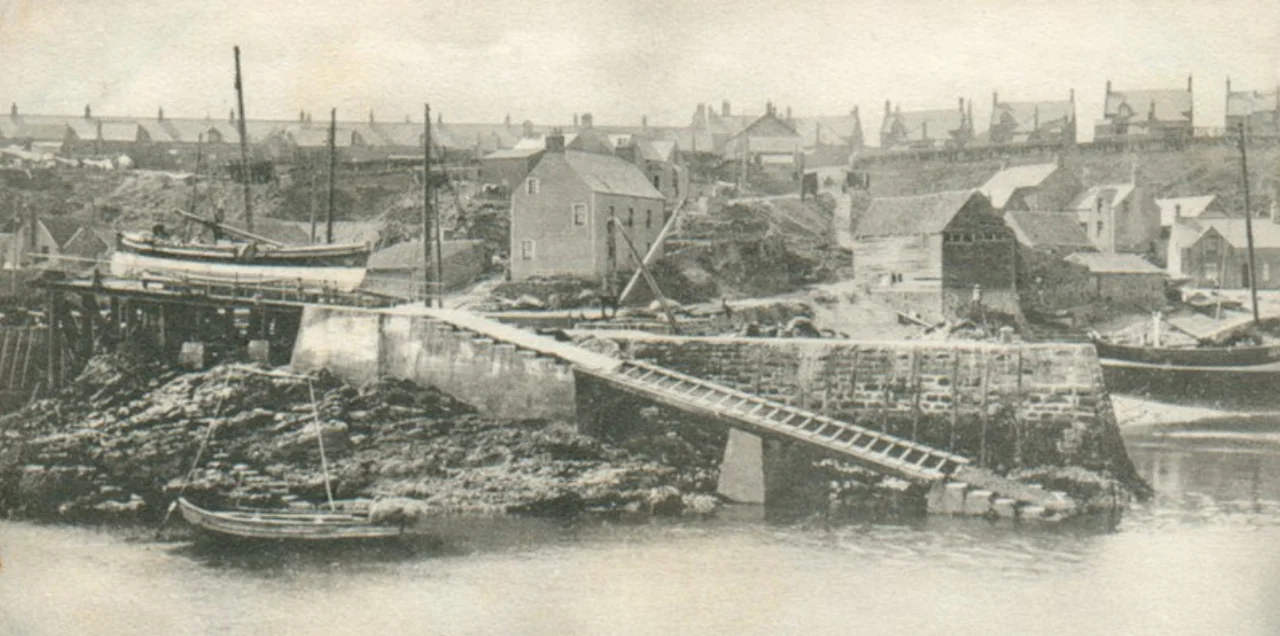

St Abbs Lifeboat Station
Jane Hay wrote the letter that built the station. On the night of 17 October 1907, she stood on the cliffs above St Abbs and watched the steamer Alfred Erlandsen go to pieces on Ebb Carr Rocks with 17 men aboard. The lifeboats came from Eyemouth and from Skateraw down the coast, but the conditions were impossible and the rescues failed. Every man on the Erlandsen drowned. Jane Hay went home and wrote to the Edinburgh Evening News: as one of those who witnessed the tragedy which occurred at St Abbs on Thursday night, I write to say that personally I shall never rest content till we have a lifeboat and rocket apparatus of our own in St Abbs. She got her station. A century later, when the RNLI tried to close it, the village got it back.
Jane Hay's Campaign
She convened a public meeting in the village and led a petition to the RNLI. The campaign was extraordinarily short. The Chief Inspector of Lifeboats visited St Abbs within weeks. On 9 January 1908, less than three months after the wreck, the RNLI committee of management resolved to establish a new lifeboat station at St Abbs. They commissioned one of the first motor-powered lifeboats in the world, a 38-foot boat built by Thames Ironworks at Blackwall in London, completed in 1910. On 25 April 1911 the Helen Smitton arrived at her new station. Jane Hay was appointed Honorary Secretary, one of the few women ever to hold that office in the RNLI. She held it until her death on 26 January 1914. She had insured her life for 200 pounds, and that sum went toward building the boathouse, completed in 1915. The current station's last all-weather lifeboat, on station from 1964, was the Jane Hay (ON 974). The village named its boat for the woman who had named the station into existence.
From All-Weather to Inshore
Four all-weather lifeboats served St Abbs across 63 years. Helen Smitton, William Arthur Millward, James and Mary Walker, and finally the 37-foot Oakley-class Jane Hay. In 1974, the RNLI placed a fast all-weather lifeboat at Eyemouth, four miles down the coast, and decided that St Abbs no longer needed its own heavy boat. The big Jane Hay was withdrawn. St Abbs went over to inshore lifeboats, small open-cockpit rigid inflatables that can be launched fast and worked close to the rocks and caves where most local emergencies actually happen. An Atlantic 21 came in 1979, an Atlantic 75 in 2002. Volunteer helms and crew kept the boathouse going. On 6 June 2011, helm Darren Crowe earned the RNLI Bronze Medal for swimming into Ty's Tunnel cave at the foot of St Abb's Head on a line, in violent water, to extract a fisherman who had fallen from the cliffs. He brought the man out. The St Andrew's Award for bravery followed.
The Closure
In early 2015 the RNLI executive announced the withdrawal of the St Abbs lifeboat. The decision was made in a coastal review at Poole headquarters without local consultation. The village did not accept it. The Save St Abbs Lifeboat campaign printed 2,000 t-shirts. The petition gathered over 13,000 signatures and was hand-delivered to RNLI headquarters. The RNLI refused to reconsider. On 6 September 2015 the RNLI took its lifeboat out of St Abbs after 104 years of service. The boathouse and slipway remained: those belonged to the village, not the RNLI. The campaign turned to fundraising. Within two months 60,000 pounds came in from local donations. Then Sir Boyd Tunnock, owner of the Lanarkshire confectionery firm Tunnock's, contributed 250,000 pounds toward a new boat. The St Abbs Lifeboat became a Scottish Charitable Incorporated Organisation, raised the money, hired no staff, and went back into service entirely on volunteer labour.
Thomas Tunnock
The new boat arrived on 28 July 2016 and was named Thomas Tunnock at a ceremony on 17 September, in honour of Boyd Tunnock's grandfather, the man who founded the family bakery in 1890 - though the famous Tea Cakes were developed by Boyd himself in 1956. She is an MST900W, a nine-metre rigid inflatable built by Marine Specialised Technology in Liverpool, powered by twin 200-horsepower Mercury outboards, capable of 40 knots. She is one of the fastest lifeboats in the UK. St Abbs Lifeboat now holds Declared Facility Status from the Maritime and Coastguard Agency, which means HM Coastguard can task her exactly as if she were RNLI. The crew is on call around the clock, all year, working without RNLI funding from a station the RNLI tried to close. The boat covers the Berwickshire coast from the south side of St Abb's Head past Eyemouth, in seas that drowned the men of the Alfred Erlandsen and built the station that bears the name of the woman who would not rest content until it existed.
From the Air
St Abbs Lifeboat Station: 55.899 N, 2.129 W on the Berwickshire coast, eight miles north of Eyemouth. Best viewed at 1,500-2,500 ft AGL on a coastal pass; the boathouse and slipway sit at the harbour mouth and St Abb's Head with its lighthouse is two miles north on a dramatic cliffed headland. The Ebb Carr Rocks, site of the 1907 Alfred Erlandsen wreck, lie offshore from the village. Nearest airport is Edinburgh (EGPH), 38 nm north-west; Newcastle (EGNT) is 47 nm south. The coast here has frequent haar and strong easterly weather; cliff turbulence on north-easterly winds.
Nearby Stories
- Luffness Castle 3.7 km away
- RAF Charterhall 6 km away
- Old Course at St Andrews 11 km away
- Galashiels 11 km away
- Bamburgh Castle Lifeboat Station 13 km away
- Crail 21 km away
- Longstone Lighthouse 39 km away
- German submarine U-58 (1938) 221 km away