
Cullerlie Stone Circle
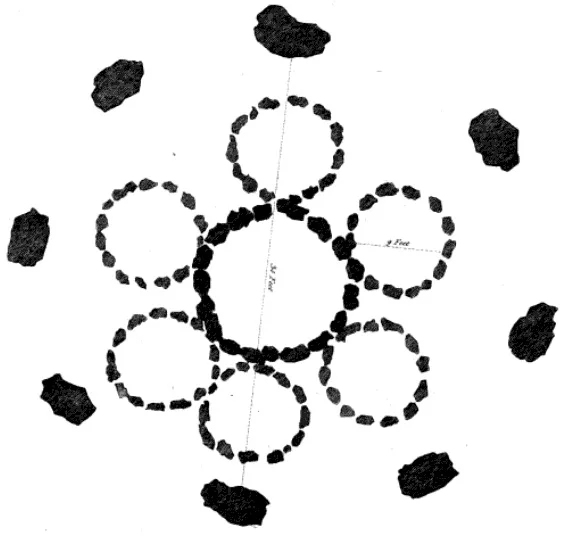
Most stone circles guard their secrets in empty centres. Cullerlie does the opposite. Eight irregular red granite stones, none taller than your shoulder, form a small ring on a low gravel ridge in Aberdeenshire - and inside them, instead of empty ceremonial ground, sit eight little burial cairns ringed with kerbstones of their own. It is the only known circle of its kind. The whole arrangement measures just over ten metres across, modest by the standards of British prehistory. But its strangeness has kept archaeologists arguing for nearly two centuries about who built it, why, and what relationship the builders intended between the standing stones outside and the dead they laid inside.
Standing Stones of Echt
Cullerlie sits about a mile south of the village of Echt, on a low gravel ridge that once formed the southern edge of Leuchar Moss. In the second millennium BC, when the circle was built, the surrounding ground was sodden bog. Hauling these stones to the site was not casual work. The red granite came from higher ground some distance away, and each block - none of them shaped or smoothed - had to be moved across difficult terrain by people who had no draft animals heavier than a small ox. The tallest stones, ranging from 1.09 to 1.80 metres, mark the northern arc of the ring. The arrangement is approximately, but not perfectly, regular. To stand there now is to feel a deliberateness that has survived four thousand years of weathering.
Eight Cairns Within
What makes Cullerlie genuinely unique is what its builders placed inside the ring. Eight small cairns - mounds of stones - sit within the circle, each enclosed by its own kerb of upright ringstones. The central cairn has a double ring of kerbstones; the other seven have single rings. All but one have eleven ringstones; the last has nine. These cairns covered cremations - the burned remains of the community's dead - and the symmetry between eight outer stones and eight inner cairns feels less like coincidence than intent. Scholars have called Cullerlie "a later development from the recumbent stone circle," the great regional tradition of the north-east. But no other recumbent or non-recumbent ring puts the dead inside the boundary like this. It is its own thing.
A 1934 Excavation
Stone circles attract speculation the way ponds attract midges. By the nineteenth century, Cullerlie was being described as the home of seven satellite circles surrounding the main ring, a kind of cosmological diagram in stone. When the site was carefully excavated in 1934, no trace of these satellite circles could be found. The eight cairns inside the main ring were real. The seven outside were not. This is the recurring story of prehistoric archaeology in Britain: every generation projects its own metaphysics onto stones that the builders left silent. The 1934 dig pinned Cullerlie down to what was actually there - a ring, a series of small cremation cairns, and the residue of fires that had once consumed members of a community we cannot name.
The Bronze Age Landscape
When Cullerlie was raised, Aberdeenshire was not yet the Aberdeenshire of green farmland and grey granite. The boggy ground around the site supported scattered woodland and reed beds; the long ridges of higher land carried the dwellings. The people who built recumbent stone circles in this region were farmers - cereal growers and cattle herders - who lived in roundhouses and buried their cremated dead in carefully selected places. Whether Cullerlie marked a family cemetery, a clan gathering point, a seasonal ritual site or all three, the builders meant something by ringing their dead with red granite. The colour of the stone may have mattered. The boundary may have mattered. The number eight, which appears twice over, may have mattered. We can guess. The stones are not telling.
What Endures
Cullerlie is now in the care of Historic Environment Scotland, free to enter, and rarely crowded. The surrounding land is farmland again. Cattle graze a few fields away. The site has the quiet, slightly forlorn dignity of every small monument that has outlived its purpose by several thousand years. To stand inside the ring and look down at the eight little kerbed cairns is to be in the presence of something simultaneously specific and unknowable - eight Bronze Age people whose ashes were placed here with care by relatives who chose this exact spot, on this exact ridge, between these exact eight red granite stones. None of them imagined that someone in the twenty-first century would walk past on the way to a holiday cottage. Nobody intended any of this. And yet, here we are.
From the Air
Cullerlie Stone Circle lies at 57.129N, 2.357W, on a low ridge approximately 12 nautical miles west of Aberdeen city centre. From the air it appears as a small ring of pale stones on a gravel patch surrounded by green Aberdeenshire farmland. The village of Echt sits about a mile to the north. The nearest distinctive landmark is Dunecht House and its parkland to the north-west. Nearest airport: EGPD (Aberdeen Dyce), 11 nm to the east-north-east. Best viewed from low altitude in clear weather.
Nearby Stories
- Dunnottar Castle 5.4 km away
- Kildrummy Castle 5.9 km away
- Delgatie Castle 10 km away
- Keith, Moray 11 km away
- Battle of Mons Graupius 12 km away
- German submarine U-58 (1938) 84 km away
- Longstone Lighthouse 146 km away
- HMS Daring (H16) 158 km away