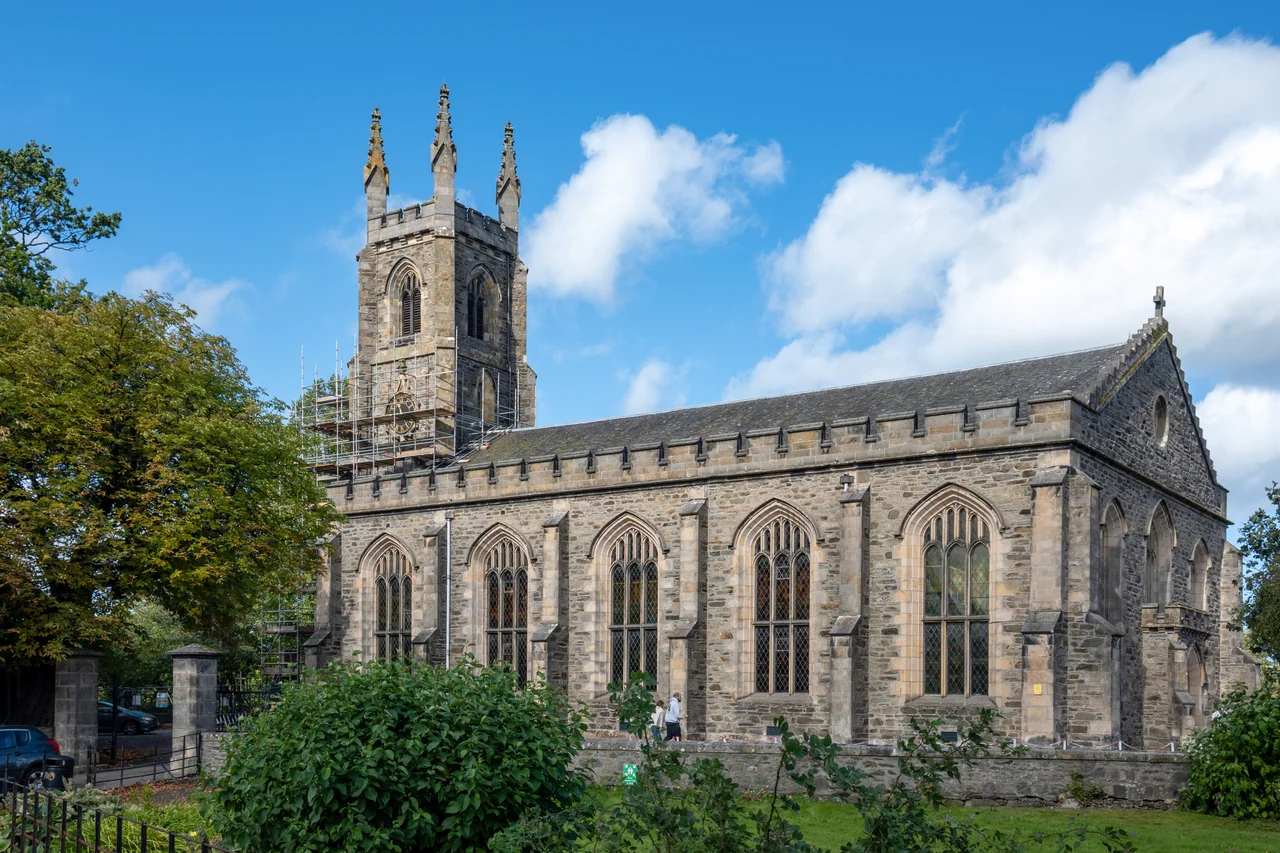

Keith, Moray
The story locals tell about Keith's Old Bridge goes like this. Two parents lost a child in the river at this crossing. Sometime in the medieval years, with their own money and grief, they built a permanent bridge here so that no one else would have to ford the water with a child in their arms. The town that grew up around that bridge is now home to 4,734 people, three working malt distilleries, and a Country Show that has run since 1872. But the founding story is the one the place keeps coming back to: this town began as a memorial, on a riverbank, around 1180.
Three Keiths, One River
Keith is, technically, three towns stitched together by a river. Old Town is the medieval core that grew around the bridge, dating to about 1180. New Keith - what locals just call Keith - sits on higher ground above the Isla and was laid out around 1750 by the Earl of Findlater, a planned grid for an agricultural age. Fife Keith was the cheeky third sibling, founded across the river by a rival earl who hoped to siphon trade away. He failed. The two towns eventually merged into one homogeneous settlement, separated now only by the water that once separated their loyalties. The name itself reaches back further than any of these layers, probably from a Brythonic root meaning "wood" - a memory of forests that have not stood here for a thousand years.
Kethmalruff
Before Keith was Keith, it was Kethmalruff - a dedication to Saint Maol Rubha, the Irish missionary monk who died in 722 and whose foundation at Applecross on the west coast made him one of the great figures of early Celtic Christianity in Scotland. The name suggests that monks from Maol Rubha's Applecross monastery, or from his mother house at Bangor Abbey in Ireland, may have reached this corner of the north-east as part of the Hiberno-Scottish mission. The first parish church stood at a site now marked only by an ancient graveyard. Centuries later, on 21 March 1746, the town hosted a small Jacobite victory. A force under Major Nicholas Glasgow and Captain Robert Stewart surprised a Government detachment here, killing more than twenty - a reminder that, even less than a month before the Battle of Culloden ended the Jacobite cause, the rising was still taking the initiative in northern Scotland.
The Start of the Trail
Today Keith is the gateway to Scotland's Malt Whisky Trail, and three distilleries operate within the town: Strathmill, Glenkeith, and Strathisla, which has been making whisky here since 1786 and has been the headquarters of Chivas Brothers since 1950. Strathisla's distinctive pagoda roofs over the kiln are the picture most visitors associate with Speyside. Within easy reach are Auchroisk, Aultmore and Glentauchers - dense distillery country, where the soft water of the Spey catchment and the local barley feed an industry that survived two world wars and the closure of dozens of competitors. The Keith and Dufftown Railway, an eleven-mile heritage line, lets visitors ride between two of the most concentrated whisky towns in the world.
Hometown of Quiet Bigness
Keith has produced more people than its population would suggest. James Gordon Bennett Sr. left here for New York and founded the New York Herald, the paper that would later send Stanley to find Livingstone. John Ogilvie, the post-Reformation Jesuit priest who was hanged for his faith in 1615 and canonised in 1976, is the town's saint. John Ripley and George Sellar both won the Victoria Cross. James Naughtie still broadcasts on BBC Radio. Isabella Gordon, a marine biologist born here in 1901, became one of the world's foremost authorities on crustaceans and earned an OBE. The Seabury Chair, preserved in Holy Trinity Episcopal Church, is the chair on which Bishop Robert Kilgour sat when he consecrated Samuel Seabury - the first Episcopal bishop in the Americas. A small town with an unusual habit of sending people, and ideas, into the wider world.
What You Pass Over
From the air, Keith is a clear pivot point on the Moray plain: the A95 and A96 cross here, and the Isla loops through the centre. The three pagoda-roofed distilleries stand out against the slate roofs. To the south the land begins to lift toward the Cairngorms; to the north the country falls away to the coast and the Moray Firth. The 1200-megawatt Caithness-Moray HVDC link comes ashore at Blackhillock substation just outside town, an invisible river of electricity that carries far north Scottish wind power south to the grid. Two memorials, eight centuries apart - a stone bridge for a lost child, and a converter station for a low-carbon future - both built by people who decided this stretch of valley was worth investing in.
From the Air
Keith sits at 57.54 N, 2.96 W in Moray, north-east Scotland. Inverness Airport (ICAO EGPE) is about 75 km west; Aberdeen International (EGPD) about 65 km south-east; RAF Lossiemouth (EGQS) about 40 km north. Recommended cruise for sightseeing is 3,000-4,000 ft AGL. Look for the three pagoda-roofed distilleries - Strathisla, Strathmill, and Glenkeith - clustered along the Isla. The A96 trunk road traces the valley east-west. In clear weather the Cairngorm peaks are visible to the south.
Nearby Stories
- Easter Aquhorthies Stone Circle 3.2 km away
- Delgatie Castle 4 km away
- Dallas Dhu Distillery 6.3 km away
- Kildrummy Castle 9.3 km away
- Loch Garten 13 km away
- Tarbat Ness Lighthouse 16 km away
- SS St Petersburg 26 km away
- Battle of Tarbat 49 km away