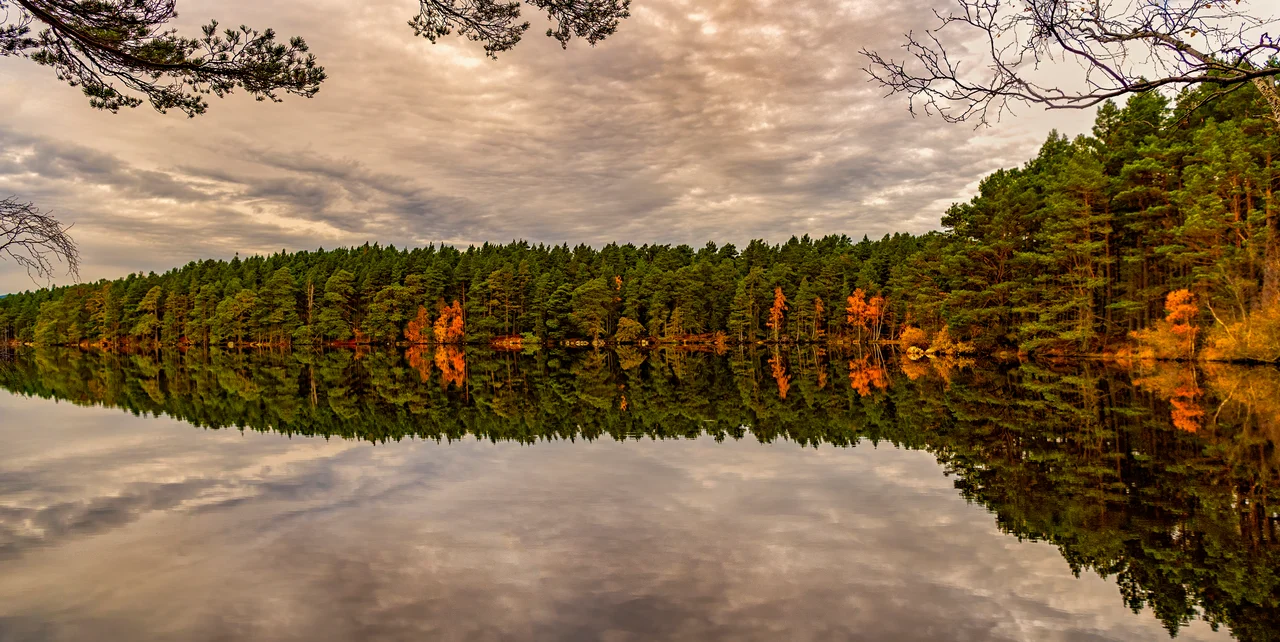

Loch Garten
In 1954, two ospreys flying north from Africa landed in a Scots pine beside a Highland loch and began building a nest. They had no way of knowing they were the first of their species to breed in Britain in roughly half a century. By the time the 19th century was over, gamekeepers and egg collectors had finished off the last British ospreys; the birds were considered locally extinct. Yet here, of their own accord, were two Scandinavian birds choosing Abernethy Forest as a place to raise chicks. The RSPB, alerted to the nest, mounted a round-the-clock guard against the egg collectors who still prowled the Highlands. The eggs hatched. The chicks fledged. The osprey had come back to Britain, and Loch Garten became the address that made it possible. Boat of Garten, the nearby village, took to calling itself the Osprey Village. The name stuck.
Operation Osprey
Saving those first chicks meant guarding the nest twenty-four hours a day for the entire breeding season - a Highland summer measured in eight weeks of close watching against weather, predators, and human collectors who would, in the early years, attempt theft. The RSPB built the operation around a viewing hide that let the public see the birds without disturbing them, and a stewardship system that has carried on uninterrupted for more than seventy years. Visitors today still file into a hide a few hundred metres from the nest tree. They look through telescopes; they watch the live camera feed showing the chicks at close range. The model worked. From that single pair in 1954, ospreys recolonised Scotland by the slow patient mathematics of fledging two or three chicks a year, returning, and finding mates. The species now breeds across Scotland in significant numbers and has begun colonising England. Loch Garten remained the focal point: a pair nested at the site every year from 1959 through 2019, though no chicks fledged between 2016 and 2019.
The Tree and the Move
The original nest tree eventually died. Decades of accumulated droppings and prey remains - fish bones, scales, the leavings of generations of chicks - had killed the Scots pine that hosted the nest. In the winter of 2021, with the nest itself largely artificial by then, the RSPB carefully relocated it to a healthy pine a few metres away, lowering some of the surrounding canopy to make the new site more appealing. The gamble worked. In 2022 a new pair of ospreys took over the relocated nest and raised two young; two more chicks fledged in 2023. The species that returned by chance in 1954 has now been actively managed at this single site for so long that conservationists have moved the nest tree itself and the birds approved. There is something quietly remarkable about a tree dying because the birds it sheltered were so successful.
The Forest Around the Loch
Ospreys are not the only attraction. Abernethy Forest, the surrounding RSPB reserve, is one of the largest surviving fragments of Caledonian pine forest in Scotland - the wild pinewood that once covered much of the Highlands, now reduced to scattered remnants. Capercaillie inhabit the deeper parts of the reserve; in spring, the RSPB runs a 'Caperwatch' programme that lets visitors observe the males performing their elaborate dawn lek, the strange clattering courtship display that gives the bird its old Gaelic name. Red squirrels work the feeders around the hide. Common chaffinches appear by the dozen, eurasian siskins flicker through the pines, and great spotted woodpeckers drum the dead wood. Crested tits and Scottish crossbills - both pine-specialists, both restricted to a few corners of the Highlands - hide deeper in the canopy. The forest extends along walking trails that pass Loch Mallachie, the loch's quieter neighbour, and link up with the long-distance Speyside Way.
Why It Matters
The osprey is the kind of bird that captures people. Large, dramatic, dependent on clean water and intact forest, photogenic in the way it plunges feet-first for trout and pike - it is a charismatic species, and the Loch Garten project leaned on that charisma to build British support for raptor conservation more broadly. The annual ritual of the birds' return from West Africa in late March or early April became, for a generation of British nature lovers, a marker of seasons changing and of something that had been lost coming back. Schoolchildren were brought to the hide. Newspapers ran updates on the chicks. The osprey, by sheer luck and good management, became one of the most familiar stories of post-war British conservation. The fact that it began with two birds choosing to land here - rather than anywhere else along the Scottish coast - is the kind of coincidence that built a movement.
From the Air
Loch Garten lies at 57.24°N, 3.70°W in the Cairngorms National Park, about 9 nautical miles southeast of Inverness Airport (EGPE). The loch sits in Abernethy Forest, immediately east of Boat of Garten village and the Strathspey Railway line. Recommended viewing altitude is 3,000-5,000 ft AGL; the loch is small (about 0.5 km long) but distinctive against the dark pinewood. The Cairngorm plateau rises to 1,245 m (4,084 ft) about 8 nm south-southeast - useful as a backdrop but also a weather generator. EGPE provides full instrument approaches. The Spey valley runs broadly southwest to northeast and makes a clean visual handrail. The osprey nest itself is on the south side of the loch in a Scots pine; you will not see it from the air, but the dark forest framing the loch is the heart of the RSPB Abernethy reserve.
Nearby Stories
- Dalwhinnie distillery 1.9 km away
- Battle of Mons Graupius 11 km away
- Black Isle 12 km away
- Battle of Auldearn 13 km away
- Keith, Moray 14 km away
- Kildrummy Castle 16 km away
- Boleskine House 16 km away
- Siege of Blair Castle 22 km away