
SS St Petersburg
Just before midnight on 16 May 1941, three Heinkel He 111 bombers came out of the dark over the North Sea and found two ships. One was the troopship Archangel, which had begun her life thirty-one years earlier as a passenger ferry running between Harwich and the Hook of Holland. The other was the destroyer HMS Blankney, her escort. The bombers dropped fast - one came in at fifty feet, almost wave-height, and put two bombs into Archangel's engine room. The boiler exploded. Aboard, two anti-aircraft batteries of the Manchester Regiment were trying to get to Aberdeen after garrison duty in Orkney. Forty-one of them would not arrive.
Built for the Hook
She was named for the imperial Russian capital - St Petersburg - and she was built by John Brown & Company at Clydebank and launched on 25 April 1910, the third of three sister ships ordered by the Great Eastern Railway. A Miss Green - daughter of a GER director - performed the launch. Three steam turbines drove three screws by direct drive, and she carried submarine signalling and wireless telegraphy at a time when both were still cutting-edge. Her regular run was between Harwich on the Essex coast and the Hook of Holland in the Netherlands, a North Sea ferry route that connected London by rail to Amsterdam, Berlin, and beyond. Her code letters were HRFS. By 1913 her wireless call sign was PQP. In peacetime she was one of dozens of such ships - cross-Channel and cross-North Sea ferries that moved travellers and mail in the years before air travel changed everything.
Two Wars, One Name Change
The Admiralty requisitioned her in 1915, less than five years into her ferry career, and turned her into a cross-Channel troopship for the First World War. They also renamed her. St Petersburg was no longer a name a British troopship could carry - by then the Russian capital had been renamed Petrograd for similar reasons, and the imperial associations had become awkward. She became Archangel, and Archangel she stayed. In the 1923 railway grouping, she passed from the Great Eastern Railway to the new London and North Eastern Railway. By the time the Second World War broke out, she was already over thirty years old, but she was still in service, and the Admiralty requisitioned her again - this time for North Sea troop transport. She was running men between Aberdeen and the Orkney bases, where the Royal Navy kept its main fleet anchorage at Scapa Flow.
The Attack Off Aberdeenshire
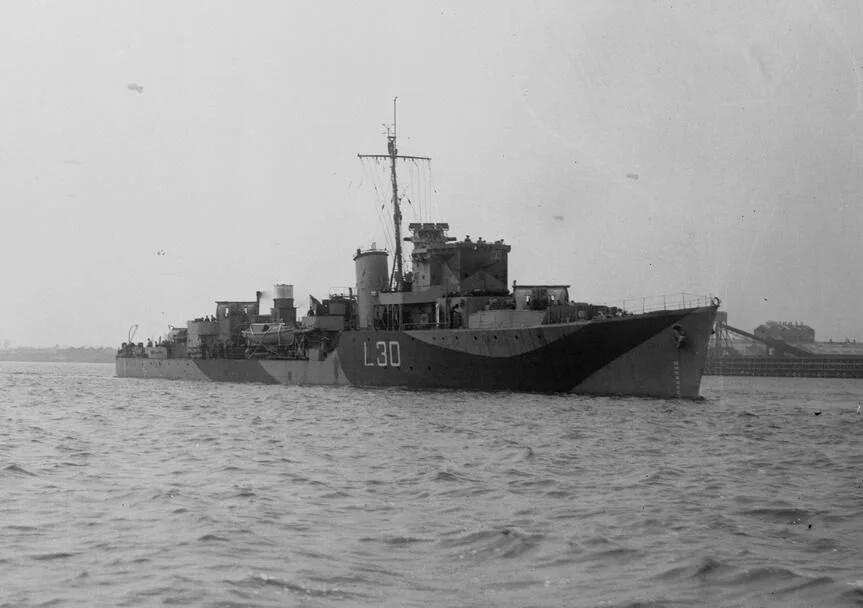
On 16 May 1941 Archangel embarked the 182 and 196 batteries of the 65th (The Manchester Regiment) Anti-Aircraft Brigade at Kirkwall in Orkney, bound for Aberdeen. HMS Blankney - a brand-new Hunt-class destroyer - escorted her. The three Heinkels caught them just before midnight, in the dark over the North Sea. One came in low, fifty feet above the water, and the two bombs it dropped hit Archangel in the engine room and boiler room. The boiler explosion severed communications between her bow and her stern. The same aircraft swung back at five hundred feet and strafed the ship with machine guns while the other two engaged Blankney. Both ships returned fire. Blankney circled Archangel at speed to draw the bombers off. The aircraft that had attacked Archangel made three runs in total, took damage, and crashed into the sea. The other two withdrew.
The Cost
Blankney launched her boats. Her surgeon went aboard Archangel to help the troopship's medical officer treat the burned. She went alongside to complete the evacuation, then brought the survivors to Aberdeen around 0800 the next morning. The toll in 182 battery was thirty-eight killed and eighteen wounded. In 196 battery, three killed and twenty-four wounded. All of the wounded were burned. Most accounts also list crew casualties, though they differ on the numbers. Captain A.P. Sutton, Archangel's master, was badly hurt. The ship herself was towed - either by Blankney or by a tug, accounts again differ - and beached at Blackdog, just north of Aberdeen. There she broke into four pieces. The men of 65th (Manchester Regiment) AA Brigade were anti-aircraft gunners. They had spent the war until that point defending other people from German bombs. They were killed on a ferry that had been built to take travellers to dinner in The Hague.
From the Air
Coordinates 57.92N, 2.05W - approximately where Archangel was hit, off the Aberdeenshire coast north of Aberdeen. The route ran from Kirkwall (EGPA) in Orkney south to Aberdeen (EGPD). Cruise altitude 3,000-5,000 ft offers a sense of the open North Sea passage these troopships made repeatedly through the war. Lossiemouth (EGQS) lies 50 nm west; Wick (EGPC) lies 60 nm north. The Blackdog wreck site, where Archangel broke into four pieces, is just north of Aberdeen harbour. Coastal weather here is often hazy, with low cloud and persistent wind off the North Sea.
Nearby Stories
- Mormond Hill 10 km away
- HMS Exmouth (H02) 14 km away
- German submarine U-58 (1938) 20 km away
- Glendronach Distillery 21 km away
- Whitehills Lifeboat Station 28 km away
- Piper Alpha 102 km away
- Jarlshof 217 km away
- German submarine U-1274 229 km away