
Mormond Hill
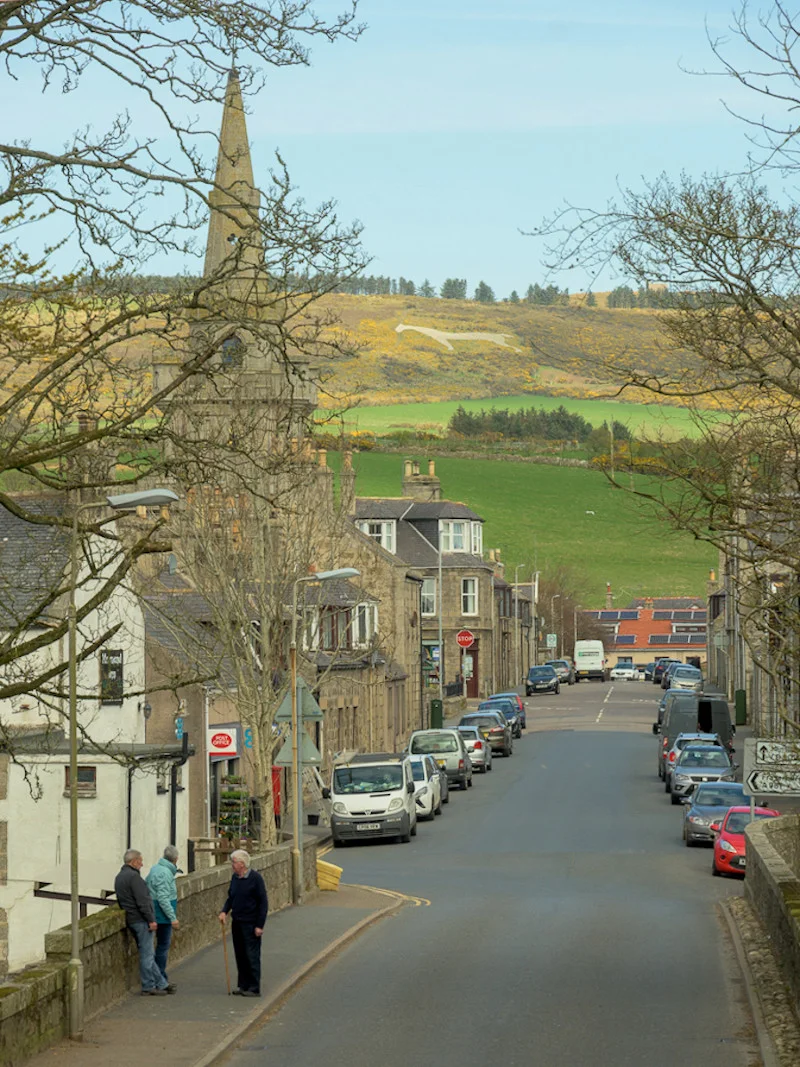
It is the only hill in Scotland that wears its own livery. A 126-foot white horse made of crushed quartz is laid out on the south-western brow, visible from the village of Strichen and from any aircraft passing over Buchan. A few hundred yards across the hill, a white stag - the only one of its kind anywhere - looks south from a slightly different angle. England has its chalk horses at Uffington and Westbury and several other places, and white horses are common enough across the world. But the stag at Mormond is unique. Captain Alexander Fraser directed the creation of the horse around 1820, with estate tenants laying the quartz figure into the hillside. Some descendant of the Frasers, around 1870, added the stag.
The Captain and the Sergeant
The story behind the white horse is the kind that nineteenth-century antiquarians liked to write down quickly before it could be tidied. In 1794, Captain Alexander Fraser was campaigning with British forces in the Netherlands during the War of the First Coalition - the chaotic early years of the French Revolutionary Wars. In a skirmish, his horse was shot from under him. A sergeant in the same unit dismounted and gave Fraser his own horse so the captain could escape. The sergeant was killed almost immediately, on foot. Fraser survived. Some years later, back on his family lands at Mormond, he ordered a horse-shaped figure cut into the south-western face of the hill and filled with quartz stones - a memorial in white to the sergeant who had given up his mount. There is some scholarly disagreement about whether the original figure was a solid shape or only an outline; today it is solid, scoured and re-laid every generation or so.
Scotland's Only Hill Figures
Mormond Hill is, in Gaelic, Mormhonadh - simply the big hill - and from a distance it does not look like much. Two summits, the higher called Waughton Hill, reaching 754 and 767 feet above the surrounding plain. But in the otherwise flat Buchan country, two-and-a-bit hundred metres of relief is enormous, and the hill commands the eye for miles. The horse, dating to around 1820, is one feature. The stag, added around 1870, is the other. The stag was cleaned in 1939, 1946, 1955, 1984, 1994-95, 2006, and most recently in 2023. Cleaning is essential: the quartz greys over with weather and lichen, and without periodic re-bedding the figure fades back into the heather. Scotland has no other hill figures. England has dozens. Mormond has both of its country's two.
The Resting Cairn and the Hermit
Long before Captain Fraser, the hill was already a landmark in a more sober sense. Before the parish of Strichen was carved out in the seventeenth century, the people of the district had to take their dead north over the brow of Mormond for burial at Rathen Kirk. The pallbearers paused for breath at one particular spot before the steepest part of the climb. The cairn of stones that grew there is still called the Resting Cairn. On the eastern side of the hill, St Eddren's Slack was said to have been the hermitage of Ethernan, an obscure local saint who founded the church at Rathen. Sailors offshore used the hill differently. An old rhyme warned: Keep Mormound Hill a handspike high, and Rattray Brigs you'll not come nigh - meaning, hold the hill at the height of a handspike on your horizon and you will steer clear of the deadly reefs at Rattray Head.
Cold War Antennas, Folk Songs and a Mention by Judy Collins
An eighteenth-century hunting lodge stands ruinous near the summit. During the Cold War, Mormond Hill Radio Station was built here as part of the North Atlantic Radio System, a chain of microwave relays linking NATO bases across the ocean. The station has since been turned over to commercial use, its dishes and masts still part of the hilltop silhouette. The hill turns up in folk songs too. Mormond Braes is a north-east ballad about a Strichen girl jilted by her lover and resolving to find better. Judy Collins recorded Farewell to Tarwathie, written by the Aberdeenshire songwriter George Scroggie, and the hill makes its appearance there. A horse, a stag, a hermit, a coffin road, a Cold War listening post, and a girl from Strichen toon: not bad for a hill that is only Mormhonadh, the big hill.
From the Air
Mormond Hill rises to 767 feet at Waughton Hill, at approximately 57.60 degrees north, 2.07 degrees west, about three nautical miles south-east of Fraserburgh. From the air, look for the white horse figure on the south-western face overlooking Strichen, and the smaller white stag near the radio masts on the summit. In sunlight the quartz stones flash bright against the heather. The hill is the dominant terrain feature for many miles in any direction in flat Buchan. Aberdeen Dyce Airport, ICAO EGPD, is about thirty nautical miles south-south-west. Best viewed at 1500-3000 feet AGL in good light.
Nearby Stories
- Mither Tap Hillfort 4.3 km away
- Banff and Macduff Lifeboat Station 11 km away
- SS St Petersburg 12 km away
- River Don, Aberdeenshire 17 km away
- HMS Exmouth (H02) 53 km away
- Piper Alpha 120 km away
- German submarine U-1274 190 km away
- HMS Nottingham (1913) 231 km away