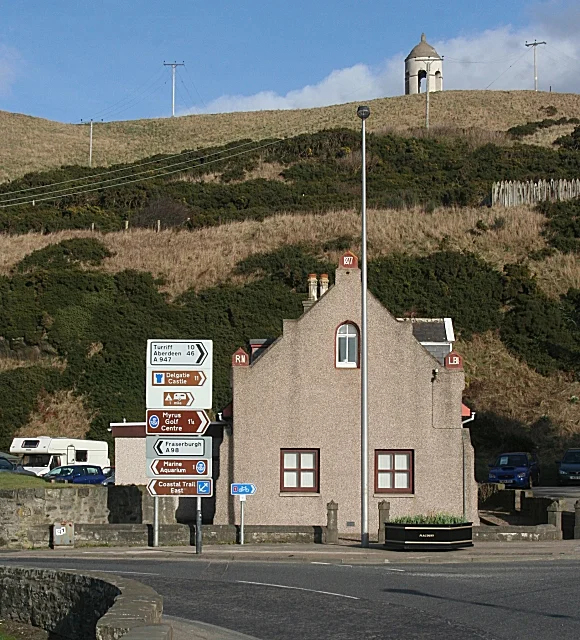

Banff and Macduff Lifeboat Station
The schooner Auchincruive ran aground off Banff harbour on a November morning in 1861, sails ripped, hull grinding on the rocks. Six men were going to die that day, and they knew it. Then the boathouse doors swung open, six oarsmen leaned into a thirty-foot self-righting boat called simply Banff, and within minutes the schooner's crew were climbing into Scottish hands. This was the second year of the new lifeboat station's existence, and already it had paid for itself a hundred times over.
The Coast That Had Been Forgotten
Until 1860, the entire north coast of Aberdeenshire had no organised lifeboat service. Storms drove ships onto the Banffshire rocks year after year, and when the wrecks came, locals did what they could from the shore, which was usually not enough. The RNLI noted with characteristic understatement that this stretch of coast had been "entirely unprovided with life-boats, and numerous lives have been lost which might probably have been saved had they been provided." The translation: people drowned because no one came for them. The new station would fix that, and Captain MacDonald of H.M. Coastguard at Banff began the campaign that brought it into being.
A Boathouse Built of Granite
The first station went up in the summer of 1860, paid for partly by Liverpool sugar refiners Macfie and Sons, who donated 180 pounds to cover the boat itself. The Banffshire Journal described the boathouse with quiet pride: substantial granite, forty feet long, eighteen feet wide, costing about 140 pounds. The Great Northern Railway and other companies carried the new lifeboat north for free. By August she sat on her launching carriage with sails furled and six oars ready, a thirty-foot Peake self-righter who could roll completely over in a North Sea swell and come up still floating. The men who would crew her were fishermen, harbour workers, anyone strong enough to pull an oar against weather their own boats had refused.
Moving Across the River
In 1866 the committee voted to shift the station to the Macduff side of the Deveron estuary. Eleven years passed before they actually did it. When a storm in 1877 finally undermined the original boathouse, they tore it down and rebuilt at Palmers Cove next to Banff Bridge, reusing what stone they could salvage. The lifeboat John and Sara spent the interim parked in the grounds of Duff House, the great William Adam mansion whose owners apparently did not mind sharing their lawn with a rescue boat. The new building still carries three carved stones on its front gable: 1877, RN, and LBI. Royal National Life Boat Institution, in the language of the Victorian era.
Crewing Difficulties
By 1922 the station had a problem the records mention politely but persistently. There were not enough men. The Great War had killed or scattered a generation of Banff fishermen, and the survivors had paying work that did not pause for distress flares. In 1923 the lifeboat George and Mary Berrey was sent on a one-year trial to Whitehills, four miles west, where a crew could still be found. The trial lasted, the station never reopened, and in December 1924 the old boathouse was auctioned. Banff Town Council bought it for 135 pounds. It became a tearoom for a while, then a private home, which is what it remains. The carved stones above the door still announce what it was.
What the Records Don't Say
The official roll counts shipwrecks and rescues, medals and meeting minutes, but it cannot count the families who got their men back because the Banff lifeboat launched in time. Six from the Auchincruive in 1861 was a single afternoon's work. Multiply that by sixty-four years of service, and the granite boathouse becomes something larger than its dimensions. Macduff still has an RNLI station today, a few hundred metres from where the original 1860 building stood. The volunteers who crew it now are continuing a watch that began when their great-great-grandparents put the first thirty-foot Peake on her carriage and rolled her down to Banff Harbour.
From the Air
Banff Bridge and the old lifeboat station sit at the mouth of the River Deveron at 57.66 degrees N, 2.51 degrees W. The estuary forms a clear notch on the Aberdeenshire coast, with the towns of Banff and Macduff facing each other across the water. Cruise altitude six to ten thousand feet gives a fine view of Banff Bay and the curve of the coastline west toward Portsoy. Nearest airports are Aberdeen (EGPD) about forty nautical miles southeast and Inverness (EGPE) about fifty nautical miles west. North Sea weather can deteriorate quickly here, which is exactly why the lifeboat station existed.
Nearby Stories
- Aberlour Distillery 4.2 km away
- Pitsligo Castle 5.8 km away
- Lossiemouth 7.7 km away
- Battle of Slioch 7.8 km away
- Old Slains Castle 18 km away
- Helmsdale 32 km away
- HMS Exmouth (H02) 35 km away
- German submarine U-58 (1938) 39 km away