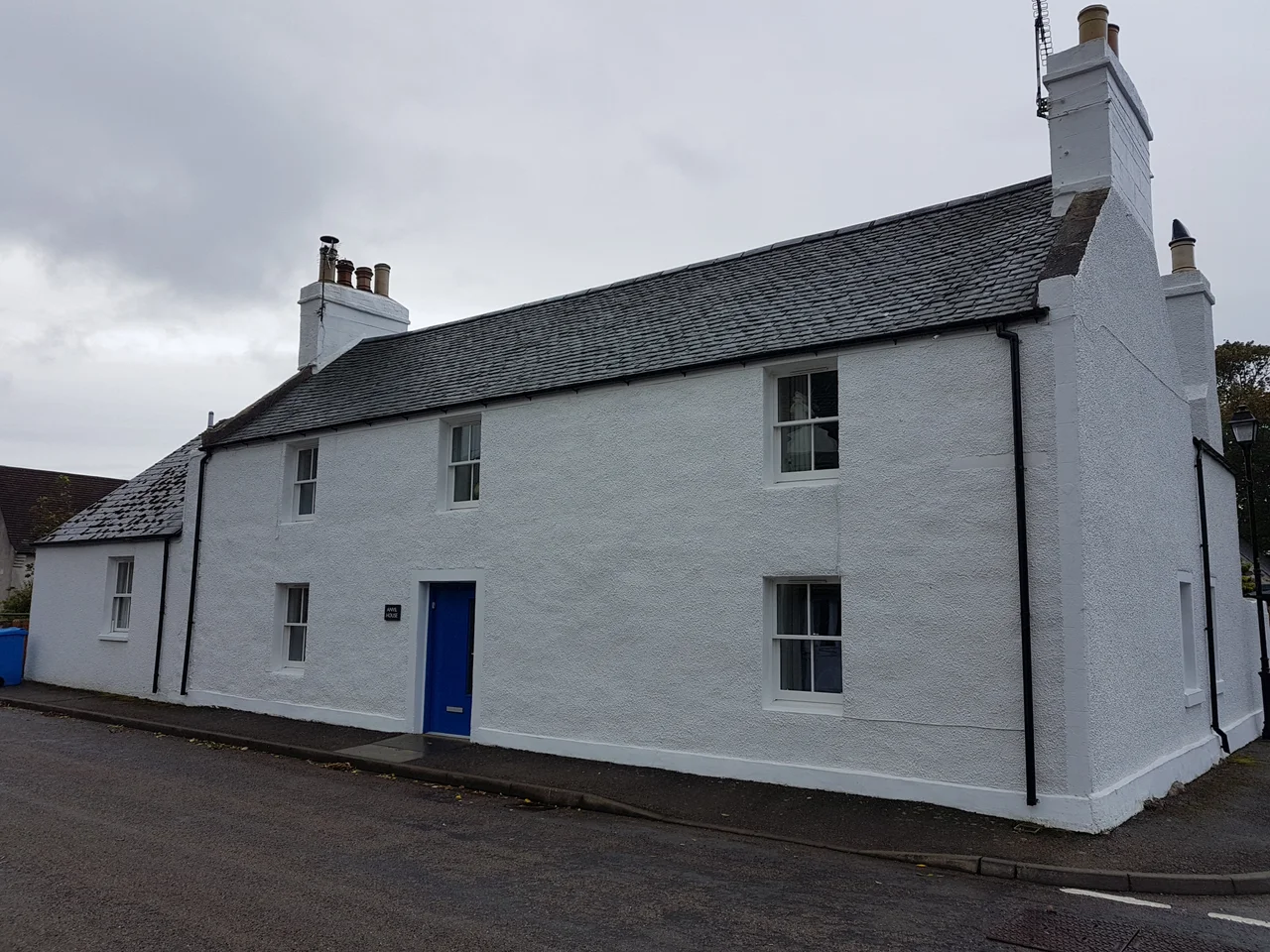

Helmsdale
The Emigrants' Statue stands by the harbour at Helmsdale: a family of three, hand in hand, looking out across the North Sea toward a future the parents could only guess at. The matching statue stands in Winnipeg, where the descendants of those families settled. Helmsdale was built to receive people who had nowhere else to go - dispossessed from the inland straths during the Highland Clearances of the early nineteenth century - and then it watched them leave again, for Canada, for Australia, for the South African gold fields. The town has been a way station for departures ever since.
Built for the Cleared
The village was planned and built on a grid pattern in the early nineteenth century to accommodate those being evicted from the valleys above to make way for sheep. The Highland Clearances reshaped Sutherland with a brutal efficiency; the inland straths emptied of tenants and filled with Cheviot ewes, and the dispossessed were directed toward new coastal settlements where they were supposed to take up herring fishing or kelp-burning. Helmsdale was one of the most successful of these planned places, partly because the river mouth made a workable harbour, partly because the herring lent themselves to large-scale processing. By the mid-nineteenth century, hundreds of boats fished from here in season. The grid of streets, the regular harbour buildings, the careful uniformity of the place - all survive as evidence of that planned-village logic. The name itself derives from the Old Norse Hjalmundal, the Dale of the Helmet, a reminder of how long this coast has been in continuous use.
Castle and Statue
Helmsdale Castle was an L-plan tower house built in 1488 just south of the river. In 1567 the Earl's aunt tried to poison her way to the succession. The last of the ruins were cleared away in the 1970s when the A9 was re-aligned across the bridge, so all that remains today is a roadside monument. The Emigrants' Statue, completed in 2007, stands nearby - sculpted by Gerald Laing and commissioned by Dennis MacLeod, a native of Helmsdale who had found success in South Africa's gold mining industry. A matching statue was unveiled in Winnipeg in 2008, the city where a group from Helmsdale had been among the founding families. Two bronzes on opposite shores of the Atlantic, holding the same poses - one watching, one arriving.
Gold in the River
In 1869 a brief gold rush hit the Strath of Kildonan along the river above the village. A man named Robert Nelson Gilchrist returned from the Australian gold fields and started panning the Suisgill Burn; within months hundreds of prospectors had set up camp at Baile an Or - the Gaelic for "village of gold." The rush lasted barely a year before declining yields and tightening estate restrictions ended it, but you can still pan for gold in the Helmsdale tributaries today, with permits available from the local outfitter. The yields are tiny but real - the geology that produced the 1869 strike has not changed, just the human appetite for the work involved in extracting it.
Wolves, Brochs, and Badbea
Inland and along the coast around Helmsdale, the older histories surface. A monument records the killing of what local tradition calls the last wolf in Scotland around 1700 - the exact date is uncertain, but wolves were extinct in England and Wales by 1500 and in Ireland by 1786. The bleak hills of Sutherland are now one area sometimes proposed for their reintroduction. Carn Liath is an Iron Age broch built over a Bronze Age village and burial site. Ousdale Broch, a substantial Iron Age tower from the 2nd or 3rd century BC, was repaired between 2015 and 2020 with improved access. Five miles north along the A9, the abandoned village of Badbea preserves perhaps the most poignant chapter of the Clearance story - from 1792, evicted crofters gathered here on land too poor even for sheep, building their own houses on the windy clifftop and supplementing their crofts with herring fishing until even that became unprofitable and the village emptied for good in the late nineteenth century.
Per Auchterarder Ad Astra
The story does not end with the emigrants. A memorial on the hillside marks where an RAF Sunderland flying boat crashed on 25 August 1942, killing fourteen of the fifteen aboard - including Prince George, Duke of Kent, the first British royal death on active service since Prince Maurice of Battenberg fell in action in October 1914. And David Mackay, born in Helmsdale in 1957, is now Chief Pilot for Virgin Galactic and has flown several sub-orbital missions. From a village on the Sutherland coast to the edge of space - the journey starts somewhere. Per Auchterarder Ad Astra, as someone joked: through Auchterarder to the stars.
From the Air
Coordinates 58.12 N, 3.66 W where the River Helmsdale enters the North Sea on the Sutherland coast. Wick Airport (EGPC) lies about 25 nm northeast; Inverness Airport (EGPE) about 60 nm south. From cruising altitude the village is a tight grid of streets either side of the river mouth, with the A9 road bridge crossing the river just inland from the harbour. The Far North Line railway runs through the village. North along the coast lies the dramatic clifftop site of Badbea; inland and northwest, the empty rolling country of the Flow Country peatlands stretches toward the Caithness border.
Nearby Stories
- Langdale Broch 1.9 km away
- Flow Country 2.3 km away
- Battle of Tannach 5.9 km away
- Lairg 14 km away
- Hilton of Cadboll Chapel 14 km away
- Alness 15 km away
- Gordon Castle 24 km away
- Castle of Old Wick 37 km away