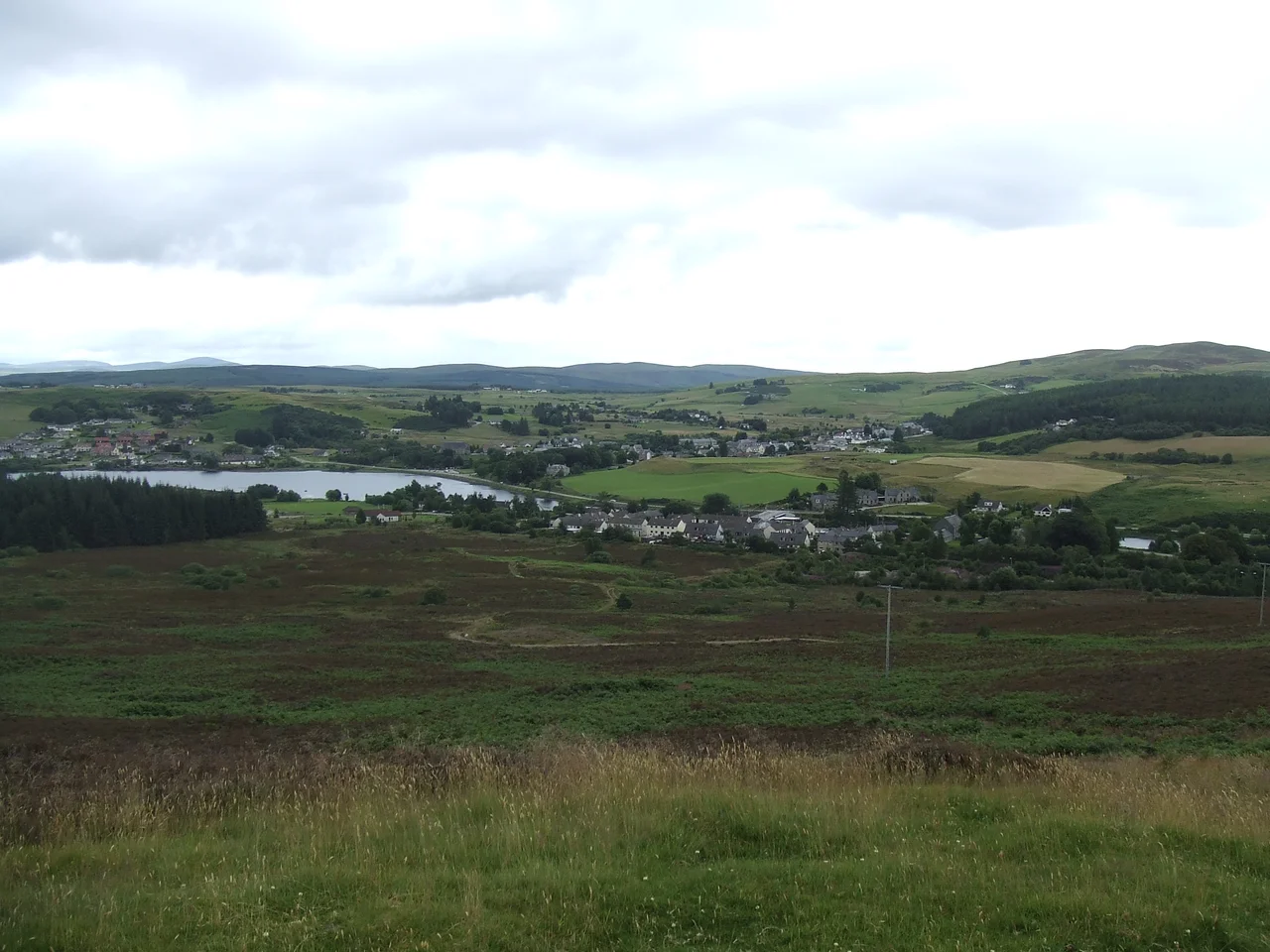

Lairg
Almost every other large settlement in the northern Highlands sits on the coast. Lairg does not. Four roads meet here in the middle of Sutherland, and that geographical accident has made the village the centre of a vast and otherwise empty region. Locals once called Lairg 'the Crossroads of the North'. Today its 891 people share the largest postcode area in the United Kingdom, IV27, which stretches from here to Cape Wrath and covers 1,393 square miles.
The Largest Sheep Sale in Europe
Every August, on a single day, more sheep change hands at Lairg than at any other auction in Europe. Farmers and crofters drive their flocks down from the empty country between here and the north coast, and buyers come from across Scotland. The sales fill the village. Hotels are booked months in advance, every spare patch of grass becomes a paddock, and the auction ring runs from early morning until late afternoon. The trade is what is left of an older economy that once moved cattle, not sheep, along the same roads. Sheep replaced people on much of this land in the nineteenth century - the silence that surrounds Lairg today is partly the consequence of those changes - and the August sale is one of the most visible reminders of the system that took shape afterwards.
Strathnaver and the Empty Country
Lairg is the southern entrance to one of the most haunting landscapes in Britain. Drive north on the single-track roads and you will pass through Strathnaver, where the Clearances of 1814 and 1819 were among the most violent in Scotland. Townships that had been settled for centuries were emptied in a matter of weeks. People were forced out of their homes, in some cases as the thatch was being lit above them, and resettled on poor coastal land or sent across the Atlantic. Patrick Sellar, the factor of the Sutherland estate, was tried for culpable homicide in 1816 in connection with one of the burnings and acquitted, an outcome that still shapes how people in the strath talk about those years. The villages you do not pass through are the ones that were never rebuilt. Travel north from Lairg and the silence between settlements is, in part, a record of what was lost.
Little Loch Shin and the Crofters' Show
In the middle of the village lies Little Loch Shin, a small manmade lake created when the hydroelectric scheme raised the level of Loch Shin in the 1950s. Sitting on an islet in the middle is a tiny wooden structure called the Broon's Hoose, a quietly affectionate local landmark. The full Loch Shin runs seventeen miles to the northwest, a long straight finger of water flanked by Ben More Assynt and Ben Klibreck. Lairg's Crofters' Show is older than the dam - it has been running for a hundred years and is held on a single summer day, with horse-jumping, sheep and cattle judging, children's sports, caber-tossing, and a wellie-throwing contest. Sheep racing has become a recent crowd-puller. The Lairg Gala Week in July adds fancy-dress parades and fishing competitions on the loch.
A Crater Beneath the Moor
In 2008 scientists from the universities of Oxford and Aberdeen published evidence that the rolling moorland around Lairg conceals one of the largest impact craters on Earth. The Lairg Gravity Low, as it is called, is about twenty-five miles across and dates from approximately 1.2 billion years ago - a meteor strike that would have been catastrophic at the time and has since been buried by a billion years of geology. The bolide is thought to have struck somewhere between modern Lairg and Ullapool. Stand on the road junction in the centre of the village and there is nothing in the view to suggest this. The hills are rounded, the loch shines flat, and the only thing to mark the event is a gravity anomaly visible to instruments deep below the heather.
The Far North Line and the Crossroads
The railway came to Lairg in the nineteenth century and the station, slightly outside the village, sits on what is now the Far North Line - the route from Inverness up through Sutherland to Wick and Thurso. The line still calls here, despite occasional proposals to bypass Lairg with a more direct route across the Dornoch Firth. Sam McDonald, a soldier and famed strongman, was born here in 1762, as was Sir James Matheson, the trader and entrepreneur who built much of Lewis. More recently the village has been home, on and off, to Alastair Bruce of Crionaich, the historian who served as the on-set adviser for Downton Abbey. The village's odd mixture of remoteness and centrality - empty country in all directions, but four roads converging here - has produced a long list of people whose lives reached far beyond Sutherland.
From the Air
Coordinates 58.02 N, 4.40 W at the southeast end of Loch Shin, in central Sutherland. Inverness Airport (EGPE) is about 45 nm south-southwest, the closest major airport. From the air, look for the southeastern tip of Loch Shin where the long northwest-southeast finger of water terminates, with Little Loch Shin and the village just below. Four roads converge: A836 from the south, A839 to the east, A838 to the northwest, A836 continuing north. Best viewing 3,000 to 5,000 ft AGL. The hills are rounded and the moorland reads as olive-brown most of the year, with snow on the higher tops well into spring.
Nearby Stories
- Loch Loyal 4.4 km away
- Ardvreck Castle 9 km away
- Corrieshalloch Gorge 10 km away
- Flow Country 12 km away
- Helmsdale 13 km away
- Edderton Cross Slab 14 km away
- Kinlochbervie 14 km away
- Moray Firth Fishing Disaster 22 km away