
Edderton Cross Slab
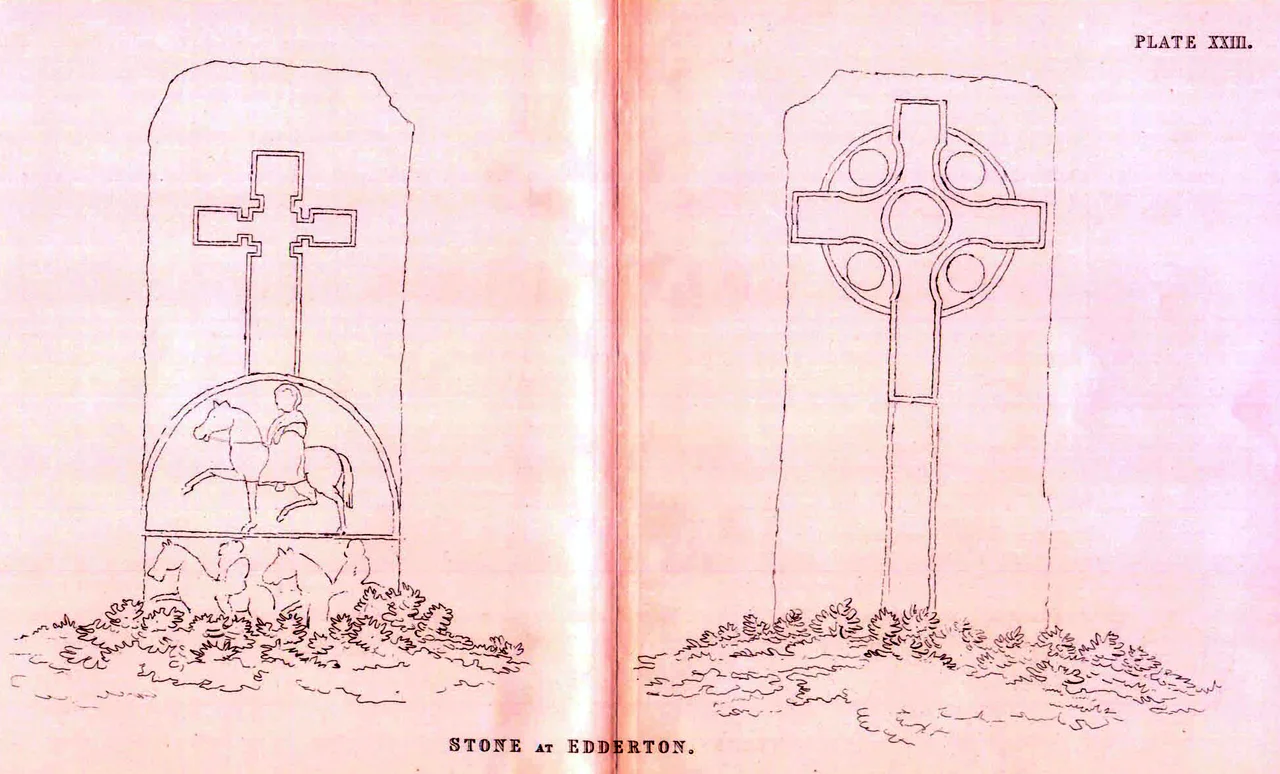
The horsemen were hidden for centuries. Edderton's Class III Pictish stone, a slab of red sandstone planted in the old graveyard of a Highland village, was sunk too deep into the soil - so deep that the two lower riders disappeared below ground level. Lichen still marks where the earth used to begin. Recently archaeologists raised the stone to its presumed original height, and three horsemen, two carved in faint incision and one in confident relief, ride again across the eastern face of a thousand-year-old monument.
Two Sides of a Stone
The slab is shaped like a tall doorway: oblong, narrowing slightly toward the top, weather-darkened on the windward side. On the western face stands a Celtic cross - undecorated, but elegant in its proportions, with the circles within its rings emphasised by being left in relief while the surrounding stone was cut away. There are no knotworks here, no spirals, none of the dense interlace that other Pictish stones show. The carver chose restraint, letting the geometry of the cross carry the meaning by itself. On the east face, another cross sits on the upper half, planted on a semicircular base or arch. Inside the arch, a horseman is carved in relief. Below him, two further riders, drawn in lighter incision, follow.
Class III and What It Means
Pictish stones are sorted into three classes by the archaeologists who study them. Class I bears only Pictish symbols - the famous V-rod, the crescent, the Pictish Beast - incised on rough boulders. Class II carries Pictish symbols together with Christian iconography, usually a cross. Class III, like Edderton, drops the older Pictish symbols entirely and shows only Christian imagery - crosses, scriptural scenes, processions. The classification tracks a slow conversion: by the time Class III stones were being raised, the Picts as a distinct people were merging into the Gaelic Scots, and their ancestral symbol system was passing out of use. Edderton's horsemen are the last echo of an iconographic tradition that the Picts almost completely abandoned within a few generations.
Two Stones, One Village
Edderton has two Pictish stones, and visitors regularly confuse them. The cross slab in the graveyard - elegant, formal, Christian - is one. The other is the Edderton Symbol Stone, also called *Clach Biorach*, the Pointed Stone, a red sandstone pillar of Bronze Age origin that stands in a field a little to the west. The Picts incised their symbols onto a megalith that was already at least 1,500 years old when they used it. The two stones span the entire arc of early Easter Ross belief: a Bronze Age standing stone reused as a Pictish symbol board, and a Pictish slab carrying a Christian cross. Further fragments of early medieval cross-slabs from the same churchyard, in poor condition, are preserved in Tain Museum a few miles up the road.
What the Horsemen Mean
Pictish horsemen turn up on dozens of stones - sometimes hunting, sometimes processing, sometimes simply present. The Edderton riders are not in obvious motion: they sit beneath their cross like a kind of honor guard. Some scholars read them as members of the local aristocracy, the patrons who paid for the carving. Others see saints, biblical figures, or noble dead being commemorated. Without an inscription, the meaning stays open. What is certain is that whoever raised this stone in this graveyard meant for the riders to be seen, eastward and upright, as long as the sandstone lasted. For more than a thousand years the lower two were buried in earth. Now they are not.
From the Air
Edderton Cross Slab stands at 57.83°N, 4.16°W in the old graveyard of Edderton village, on the southern shore of the Dornoch Firth in Easter Ross. Best viewed at 1,500-2,500 ft AGL for the village and the firth itself. Nearest ICAO airport is Inverness (EGPE) approximately 24 nm south. The Tain peninsula juts north-east of the village and makes a clear coastal landmark; the A9 runs along the firth shore. The stone itself is a small upright sandstone slab visible only at low altitude or on the ground.
Nearby Stories
- Moray Firth 1.1 km away
- Culloden Viaduct 1.2 km away
- Cardhu Distillery 9.5 km away
- Clynelish Distillery 10 km away
- Alladale Wilderness Reserve 15 km away
- Corrimony Chambered Cairn 18 km away
- Ardvreck Castle 31 km away
- Hill o' Many Stanes 40 km away