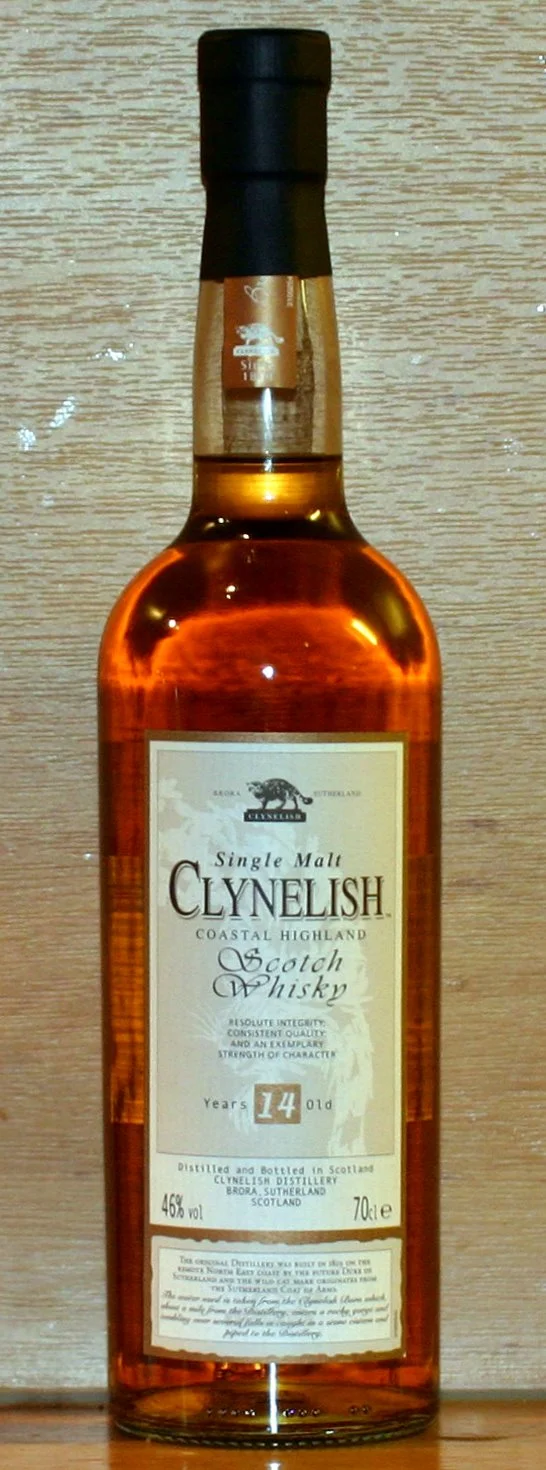

Clynelish Distillery
About ninety-five percent of what Clynelish makes never appears in a bottle of Clynelish. The pale, waxy spirit produced in this large 1960s distillery on the Sutherland coast goes mostly into Johnnie Walker - the world's best-selling Scotch whisky blend - where it provides the distinctive honeyed body of Gold Label Reserve. The independent bottlings and the official 14-year-old release are afterthoughts of a sort. Clynelish exists to feed something larger than itself.
Two Distilleries, One Site
The original Clynelish distillery was built in 1819, next door to where the present distillery now stands. When it first started distilling in the years 1820 to 1822, Clynelish produced around 12,000 gallons per year - roughly 54,000 litres. Through the nineteenth century the distillery passed from owner to owner, expanding around 1896 to about 580,000 litres a year and adding a new warehouse on site. The original site is now Brora distillery, the legendary ghost name in modern whisky. The present Clynelish, built in 1967 and opened for production in 1968, takes its name from the older partner and almost all of its purpose from the blending world.
Built for the Boom
By the 1960s, more and more of Clynelish's spirit was disappearing into blends. The decade was a boom for Scotch - people were buying more luxury goods generally, including cars and whisky. The owners needed more capacity than the cramped old still-house could give them, so they built the current distillery and ran the two side by side as Clynelish A and Clynelish B until the new building's character had been properly settled. Then the older one was retired. A few years later the same building reopened as Brora to make heavily peated spirit while Caol Ila on Islay was closed for refurbishment - a quirk of corporate scheduling that produced one of the most desired ghost whiskies in the world.
The Waxy Style
Modern Clynelish is famous in the blending world for a particular waxy, oily texture that coats the glass and lingers on the palate - a quality that no other distillery quite replicates. Much of the waxy character is attributed to a curious accident of plant operation: certain residues in the spirit receivers and feints lines that the distillery has been careful never to fully clean. Whisky distillation is partly chemistry and partly habit. Change the habits and you can lose what you cannot describe. The 14-year-old official bottling is the most accessible single-malt expression of that character - a pale gold whisky with notes of beeswax, lemon zest, and a faint coastal salinity.
Brora Reborn
Brora's PPM levels - phenol parts per million, which describe how much peat character the malt carries - started at around 30 to 35 PPM, on a level with Caol Ila (30-35 PPM) and slightly below Lagavulin (35-40 PPM). Brora went into the blends for one year while Caol Ila was closed, then continued as a single malt until July 1983 when it was finally shut down. The Brora warehouses kept their slowly maturing casks, and the value of every remaining bottle climbed for decades. The bi-centenary 40-year-old bottling celebrated 200 years of production from the 1819 founding, with 1,819 bottles to mark the year. After Brora's reopening in 2021, the twin distilleries are once again working side by side - separately owned and operated under Diageo's banner, but visible to each other across the same parcel of Sutherland coast.
From the Air
Coordinates 58.02 N, 3.87 W just outside the village of Brora on the Sutherland coast. Inverness Airport (EGPE) lies about 55 nm south-southwest. From cruising altitude the distillery complex sits on the inland edge of the village, with the Clynelish and Brora buildings nearly adjacent on the same site. The Far North Line railway runs between the complex and the sea. From the Inverness-to-Wick corridor, look for the village of Brora, the broad sweep of beach to the east, and the small industrial roof-lines of the two distilleries just inland.
Nearby Stories
- Glenmorangie Distillery 2.1 km away
- Moray Firth 9.2 km away
- Langdale Broch 11 km away
- Battle of Tuiteam Tarbhach 14 km away
- Grey Cairns of Camster 15 km away
- Loch Eriboll 17 km away
- Corrieshalloch Gorge 28 km away
- Hill o' Many Stanes 32 km away