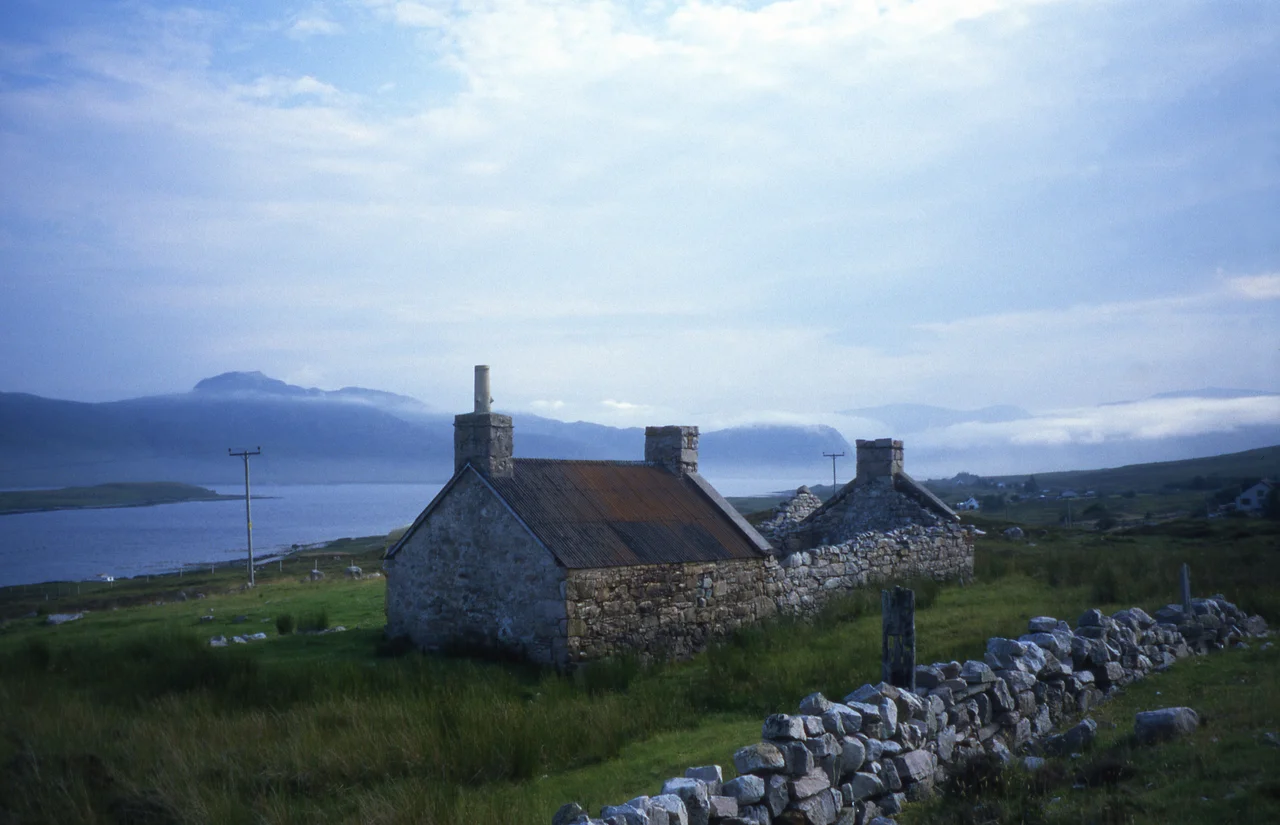

Loch Eriboll
The Royal Navy called it Lock 'Orrible. Sailors stationed at this 16-kilometre sea loch during the Second World War spent enough freezing, sodden weeks here to invent the nickname and arrange stones on the hillside above Laid into the names of their ships - Hood, Amethyst, others - so that anyone passing afterwards would know they had been there. The names are still readable today. So is the rest of the story: this is the loch where the Battle of the Atlantic ended, in a long, quiet column of black-flagged U-boats arriving to surrender in May 1945.
Why the Navy Came Here
Loch Eriboll cuts 16 kilometres into the north coast of Sutherland, a deep, sheltered fjord that has been used as a safe anchorage for centuries. The seas off Cape Wrath and through the Pentland Firth are among the most violent in Europe - tidal races collide, gales pile in from the Atlantic, and a ship caught out can be in trouble within minutes. Eriboll offers escape. The walls drop steeply enough that warships can lie close to shore in deep water, and the loch is wide enough to swing at anchor. The Royal Navy used it heavily through both world wars. In 1944 the Fleet Air Arm even practised aerial bombing here, treating Eilean Choraidh - the largest island in the loch - as a stand-in for the German battleship Tirpitz before the successful Operation Tungsten raid in Norway that April.
The Surrender of the U-Boats
On 8 May 1945, Germany surrendered. Karl Donitz signalled his remaining U-boat captains to surface, fly a black flag, and steam to the nearest Allied port. Many came here. The 33 surviving German U-boats that surrendered at Loch Eriboll arrived one by one through May - long, low silhouettes nosing into the calm water under the guns of the Royal Navy. Their crews were taken off and processed. The boats themselves were inspected, then mostly transferred to Lisahally in Northern Ireland and eventually sunk in Operation Deadlight, the deliberate scuttling of the Kriegsmarine submarine fleet. Eriboll did not feature in the major battles of the Atlantic. It featured in their ending. The loch that had sheltered Royal Navy convoys through six years of war also held the moment those convoys no longer needed to be there.
Crofts, Kilns and Quiet
Long before the warships, Loch Eriboll had a quieter history. Bronze Age people built a souterrain and a well-preserved wheelhouse on the hillside above the west shore - stone-walled, semi-underground homes that survived the millennia mostly because nobody disturbed them. Around 1870, four large lime kilns were built on Ard Neakie, a small promontory on the eastern shore, to burn local limestone into agricultural lime. Before the coast road went in around 1890, the only way to cross the loch was the Heilam ferry, running from Portnancon on the west side to Ard Neakie on the east. Both were also fishing stations. Today the crofting townships of Eriboll, Laid, Heilam and Portnancon remain scattered along the shore. The MoD still leases a slice of the loch as a minor training area for amphibious exercises, but for most of the year Eriboll is what it has always been - a long, quiet sea loch in a region that holds the lowest population density in the United Kingdom.
From the Air
Located at 58.51 degrees north, 4.67 degrees west on the north coast of Scotland. Nearest controlled airfield is Wick (EGPC) approximately 45 nautical miles east; Inverness (EGPE) is about 90 miles south. From the air the loch is unmistakable - a long, dark, finger-shaped sea loch cutting south into the Sutherland moor, with the island Eilean Choraidh near its centre and the white croft cottages of Laid and Portnancon along its shores. Weather typically poor: low cloud, frequent rain, and Atlantic gales that build the entrance into heavy seas in hours. The MoD training area along the south-east shore is occasionally active for amphibious exercises - check NOTAMs.
Nearby Stories
- HMS King Edward VII 1.1 km away
- HMS Bullen 6.4 km away
- Strathnaver Museum 9.1 km away
- Enard Bay 10 km away
- Ardvreck Castle 15 km away
- Battle of Torran Dubh 20 km away
- Stoer Head Lighthouse 24 km away
- The Laki Eruption: The Volcano That Changed World History 909 km away