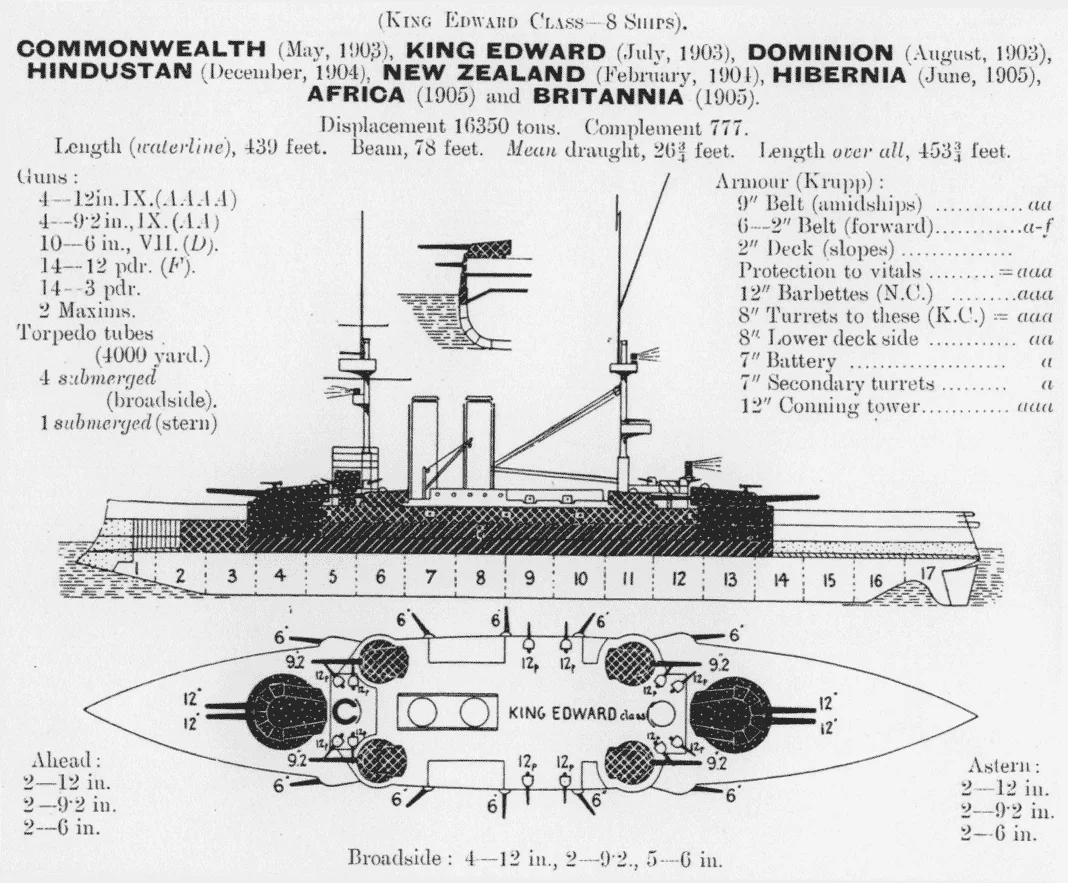

HMS King Edward VII
The king attended his own launch. On 23 July 1903, Edward VII stood at Devonport Dockyard and watched the 453-foot battleship that bore his name slide down the slipway into the Hamoaze. He had personally laid the first plate when she was laid down in March 1902, and he had agreed to lend the ship his name on one condition: that she always serve as a flagship. The Royal Navy honoured that wish for the whole of her career - eleven years of flag duty, in three fleets and several reorganisations - until on the morning of 6 January 1916 she struck a mine off Cape Wrath, north of Scotland, and the only thing she could be a flag for was the sea that closed over her.
An Obsolete Idea, Beautifully Executed
HMS King Edward VII was the lead ship of her class - eight pre-dreadnought battleships of 15,585 tons, 453 feet long, with a mixed armament that marked a real advance on previous British designs. The main battery was four 12-inch guns, fore and aft in twin turrets. The novelty was the secondary battery: four 9.2-inch guns in single turrets on the sides, much heavier than the 6-inch secondaries of earlier ships. They were the work of Sir William Henry White, Director of Naval Construction, who had built up to this design through several iterations. Then, on 10 February 1906, while King Edward VII was less than a year in service, HMS Dreadnought commissioned at Portsmouth carrying ten 12-inch guns and steam turbines, and the entire concept of the mixed-battery pre-dreadnought became obsolete overnight. King Edward VII and her seven sisters - sometimes called the Wobbly Eight for their tendency to roll - were modern when laid down and historical artifacts when delivered. The navy kept them in front-line service anyway.
Flagships and Flag Movements
She commissioned on 7 February 1905 as flagship of the Atlantic Fleet. She paid off at Portsmouth on 4 March 1907 and recommissioned the next day as flagship of Admiral Lord Charles Beresford in the Channel Fleet. When the fleets were reorganised in March 1909 and the Channel Fleet became the 2nd Division of the Home Fleet, she was recommissioned again, this time as flagship of the Vice Admiral, Home Fleet. Another reorganisation in 1912 brought her into the 3rd Battle Squadron, where she joined her seven sisters as Vice Admiral's flagship. The squadron was sent to the Mediterranean in November 1912 for the First Balkan War, participating in an international blockade of Montenegro and the occupation of Scutari - now Shkoder in Albania - to force the Macedonians to relinquish the city. The squadron returned to British waters in 1913. King Edward VII had now flown a flag for almost every year of her existence.
The War She Almost Fought
When war was declared on 4 August 1914, the 3rd Battle Squadron was attached to the Grand Fleet at Rosyth. The Grand Fleet's job was to maintain naval superiority over the German High Seas Fleet, and the way it did this was to conduct sweep after sweep into the North Sea hoping to catch German vessels and force a battle. The Germans rarely cooperated. King Edward VII spent the next eighteen months on these sorties: out to look at the coast of Norway in August 1914 in search of a non-existent German base; out for battle practice and a North Sea sweep on 14 August; out to support the battlecruisers during the Scarborough raid on 16 December; out for the Battle of Dogger Bank on 24 January 1915, arriving after the battlecruisers had already sunk the armoured cruiser Blucher. The 3rd Battle Squadron's actual purpose, increasingly, was to walk ahead of the precious dreadnoughts and take whatever mines or torpedoes the sea offered. The old ships were expendable. The new ones were not.
The Mine off Cape Wrath
Five days before the end, on the night of 1-2 January 1916, the German auxiliary cruiser Mowe slipped past British patrols under cover of darkness and a snow storm and laid 252 mines in the shipping lane off Cape Wrath. The British knew nothing of the minefield. On 6 January, King Edward VII left Scapa Flow at 07:12, transferring her flag temporarily because she was heading to Belfast for a refit. At 10:47 she struck a Mowe mine under her starboard engine room. The list came on at eight degrees. Her commanding officer, Captain Crawford Maclachlan, ordered the helm hard to starboard to close the coast and beach her if necessary, but the helm jammed and the engine rooms flooded and the engines stopped. Counterflooding brought the list back to five degrees. A passing collier, Princess Melita, was signalled and closed in to attempt a tow; the destroyer Kempenfelt and twelve other destroyers raced from harbour, initially believing King Edward VII had been torpedoed by a U-boat. Towing began at 14:15 and lasted twenty-five minutes before the ship took a fifteen-degree list and proved unmanageable. Captain Maclachlan ordered the lines slipped and the ship abandoned. The destroyer Musketeer came alongside at 14:45. Maclachlan was the last man off. He boarded a destroyer at 16:10. King Edward VII capsized at 20:10 and sank, nine hours after the mine. The crew loss was one man, who fell between the battleship and one of the rescue vessels.
What She Left
The wreck lies on the seabed off Cape Wrath, roughly where the mine took her. The British remained ignorant of the minefield for some time after, because the battleship Africa had passed the same area earlier that day without incident, and minesweepers were in short supply. Mowe herself returned to Germany and continued raiding for the rest of the war. Edward VII the man had died on 6 May 1910; he never knew his flagship was lost. The condition he had attached to her use - that she always carry a flag - was, by the morning she sank, a piece of pre-war ceremonial logic in a war that had stopped honouring such things. She had served as flagship to admirals, gone to war in a reorganised fleet, and steamed ahead of dreadnoughts in the hope of catching a mine before they did. Then she caught one. Crawford Maclachlan was later promoted to admiral. One sailor died. The ship herself was old by the standards of her own navy and irrelevant by the standards of every navy that came after. She has rested in the cold dark water off the cape for more than a century.
From the Air
The HMS King Edward VII wreck site lies at approximately 58.716°N, 4.202°W in the North Atlantic about 7 nm offshore from Cape Wrath, the north-west tip of mainland Scotland. The wreck is in deep water - around 100 metres - and is not visible from the surface. Best viewed as a flightpath waypoint at 2,000 to 5,000 feet AGL with Cape Wrath's distinctive cliffs and the white-painted lighthouse to the south-east; the open Atlantic stretches to the horizon to the north and west. Wick John o' Groats Airport (EGPC) is 50 nm east; Stornoway (EGPO) lies 70 nm west across the Minch. Atlantic weather here is severe and rapidly changing - low cloud, strong winds, and limited visibility are common.
Nearby Stories
- Loch Eriboll 6.7 km away
- Strathnaver Museum 9.7 km away
- Old Man of Hoy 11 km away
- HMS Bullen 18 km away
- Grey Cairns of Camster 23 km away
- Broch of Gurness 26 km away
- Fair Isle 147 km away
- The Laki Eruption: The Volcano That Changed World History 910 km away