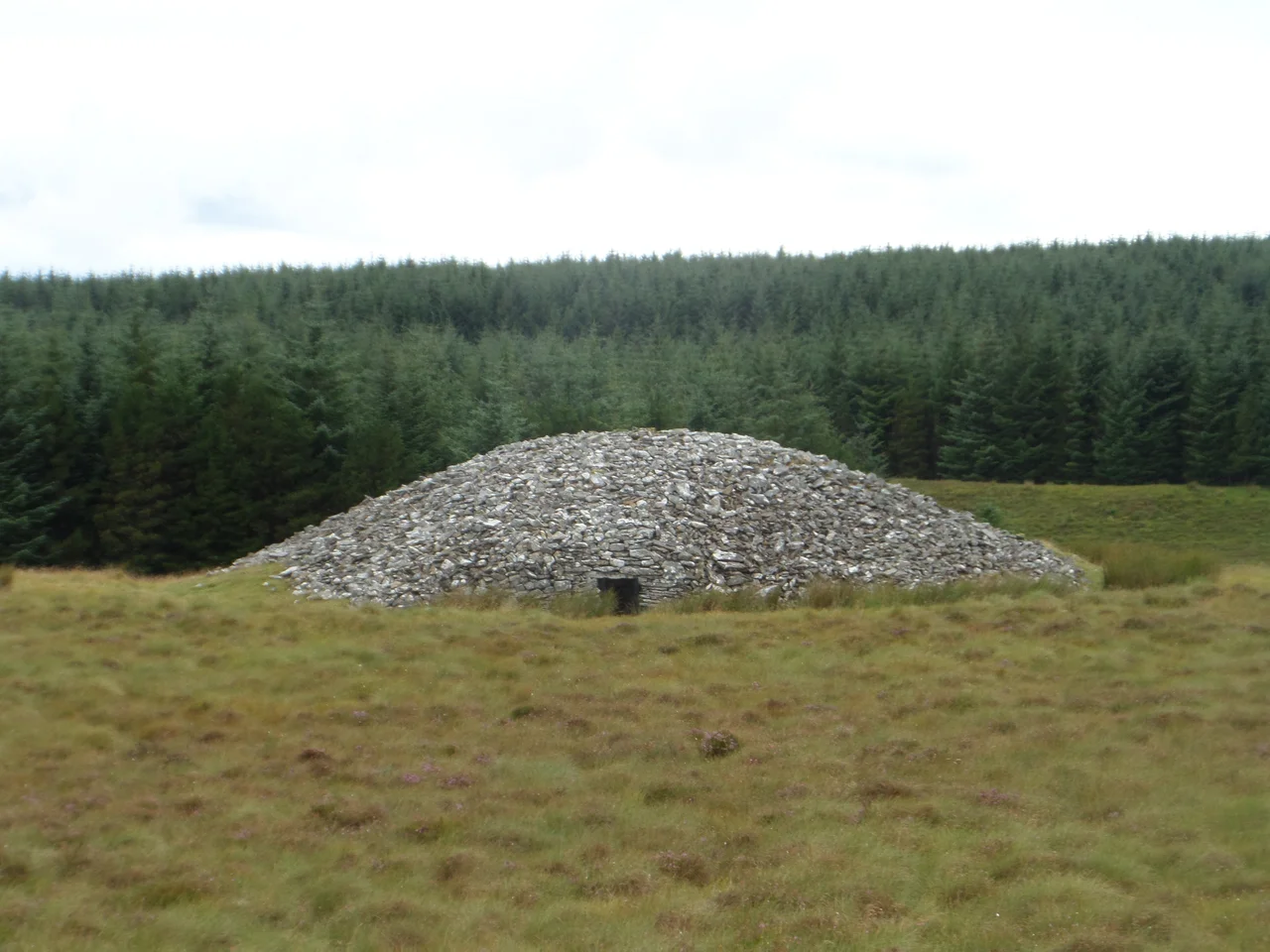

Grey Cairns of Camster
Crawl on your hands and knees down a narrow stone passage, and you arrive in a chamber built before the pyramids. The Grey Cairns of Camster sit on a sweep of peat-soaked moorland in the Flow Country of Caithness, two great mounds of carefully stacked stone that have weathered five thousand winters of Atlantic wind. To stand here now, on a road built in the 19th century to link Watten and Lybster, is to look at something whose builders left no name, no language we can read, and no monument to themselves except the cairns themselves.
Before the Peat
The moorland around the cairns is bleak today, a brown-green expanse of bog and heather where almost nothing lives in numbers. It was not always so. When the cairns were built, in the third or fourth millennium BC, this was fertile farming country. The peat that now blankets the Flow Country only began to form during the Bronze Age, smothering the soil that Neolithic farmers once tilled. The cairns sit between Camster Burn, running north to south about a hundred meters west, and the small Loch of Camster a short walk to the east. Imagine the land green and worked, small fields and grazing animals, the cairns rising on a low ridge where the dead could be honored within sight of the living.
Round and Long
The two structures stand 180 meters apart, and archaeologists call them Camster Round and Camster Long. They are examples of the Orkney-Cromarty type of chambered cairn, a tradition that flourished along the northern Scottish coast and into the islands. Each cairn contains a central burial chamber reached through a low, narrow passage from the outside. The Long Cairn is the stranger of the two: its two chambers appear to have begun life as separate round cairns and were only later incorporated into a single elongated mound for reasons no one understands. A third cairn 120 meters from Camster Round is not considered part of the grouping. Whether ritual, status, or family loyalty drove the rebuild, the result is one of the most extensive Neolithic monuments in mainland Scotland.
A Century of Excavation
The cairns have been investigated since the Victorians first pried them open. The Round Cairn was excavated in 1865, the Long Cairn in 1866. A century later, between 1966 and 1968, P. R. Ritchie cleared debris and laid groundwork for conservation. Larger studies followed between 1971 and 1973 under John Corcoran, but Corcoran's illness and death during the work meant his findings were never published. Lionel Masters took up the task between 1976 and 1980, completing both the excavation and the conservation. The consolidation work finished in 1981, and the cairns reopened with their passages cleared and their roofs stabilized. Today Historic Environment Scotland maintains the site, free to visit, open in any weather, with wooden boardwalks across the bog to keep your feet dry.
Crawling In
The experience of entering a chambered cairn is hard to describe to anyone who has not done it. The passages are short and low. You drop to your knees, sometimes to your belly, and squeeze through cold stone slabs set by hands now five thousand years gone. Then suddenly you can stand. The chamber opens above you, corbelled stone rising to a roof that feels impossible. It is dark, and silent, and old beyond comprehension. Whatever the Neolithic people of Caithness believed, they believed it enough to move tons of rock by muscle and rope to build it. Whether they buried their dead here, or honored ancestors, or worked rituals we will never know - the cairns keep their secrets.
From the Air
58.3793N, 3.2662W. Inland on the boggy Flow Country plateau, roughly 8.5 miles south of Watten and 5 miles north of Lybster. Best viewed at 1,000-2,000 ft AGL as two pale mounds in dark moorland - the long cairn appears as a distinct elongated shape. Nearest airport: Wick (EGPC) about 12 nm northeast. Weather in Caithness is changeable - cloud bases low, winds often strong from the west. The Flow Country's flat expanse and few landmarks make GPS essential.
Nearby Stories
- HMS Sword Dance (1918) 6.3 km away
- Longhope Lifeboat Museum 10 km away
- Caithness and Sutherland Peatlands 14 km away
- Brora Distillery 18 km away
- HMS King Edward VII 19 km away
- Helmsdale 20 km away
- Copinsay 22 km away
- SS St Petersburg 54 km away