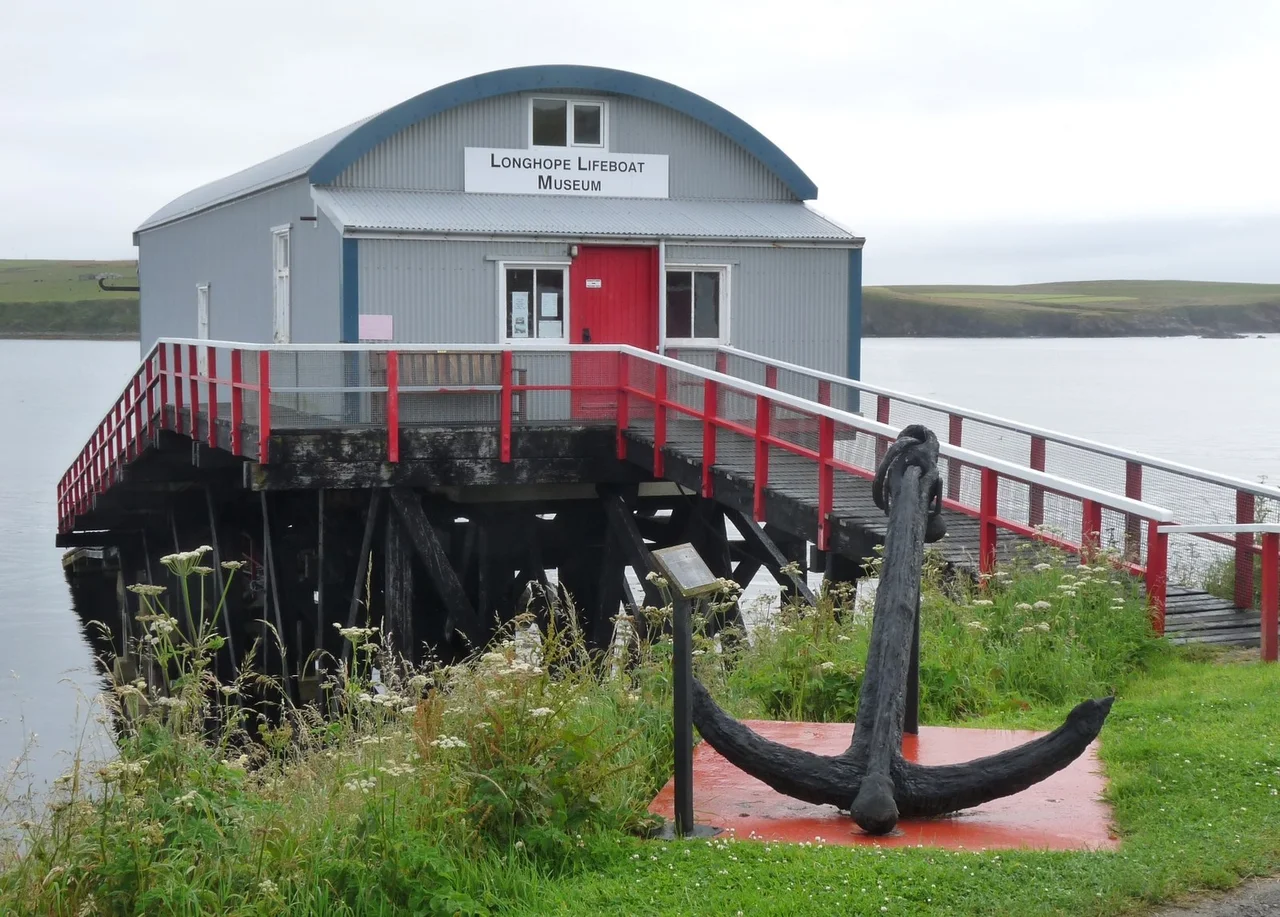

Longhope Lifeboat Museum
Eight men. That is the number that anyone in Longhope will tell you first, before any of the museum's exhibits, before any of the dates. Eight men were lost on the night of 17 March 1969 when the Longhope lifeboat TGB capsized in the Pentland Firth on her way to a Liberian cargo ship in trouble. The crew were all volunteers. They were all from the same small island community. Many of them were related - fathers and sons aboard the same boat. The little museum at Brims, built around the older lifeboat Thomas McCunn, is partly a tribute to lifeboat history and partly something quieter: the place where Longhope keeps the memory of the night that took so much of itself.
The Station at Brims
The original Longhope Lifeboat Station was built in 1901 on the north shore of Aith Hope, at Brims on the island of Hoy. It was a simple stone boathouse with a slipway running down to the water - the kind of building you see at hundreds of points around the British coast, plain and purposeful. From 1901 until 1999 the station served the surrounding waters of Scapa Flow, the Pentland Firth, and the approaches to the Atlantic. Lifeboats came and went over the years as the RNLI's fleet evolved. The crews remained who they had always been: local men, fishermen and farmers and shopkeepers, volunteers who would drop everything when the maroons went up. In 1999 the station was finally closed, replaced by a new facility a mile away in Longhope village on South Walls. The old boathouse stood empty.
Thomas McCunn
The museum's centrepiece is the lifeboat Thomas McCunn (ON 759), the boat that served Longhope from 1933 until 1962. She was a 45-foot Watson-class motor lifeboat, the workhorse design of the inter-war RNLI fleet, built to handle weather that would put any ordinary vessel back in harbour. During her almost three decades at Longhope she launched repeatedly into the Pentland Firth - one of the world's most punishing stretches of water - and her crews rescued sailors from wrecks, from fires, from machinery failures, from the simple business of being caught at sea when the sea turned. The Thomas McCunn was retired in 1962 and replaced by the TGB. She returned to Longhope years later to become the heart of this museum.
The Night of 17 March 1969
On the evening of 17 March 1969 the Liberian-registered cargo ship Irene was driven by hurricane-force winds onto the rocks of South Ronaldsay. Around 8 pm the Longhope lifeboat TGB launched with her crew of eight to assist. She never reached the Irene. Sometime that night the TGB was overwhelmed by the seas in the Pentland Firth and capsized south of South Ronaldsay. There were no survivors. The crew of the Irene, by tragic coincidence, all made it ashore safely on the other side. The eight men aboard the TGB - Coxswain Daniel Kirkpatrick, his sons Ray and Jack, Second Coxswain James Johnston, his sons Robert and Jimmy Swanson, Mechanic Robert Johnston, and Eric McFadyen - left behind seven widows and ten children. Two father-and-son pairs were aboard. In a community of a few hundred people, the loss was almost unimaginable.
What the Community Built
Longhope did not collapse. The lifeboat station was reopened within months. New volunteers came forward - some from the same families that had just lost their men. The community held together because there was no other choice and because that is what these communities do. The Longhope Lifeboat Museum Trust was established in 2000, founded by the local people of Hoy and South Walls. They restored the old station building at Brims, brought back the Thomas McCunn, and gathered photographs, newspaper clippings, log books, medals, and personal memorials. The museum is small and run almost entirely by volunteers, many of them from RNLI families. It tells the long history of lifeboats on Hoy. And in one quiet corner, it tells the story of the eight men of the TGB - not as statistics, but as the husbands, fathers and sons they were.
A Working Coast
The Pentland Firth has not become any safer. Even now, with GPS and modern hulls and engines and forecasting, the tide race that has destroyed ships for centuries continues to demand respect. The Longhope lifeboat - a Tamar-class boat at the new station now - launches when called, in weather most people would not consider going outside in. The crew are still volunteers. They are still local. They still go because someone has to, and because the memory of 1969 is a presence rather than a deterrent. The little museum at Brims sits a mile away from the new station, on the same shore looking out at the same water. Visitors are welcome between April and October. There is no admission charge. There is, however, a donation box.
From the Air
Located at 58.7797 N, 3.22794 W at Brims on the south coast of the island of Hoy, on the north shore of Aith Hope. The small stone museum building (the former lifeboat station, 1901) sits just above the water with a slipway running down to the shore - distinctive from low altitude. The newer Longhope Lifeboat Station lies a mile southeast in Longhope village on South Walls (joined to Hoy by a causeway). Kirkwall Airport (ICAO: EGPA) lies 14 nautical miles north on Orkney Mainland. The vast natural anchorage of Scapa Flow opens to the east. Wick (ICAO: EGPC) lies 18 nautical miles south across the Pentland Firth. Recommended viewing altitude 800-2,000 feet for the museum and its setting on Aith Hope. The dangerous waters where the TGB was lost in 1969 lie east-northeast off the south tip of South Ronaldsay - approximately 10 nautical miles from the station. Treat aerial passes near Longhope with the quiet respect the site deserves.
Nearby Stories
- HMS Sword Dance (1918) 9 km away
- Battle of Harpsdale 12 km away
- Copinsay 14 km away
- Broch of Gurness 16 km away
- Strathnaver Museum 20 km away
- HMS King Edward VII 21 km away
- Fair Isle 85 km away
- The Laki Eruption: The Volcano That Changed World History 939 km away